Sunday, August 16, 2015

Enough about climate change; what about language change?

Here's a post from last year that has it roots in crime and explains why "language changes" is no reason to use "partner" as a verb, "transparency" to mean "openness," or "they" as a singular. 
==================
  Monday's post contained the following, from Eric Partridge's Origins: A Short Etymological Dictionary of Modern English:
 "1. Crime, adopted from OF-F, derives from L crimen, *that which serves to sift (hence, to decide), decision, esp a legal one, hence an accusation, finally the object of the accusation—the misdeed itself, the crime ... "
The next day a sentence came to my attention in which a buyer "could not ... pay the ... price tag" for an item, emphasis mine.

Now, reporters love to write price tag for price, presumably because they think it gives their writing colloquial zing. The affectation is superfluous, except in such constructions as this:
"Juventus slap £53m price tag on Man United, City, Chelsea and Arsenal target Paul Pogba."
There, slap works with price tag to create a vivid image. The examples I generally remove from the stories, though, are on the order of:
"Finally, there's a paragraph that amounts to an explanation of just what makes for a $24 hamburger, the price tag for Harvey's product."
in which tag is unnecessary, but easily removed with damage neither to the sentence's rhythm or sense nor to the writer's pride. But "pay the price tag" suggests a shift, in which the writer imagines tag, rather than price, as the object of pay.

"Pay the price tag" is painful to me, but then, the writer in question may have seen few price tags in her life and, with the spread of online shopping, will likely see even fewer in the future. It is not out of the question that in five, 50, or 100 years, the tag in price tag will lose any relevance to what people see every day. But that does not mean the word will disappear. It could ease into a new function, the way crime acquired its current meaning. In five, 50, or 100 years, literate speakers and readers, if any of the latter remain, may speak without embarrassment of "paying the price tag" or even "paying the tag." But not as long as I have any say in the matter.
***
I thought of titling this post "The hell with climate change," which might be an example of change something like what I discuss here, in which one word replaces another as speakers and writers lose contact with an expression's original meaning. "To hell with ... " makes much more sense, doesn't it? But how many people would write it that way?

© Peter Rozovsky 2014

Labels: , , , , , ,

Tuesday, March 11, 2014

Eric Partridge and the meaning of death

More from Eric Partridge's Origins: A Short Etymological Dictionary of Modern English that may interest crime readers:

1) Dead, dear, death, debased, and debauched are close enough (about a quarter of a column apart) to suggest any number of hard-boiled story possibilities. Noir, even.

2) Kill is probably related to quell, which, in turn, is akin to German quälen, to grievously torment.

3) Mystery is akin to Greek mustēs, literally close-mouthed.

4) For murder (n,v ), murderer, murderous, see MORTAL

5) Partridge's sly humor at some of his predecessors' expense:
"The transliteration of Greek words, in particular, has been more exact than in several dictionaries one might, but does not, name."
6) And, finally, an enlightened attitude to swearing that heads the dictionary' entry for a word familiar to readers of current hard-boiled and noir writing, emphasis mine:
"f**k, v hence n, is a standard English word classed because of its associations as a vulgarism."
© Peter Rozovsky 2014

Labels: , ,

Monday, March 03, 2014

Crime, defined

(From the excellent Bucks County
Bookshop
in Doylestown, Pa.)
"What is crime, anyway?" Palmqvist said as we shared a pizza.

"I'll tell you," she went on before I could answer:
"1. Crime, adopted from OF-F, derives from L crimen, *that which serves to sift (hence, to decide), decision, esp a legal one, hence an accusation,  finally the object of the accusation—the misdeed itself, the crime: for *cernīmen (cf regimen from regere, s reg-), from cernere, to sift: f.a.e. CERTAIN, para 1."
No, I'm not
We'd planned the heist for months, timing cash deliveries and pickups, noting the employees' habits: who showed up on time, who made sure everything was locked and sealed, who didn't give a crap because the bank was likely to be sold to a whole new, bigger bank, with a whole new set of customer-service slogans and a whole new set of fees by the time she got back from lunch.

We knew things could change, but we never imagined that Your Local Bank would be sold off and converted to a pizzeria before we could stick it up. So Palmqvist and I had reason to be pensive.

"Robbery," I said,
"derives from MF roberie, robber from MF robeor, both F words coming from OF-ME rober, to rob, whence, ME robben, E `to rob'; OF rober comes from OF robe, booty, whence, in MF-F—from booty in the form of robes—a gown, a robe, adopted by ME: and OF-F robe comes from W Gmc *rauba, booty: cf OHG roub, MHG roup, G Raub, spoil, robbery, and OHG roubōn, MHG rouben, G rauben, Go bi-raubōn, to which are prob akin the Go raupjan, to pluck, and OHG roufēn, MHG roufen, G raufen, to pluck, to fight, and perh akin, the ON riūfa, L rumpere (nasalized *rup-), to break."
"I know what you mean," she said, sighing. "I'm bedraggled. See draggle at DRAW."


[More to come (pt came, pp. come, presp [and vn] coming ...)]
© Peter Rozovsky 2014

Labels: , , , , , ,

Thursday, March 07, 2013

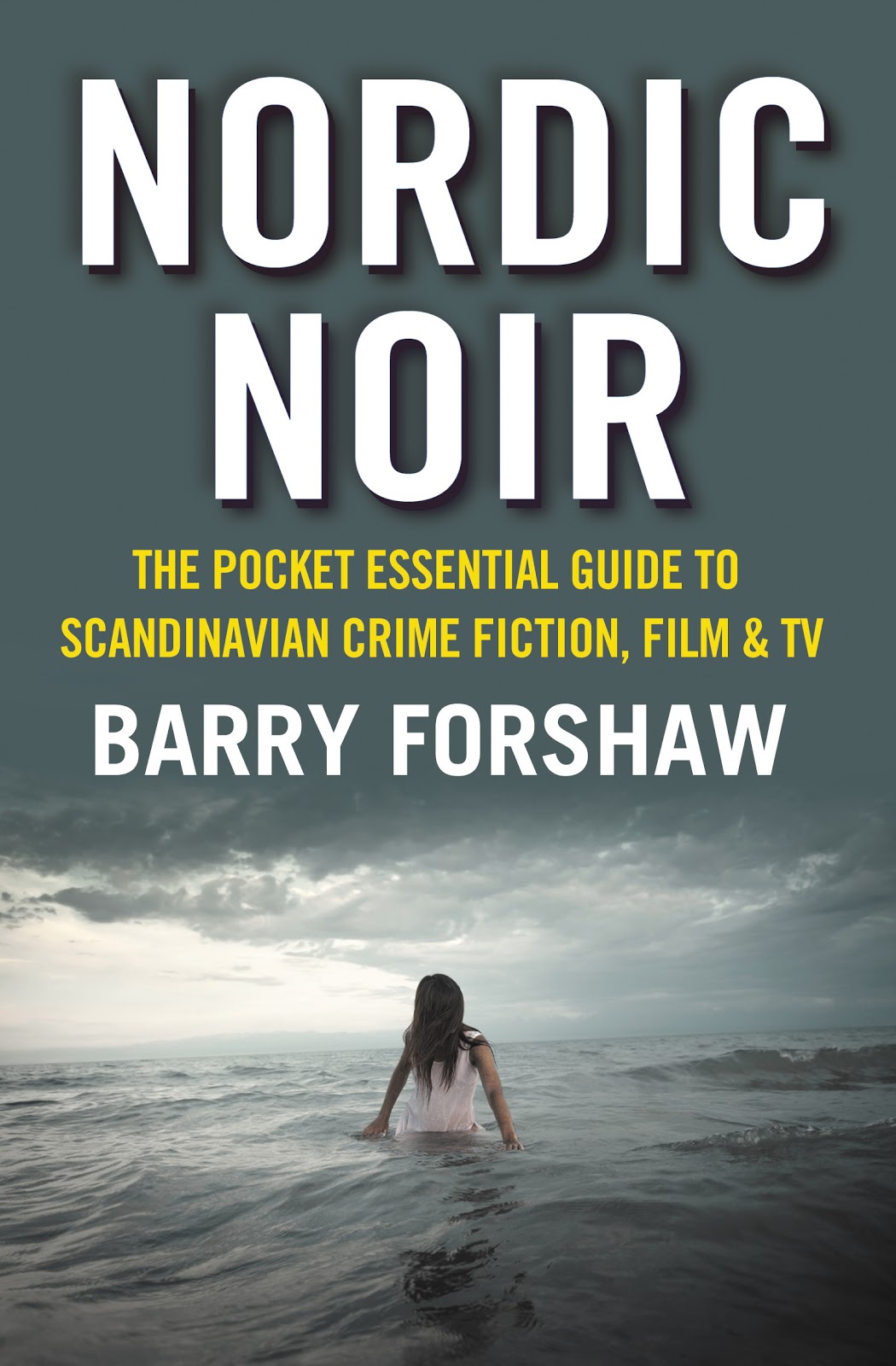
DBB in Nordic Noir book

Nordic Noir: The Pocket Essential Guide to Scandinavian Crime Fiction, Film & TV has lots of Swedes and Norwegians, roving gangs of Danes and Icelanders. a smattering of Finns, and a Faroe Islander or two.

It also has me, holding forth on Stieg Larssonism on Page 38 and Harri Nykänen's Raid and the Blackest Sheep on Pages 107 and 108, and I admit it was fun to see my name in the index.

The book's author, Barry Forshaw, is probably best known for his biography of Stieg Larsson, but he writes all over the crime fiction, film, and television map. He's the man behind British Crime Writing: An Encyclopedia, Italian Cinema: Arthouse to Exploitation, and British Crime Film, for instance, and I was chuffed when he asked me to take part in this project.

Nordic Noir: The Pocket Essential Guide is out now in the U.K. in paperback and e-book formats, with a U.S. edition to follow in September. As always, Forshaw packs lots of information into a compact space (I have just verified that the book does indeed fit in a pants pocket.) He brings a light, conversational touch to a subject not always celebrated for such qualities, and I'd call the book a good choice if you want to know what the Scandinavian fuss is about and who the up-and-comers are.
© Peter Rozovsky 2013

Labels: , , , , , , , , , ,

Wednesday, September 22, 2010

Following the Detectives is in my hands!

I can't review a book to which I contributed, but I can say that Following the Detectives: Real Locations in Crime Fiction manages the neat trick of offering information beyond the ostensible range of its subjects.

The book's core is twenty-one essays, each about a single fictional detective and the real city, country or region where he or she works. One of my assignments was Arnaldur Indriðason's Iceland, for instance, but a full-page insert tells the reader about Arnaldur's fellow Icelandic crime writer Yrsa Sigurðardóttir as well. That sort of efficient conveyance of information is a good idea for a book whose other crime-fiction destinations include London, Paris, New York and Los Angeles. Pretty hard to squeeze all the fictional detectives who call any of those cities home into a single essay.

The extras include maps, graphics, information boxes, guides to television and movie adaptations, walking tours, useful Web sites and, as an accompaniment to my essay on Andrea Camilleri, remarks on the history of Sicilian cuisine with explanations of some of Salvo Montalbano's favorite dishes. Pappanozza. Just the sound of it makes me hungry.

Here's a list of contributors and their fictional destinations:

Boston: Michael Carlson
Brighton: Barry Forshaw
Chicago: Dick Adler and Maxim Jakubowski
Dublin: Declan Burke
Edinburgh: Barry Forshaw
Florida: Oline Cogdill
Iceland: Your humble blogkeeper
London: David Stuart Davies
Los Angeles: Maxim Jakubowski
New Orleans: Maxim Jakubowski
New York City: Sarah Weinman
Nottingham: John Harvey
Oxford: Martin Edwards
Paris: Barry Forshaw
San Francisco: J. Kingston Pierce
Shropshire: Martin Edwards
Sicily: Your humble blogkeeper
Southern California: Michael Carlson
Sweden: Barry Forshaw
Venice: Barry Forshaw
Washington, D.C.: Sarah Weinman
======
Order Following the Detectives here (free shipping!), from the publisher, here, here, or from an independent bookseller in the UK or Canada.

© Peter Rozovsky 2010

Labels: , , , , , , , , , ,

Saturday, September 11, 2010

A taste of Following the Detectives

Following the Detectives has taken another step closer to tangible reality: A selection is available for browsing online. Someone put a lot of effort into the book, and it looks good: lavishly illustrated, with useful reference maps and attractive graphics and photos. Alert readers will also spot my name in the table of contents.

The book, assembled by Maxim Jakubowski and issued by New Holland Publishers in the UK, is a travel guide to crime fiction's world, a collection of essays about fictional detectives and the cities, countries and regions where they work and live.

Barry Forshaw contributed, as did Martin Edwards, John Harvey, Sarah Weinman, the Rap Sheet's J. Kingston Pierce, Michael Carlson, Declan Burke, Dick Adler, Jakubowski himself, Oline Cogdill, David Stuart Davies, and me, writing about Andrea Camilleri's Sicily and Arnaldur Indriðason's Iceland.

Here's the blurb:
Whether it be the London of Sherlock Holmes or the Ystad of the Swedish Wallander, Dashiell Hammett's San Francisco or Donna Leon's Venice, the settings chosen by crime fiction authors have helped those writers to bring their fictional investigators to life and to infuse their writing with a sense of danger and mystery. "Following the Detectives" follows the trail of over 20 of crime fiction's greatest investigators, discovering the cities and countries in which they live and work ... allowing the reader to follow Inspector Morse's footsteps through the college squares of Oxford or while away hours in a smoky Parisian cafe frequented by Inspector Maigret, for example.
Following the Detectives. It's the perfect solution to your gift-giving needs.

(Hat tip to fellow contributor Martin Edwards.)

© Peter Rozovsky 2010

Labels: , , ,

Friday, August 06, 2010

We are the world (of crime fiction)

My advance copy of Following The Detectives: Real Locations in Crime Fiction (right) is on the way; you can pre-order yours at bookstores and computer terminals near you.

Maxim Jakubowski edited this collection of essays about fictional detectives and the cities and countries where they work and live. I contributed chapters on Andrea Camilleri's Sicily and Arnaldur Indriðason's Iceland, but I'm just a sixth-magnitude star in a coruscating firmament of crime-fiction luminaries that includes authors, critics, commentators and men and women about the international crime-fiction scene such as:
Only 140 shopping days until Christmas, should you wish to order the book here (free shipping!), from the publisher, here, here, or from an independent bookseller in the UK or Canada.

© Peter Rozovsky 2010

Labels: , , , , , , , ,

Friday, March 12, 2010

Detectives between covers

Maxim Jakubowski, that man of exquisite sensibilities and wearer of many crime-fiction hats, is putting me in a book.

Following the Detectives, out from London's New Holland Publishers this fall, is a collection of essays about cities and regions around the world and the fictional detectives who bring them to life. I wrote the essays on Arnaldur Indriðason's Iceland and Andrea Camilleri's Sicily, and let me tell you, that was not the most onerous work I've ever had to do. My fellow contributors include a bunch of people you ought to know, read and admire:

Boston: Michael Carlson
Brighton: Barry Forshaw
Chicago: Dick Adler and Maxim Jakubowski
Dublin: Declan Burke
Edinburgh: Barry Forshaw
Florida: Oline Cogdill
London: David Stuart Davies
Los Angeles: Maxim Jakubowski
New Orleans: Maxim Jakubowski
New York City: Sarah Weinman
Nottingham: John Harvey
Oxford: Martin Edwards
Paris: Barry Forshaw
San Francisco: J. Kingston Pierce
Shropshire: Martin Edwards
Southern California: Michael Carlson
Sweden: Barry Forshaw
Venice: Barry Forshaw
Washington, D.C.: Sarah Weinman

A dummy and sample pages will be on view at the London Book Fair next month, should you happen to be in the neighborhood, and Maxim says the book will be out in early autumn. Your Christmas shopping just got easier.

© Peter Rozovsky 2010

Labels: , , , , , ,

Sunday, July 27, 2008

Around the world (but without Raymond Chandler this time)

A hat tip to In Reference to Murder, who let me know about an article from the Independent called "Crime fiction: Around the world in 80 sleuths."

This guide to crime fiction set in eighty locations around the world is more intelligently written than most newspaper articles on the subject, and it includes at least one comic gem, for its selection set in Glasgow: "If you find Ian Rankin's books a little Miss Marple, try Denise Mina."

© Peter Rozovsky 2008

Labels: ,

Thursday, April 03, 2008

A critical question for readers

A week and a half ago, I quoted Joe Gores' praise of Michael Gilbert's dapper but deadly fictional spies, Mr. Calder and Mr. Behrens. Gores' thumbs-up appears in a useful collection called 100 Great Detectives, edited by Maxim Jakubowski and winner of an Anthony Award for best critical work in 1992.

Another entry in the book, Peter Robinson's, shines an illuminating light on Georges Simenon's Maigret, demonstrating in the process that criticism need not be diffuse, obscurantist, frivolous or incomprehensible. Robinson writes:

"H.R.F. Keating has noted that the Maigret stories represent the first examples of the detective as writer. Part of this clearly stems from Maigret's desire to understand human motivation and his need to soak up the atmosphere of a place and immerse himself in a complex mesh of relationships until the solution to the crime becomes clear. Simenon's plots are often flimsy or far-fetched, and Maigret's actual detective work can be minimal at times. What makes the books so absorbing is his empathy with the characters he encounters ... " (Highlighting is mine.)
What can I say except that the man is right and that his comments say much about why we read crime fiction.

As it happens, crime-fiction reviewers come in for some criticism on Crime Scraps this week, where a comment laments the shakiness of the Telegraph's recent list of 50 crime writers to read before you die. The commenter complains that:

"With the odd exception — Marcel Berlins, e.g. — reviewers are stringers or staff with a passing interest and without knowledge either wide or deep of the genre, nor of what, in literary terms, constitutes fine writing. And they [don't] particularly care — after all, it's just crime fiction. Today we have no Julian Symons, no Harry Keating, no Jacques Barzun, and that is a very unhappy thing."
That's another bouquet for H.R.F. Keating. Now, how about you, readers? Who's your favorite crime-fiction critic? What remarks about crime fiction have made you stroke your chin thoughtfully and muse, "Hmm, that's right."?

© Peter Rozovsky 2008

Labels: , , , , ,

Monday, November 12, 2007

Veterans Day

I recently threw a bouquet at In Reference to Murder. Today, I was impressed again. In honor of Veterans Day in the U.S., the site offers a list of crime novels with veterans as protagonists, grouped by war from the Civil War through the Gulf War. You'll also find biographies of a few prominent crime writers who served in the military or whose protagonists did. The post makes enjoyable reading and might help you think about certain books, authors and characters in a new way.

© Peter Rozovsky 2007

Labels: ,

Friday, November 09, 2007

Look it up!

I've been trying to think of a suitable occasion to spotlight In Reference to Murder, which I added to my blog roll not long ago. But the site offers such an interesting collection of miscellany that no one time seemed right. So I’m waiting no longer. Go have a look.

You’ll find lists of: agents, associations, bibliographies, blogs, bookstores, conferences, contests, crime by type, dictionaries and discussion groups ... In short, the link is a good one to click whether you read, write, publish, edit or discuss crime fiction. And yes, that alphabetical list of categories includes one headed “miscellaneous.”

And that’s just the side bars. The posts make good reading, too. One that attracted my attention concerned the Australia Sisters in Crime organization’s Davitt Awards. Among the winners, for best true-crime book, was Karen Kissane, “a journalist for 28 years and law and justice editor of the Age.” The things that a serious newspaper can do!

© Peter Rozovsky 2007

Labels: ,

Monday, October 08, 2007

Maigret and the Wonderful Meals

Years before Andrea Camilleri's Salvo Montalbano or Jean-Claude Izzo's Fabio Montale ate their first fictional meals, there was Inspector Jules Maigret. Georges Simenon's creation is, of course, right up there with Sherlock Holmes among the world's most popular fictional detectives. If benefit of the doubt goes to the detective who eats best, though, Maigret leaves the competition trailing in a cloud of kitchen aromas and pipe smoke.

Thirty-two years ago, in fact, a noted French food writer and a prestigious publisher got together to produce Madame Maigret's Recipes, a collection of instructions for the most enticing dishes from the seventy-five Maigret novels and twenty-eight short stories.

Robert J. Courtine, author of books on French cooking and of a food column for the French newspaper Le Monde, translated into recipes the dishes that Maigret enjoys so much at neighborhood bistrots, on his investigations all over France and, most memorably, in his own kitchen, as prepared by Mme. Maigret. The dishes are classified by type, and each is preceded by an excerpt or excerpts from Maigret stories in which the dish is mentioned.

These brief selections convey the flavor of Maigret's wanderings throughout France and of his leisurely love of a good meal. The juxtaposition of food talk with the sometimes grim titles of the stories from which it taken is also good for a smile, as in this introduction to Courtine's recipes for filets de harangs, or fileted herring:

"Bring us a carafe of Beaujolais right away. What's on the menu?"

"
Andouilettes. Just came in from Auvergne this morning."

"Maigret decided to start with
filets de harangs."

Maigret and the Madwoman

Each recipe comes with Courtine's comments ("You can shell the mussels completely — they'll be easier to eat, but it won't look so amusing."), including suggestions for possible substitutions. The American edition, at least, includes a useful glossary of French wines along with suggested American substitutions. The publisher, by the way, is the Helen and Kurt Wolff imprint of Harcourt Brace Jovanovich.

The book is out of print, unless I am mistaken, but you may be able to find a copy in a secondhand bookshop, as I did. The entertaining, zestful writing may turn you into a fan of Maigret, of French cooking, or of both, even if you know nothing about either when you pick the book up.

© Peter Rozovsky 2007

Technorati tags:


Labels: , , , , , ,

Monday, July 02, 2007

What German crime-fiction readers read

An article in English on the Goethe-Institut Web site calls Germany a Mystery Story Paradise in the Middle of Europe. The article is a year old, but, assuming it remains relatively current, it has much of interest to say about German readers' tastes and about the crime fiction available to them. A few highlights:

1) Every year 600 to 800 mystery stories are published in Germany, about two-thirds in translation. Of approximately 800 mystery stories that appeared in 2005, just under 200 were imports from Europe. An estimated 200 more come from the United States and Canada, and a small remainder from Asia, Africa, Australia and Oceania. (Since publication of the article, The Broken Shore, by the superb Australian Peter Temple, has won an award in its German translation as Kalter August. Read more in German about Temple at that wide ranging German crime-fiction site Krimi-Couch.)

2) The most influential present-day British author is Ian Rankin.

3) Germans have been reading crime fiction from the Nordic countries since the nineteenth century. The list of Nordic writers available in German includes some of the same authors availble in English, and some whose work I wish were available in English, including Finland's Harri Nykänen. (Quite apart from the article, I know that more than ten of Håkan Nesser's books are have been published in German translation, versus the two available in English. No wonder Nesser calls Germany "the door-opener to the rest of Europe.")

4) At least in 2006, Italian crime fiction was "(w)idely publicised, but unfortunately not very successful." The article cites Carlo Lucarelli, Andrea Camilleri and a writer I don't know: Giuseppe Genna.

5) Among French crime authors who have made a splash in Germany are Jean-Claude Izzo, Fred Vargas, and, again, one I don't know: "the mystic-adventurer Jean-Christophe Grangé."

6) Crime fiction is just beginning to stir in the countries of the former Soviet bloc: "In their homeland, Polina Daschkowa, Darja Donzowa, Alebxandra Marinina, Tatjana Ustinowa and Viktoria Platowa have enjoyed vast million editions. Their novels are entertaining, not particularly difficult, and in part written with an eye to a mass public which wants to experience history through children of the Tsar and heroes in the shape of nouveau riche capitalists. Often brilliantly written, fabulous froth of the day from a society that is seeking itself."

P.S. I forgot to add that the article shows special appreciation for my man Bill James: "Alas, only confirmed mystery story fans know the authors of the “Brit Noir” – Charles Lewis, Derek Raymond, Bill James, and Helen Zahavi ..."

© Peter Rozovsky 2007

Labels: , ,

Monday, June 25, 2007

A European crime-fiction Web site

It's called EuroPolar, and it offers articles, news, schedules of crime-fiction events, reviews and fiction in English, French, German, Italian and Spanish versions, so you might even be able to teach yourself that language you've been vowing for years to learn. (A hat tip to Crime Always Pays, which led me to EuroPolar.)

© Peter Rozovsky 2007

Labels:

Thursday, June 14, 2007

Something new to me, if not to you.

The Bastulli Mystery Library offers the potential for interesting browsing and the chance to build up your to-read list. Its indexes crime books by author and category and also includes interviews and lists of awards.

I like the site because it introduced me to two Italian writers whose work I had not known: Santo Piazzese and Giorgio Scerbanenco, "one of the fathers of the Italian mystery."

© Peter Rozovsky 2007

Technorati tags:

Labels: ,

Saturday, June 09, 2007

The little world of Mayhem Parva

That's the celebrated title of Colin Watson's celebrated chapter on the classic era of detection ushered in by Agatha Christie. It is here and in succeeding chapters in the final third of Snobbery With Violence that the arguments become more convincing, in large part because the authors Watson discusses are more familiar.

Earlier chapters deal with Sax Rohmer, Sydney Horler, `Sapper' and Edgar Wallace. In the book's later chapters, Watson wrestles with Christie, Dorothy L. Sayers and Leslie Charteris ("The Saint"), wrapping up with a discussion of that sadistic, retrograde, socially insecure faux snob (Watson's verdict, my words), Ian Fleming. The older writers are easy to lampoon because of their outlandish plots, their cartoonish characters, their racism, and their pandering. But a current reader of Watson's entertaining survey may find the earlier chapters harder to engage with because, I suspect, the authors are little read today (although Edgar Wallace did make it into the blogophere in
this discussion of When the Gangs Came to London last year).

The later chapters also make better reading because the authors under discussion were, for the most part, better, subtler and more sophisticated writers. It's easy to mock E. Phillips Oppenheim's contempt for the working classes, Sydney Horler's weird prudery and anti-Semitism, Sapper's embodiment of ideals akin to those that flowered later in British fascism, and Wallace's inconsistent and wild plots. Authors such as Christie and Sayers, however, leavened their embrace of current attitudes with just enough self-mockery to leave the matter in doubt, according to Watson, and that doubt, he says, could benefit them commercially. Here's a selection from Christie's Cards on the Table followed by Watson's assessment:
"He was tall and thin, his face was long and melancholy, his eyebrows were heavily accented and jet black, he wore a moustache with stiff waxed ends and a tiny black imperial. His clothes were works of art — of exquisite cut — but with a suggestion of bizarre. Every healthy Englishman who saw him longed earnestly and fervently to kick him. They said, with a singular lack of originality: `There's that damned Dago, Shaitana!'
"The passage shows Mrs. Christie's awareness of how widespread in the England of 1936 was xenophobia, her own disapproval of which she implied in the phrase `with a singular lack of originality.' But it would have taken someone with a little more substance than that of the average reader to notice that here was not just another sneer at the foreigner."
Watson offers a number of acute judgments on how post-war crime and thriller writing changed in style while remaining as unrealistic as ever in substance. Fleming and the thriller writers who followed, writes Watson, pulled off the high sleight of hand of making espionage seem realistically exciting: "Into what was still the old-style hokum — the gunplay, kidnapping, chases, escapes and so forth — was elaborately insinuated the proposition that not only were these things happening in very truth, but they were unavoidable ... "

Watson has a lively eye for absurd statements, and his book contains more witticisms than do most works of social and literary history. Here, he takes Kingsley Amis to task for Amis' defense of Fleming against allegations of gratuitous, vicious violence: "More ingenuous was Amis's attempt to counter the sadism charge by quoting two extracts from `the real thing' — the works of Mr Mickey Spillane. This is rather like retorting to a diner who complains of having found slugs on his cabbage that he is lucky not to have gone to the establishment next door, where slugs are served as the main course."

And what, by the way, is Mayhem Parva? Let Watson explain:
The setting for the crime stories by what we might call the Mayhem Parva school would be a cross between a village and commuters' dormitory in the South of England, self-contained and largely self-sufficient. It would have a well-attended church, an inn with reasonable accommodation for itinerant detective-inspectors, a village institute, library and shop — including a chemist's where weed killer and hair dye might conveniently be bought. The district would be rural, but not uncompromisingly so — there would be a good bus service for the keeping of suspicious appointments in the nearby town, for instance — but its general character would be sufficiently picturesque to chime with the English suburb dweller's sadly uninformed hankering after retirement to `the country.'
N.B. I complained that Watson's early chapters cited but failed to name any of the rare authors of quality whose books he says suffered because of reviewers' facetious attitudes toward crime stories. Later in the book, he offers highly interesting comments about Anthony Berkely Cox, who "had written in 1930 that the detective story was in the process of developing into the novel with a crime theme, `holding its readers less by mathematical than by psychological ties.'" That seems an astonishingly prescient statement, and Watson says the change did not make itself felt for several years. In the interim, a popular magazine rejected a version of one of Cox's books. "'Life,' commented Cox patiently, `is very, very difficult,' and he went on to write more crime novels that bore a disconcerting resemblance to literature."

© Peter Rozovsky 2007


Technorati tags:

Labels: , , ,

Friday, June 08, 2007

More Snobbery With Violence

Colin Watson's 1971 book Snobbery With Violence is not, a cover blurb and my previous post to the contrary, a work of literary and social history, at least not in its first half. Rather, it is an entertaining, informative and occasionally illuminating essay and chronicle of the shortcomings, prejudices and popular reception of English crime fiction in the first half of the twentieth century. If it comes close to a traditional academic field, that field is sociology rather than history.

It's not history because Watson avoids examples that might create difficulties for his thesis. As English crime fiction grew unavoidably popular in its Golden Age between 1920 and 1939, Watson writes, "Book reviewers settled into an attitude of good-natured, if slightly supercilious tolerance." Such reviewers' "slightly facetious style," he says, "revealed singularly little about the books and although in most cases this was a blessing for their authors, the rare novel of quality was likely to suffer the injustice of exactly similar treatment simply because it happened to treat of crime. Librarians unwittingly performed a like disservice to the few writers in the field who believed that if a book of any kind was worth writing it was worth writing well."

You can guess what's coming, can't you? Watson fails to name any such "rare novel of quality" or any of the few writers who wrote them. He does cite Raymond Chandler, who "never produced a dull line," but for his observations about crime writing and English writers (Chandler, though American, was educated at Dulwich College) rather than as an author in his own right.

Without counterexamples of such rare crime novels by rare good writers, Watson can come off as a bit of a scold, albeit an entertaining one. But the funniest and most telling line, at least in the book's first half, is probably Chandler's, from "The Simple Art of Murder": "The average detective story is probably no worse than the average novel, but you never see the average novel. It doesn't get published."

© Peter Rozovsky 2007


Technorati tags:

Labels: , ,

Thursday, June 07, 2007

Snobbery With Violence

That's the title of Colin Watson's highly opinionated social history of English crime fiction, published in 1971 and reissued by Mysterious Press in 1988.

His thesis, at least a mildly provocative one, is that detective stories were expressions of conventional attitudes and prejudices on sex, foreigners and other dicey matters. "It would be difficult to point to any other single branch of popular entertainment that conformed more strictly to current notions of decency," he writes.

Watson presents the detective story against a background of the rise in literacy among the English and the flourishing of commercial libraries. Among other things, his opening chapters are a reminder that commerical expansion can mean restriction rather than expansion of avenues for unconventional expression.

And you may be surprised by what he has to say about George Orwell.

© Peter Rozovsky 2007

Technorati tags:

Labels: , ,

Monday, May 21, 2007

100 Must-Read Crime Novels

There may not be precisely a hundred, and not all are novels (the list includes story collections by G.K. Chesterton and Arthur Conan Doyle), but Richard Shephard and Nick Rennison's 100 Must-Read Crime Novels makes a nice, compact guide. It will fit easily into your pocket to replace the 5 pounds, 99 pence you take out to pay for it.

The occasionally flat prose in the capsule descriptions (Novels are "unbelievably powerful" or "atmospheric, entertaining") is offset by interesting choices from authors I had not read (John Franklin Bardin, Nicholas Blake) or knew only through movie adaptations (Vera Caspary's Laura). I was pleased to see Fredric Brown's The Fabulous Clipjoint on the list and tantalized by the description of Eric Ambler's writing as "poles apart from the run-of-the-mill, imperialist yarns favoured by such writers as John Buchan and Sapper."

© Peter Rozovsky 2007

Labels: , , , , , , , ,