Saturday, November 30, 2013

Nordic humor and satire from Hallgrímur Helgason

I've run into deadpan Danes, wisecracking Swedes, jovial Icelanders, and Norwegian authors who enjoyed a good joke, and the one Finn I've met was a gregarious hotel clerk who radiated benevolence and good fellowship. In short, if dour, gloomy Nordics exist, they cheer up when they see me coming.

So I was not shocked by the following in Hallgrímur Helgason's The Hitman's Guide to Housecleaning:
"I understand the smoking ban is on its way up here [to Iceland], in a sunny sailboat named the Al Gore. ... Only when you've had some fifty warless years do you start worrying about things like air quality in bars."
and
"Getting Friendly off my back was like dumping a loud girlfriend with a Texan accent and a cell-phone addiction."
and
"She smells like a New Jersey Devils' banner that's been hanging on the dim corner of a seedy Newark lounge for the past twenty years."
and
"I don't know. I just hate it when people discriminate against me, only because I kill people."
Along the way, Hallgrímur's satirical targets include sanctimonious public apologies and spurious declarations of corporate duty to the customer. And I have to think that his decision to make the protagonist a Croat is a bit of sly fun at the expense all the crime novelists who have found it expedient in recent years to people Europe with Balkan characters, usually one per book, generally dark and forbidding, all the better a background against which we are asked to contemplate big subjects like human depravity and the vicissitudes of history. (I can't be sure, but I think those characters have tended to be Croats rather than Serbs, possibly because Serbs were the bad guys in the recent Balkan wars, as opposed to World War II, when Croats filled that role.)

The Icelandic author's decision to make his protagonist/narrator a foreigner also affords him the opportunity to observe the oddities of his own country: its silence, its high prices, its cleanliness, its difficult language, its beautiful women. And the briefer glimpses of the protagonist's native Split tally with my recollections of that marvelously situated city.

I'm not sure how well a middle section works in which the multi-named protagonist has an emotional crisis and undergoes a kind of exorcism. The section is melodramatic, and Hallgrímur has more fun when the soul-savers turn out to engage in some of the same crimes as the protagonist does.  But even there Hallgrímur works in a few good observations and jokes.

© Peter Rozovsky 2013

Labels: , , , , , , , ,

Thursday, March 28, 2013

Who needs copy editørs?

I don't like crime-novel cover copy that brags that the author is a lawyer for the same reason that I don't like covers that identify the author as So-and-so, Ph.D. Such braggart branding plays on the intellectual insecurity of readers. It's a not so subtle effort to bully shoppers into thinking that the author must be smarter than they are, so they will either improve themselves by buying the book or else get a dirty little insider's glimpse at a world they would never know without the author's help.

Me, I don't give a crap what authors are or what degrees they have; I want to know what they can do.

I was thinking about this while reading the following this evening on the back cover of a trade paperback edition of Easy Money by Jens Lapidus when something else caught my attention:
"From one of Sweden's most successful defense lawyer(sic) comes an unflinching look at Stockholm's underworld."
Someone's not paying to have cover copy proofread carefully.

And note the o with a slash in the cover's rendering of the book's title. Jens Lapidus is Swedish, and he wrote the book in Swedish. Ø is a letter in Danish, Norwegian, and Faroese — but not Swedish.

***
In recognition of professional reality, I have taken a number of the posts I'd previously classified as "Things that drive me nuts" and reindexed them under the heading "Who needs copy editors?" Read them and weep. Just don't expect to be paid for your tears.

© Peter Rozovsky 2013

Labels: , , , , , ,

Thursday, March 07, 2013

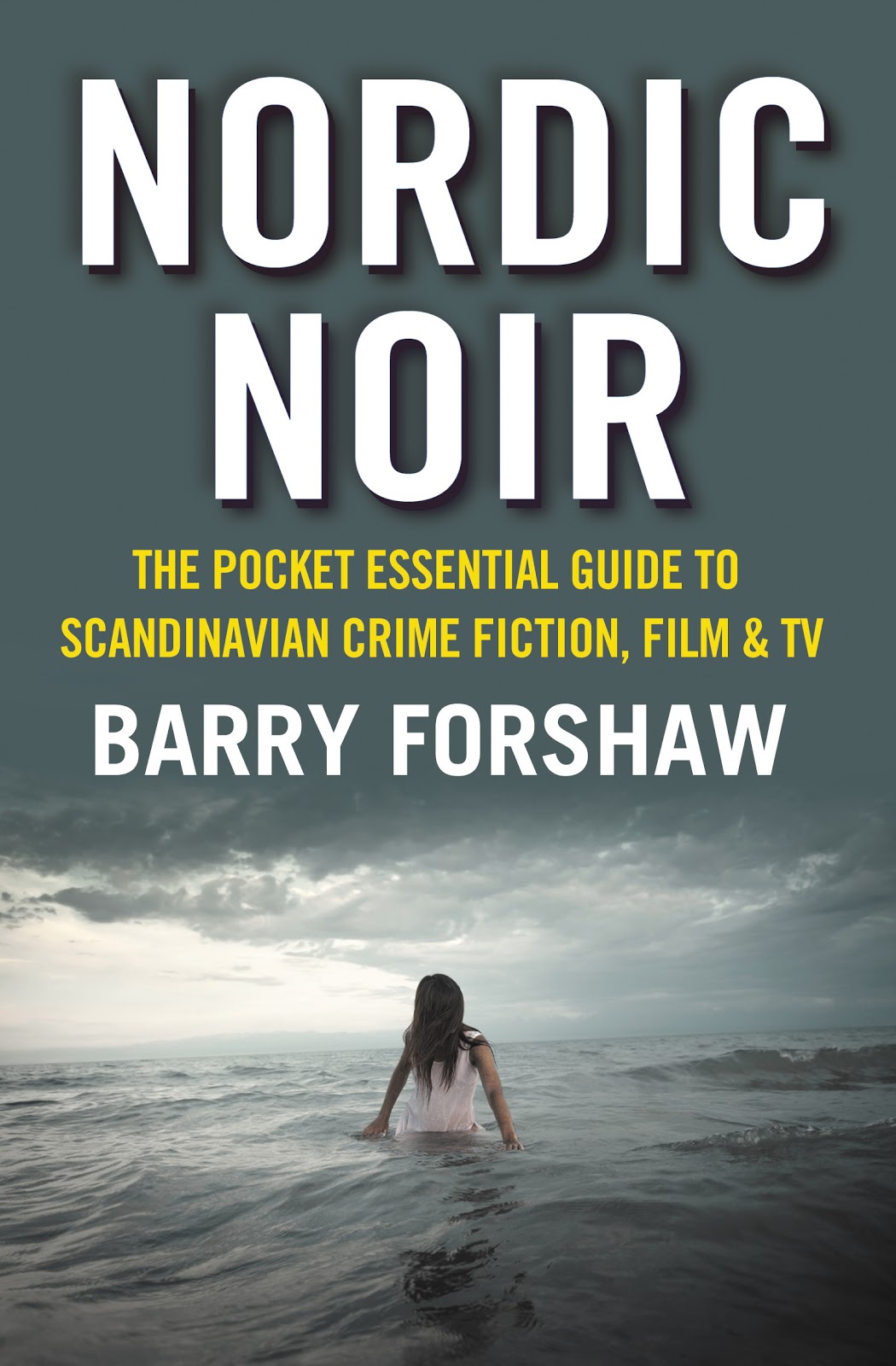
DBB in Nordic Noir book

Nordic Noir: The Pocket Essential Guide to Scandinavian Crime Fiction, Film & TV has lots of Swedes and Norwegians, roving gangs of Danes and Icelanders. a smattering of Finns, and a Faroe Islander or two.

It also has me, holding forth on Stieg Larssonism on Page 38 and Harri Nykänen's Raid and the Blackest Sheep on Pages 107 and 108, and I admit it was fun to see my name in the index.

The book's author, Barry Forshaw, is probably best known for his biography of Stieg Larsson, but he writes all over the crime fiction, film, and television map. He's the man behind British Crime Writing: An Encyclopedia, Italian Cinema: Arthouse to Exploitation, and British Crime Film, for instance, and I was chuffed when he asked me to take part in this project.

Nordic Noir: The Pocket Essential Guide is out now in the U.K. in paperback and e-book formats, with a U.S. edition to follow in September. As always, Forshaw packs lots of information into a compact space (I have just verified that the book does indeed fit in a pants pocket.) He brings a light, conversational touch to a subject not always celebrated for such qualities, and I'd call the book a good choice if you want to know what the Scandinavian fuss is about and who the up-and-comers are.
© Peter Rozovsky 2013

Labels: , , , , , , , , , ,

Sunday, February 03, 2013

I review Nesbø in the Philadelphia Inquirer

The novel is Phantom, ninth of Jo Nesbø's Harry Hole novels, and my review begins thus:
"I once suggested that some Nordic crime novels are Jackie Collins or Harold Robbins with enough mildly leftist musing thrown in to make readers feel intellectually respectable."
More than in my previous reviews, I write about why I think Nesbø made some of the choices he made. The man has a living to make, after all.

Read my guesses about Phantom, Nesbø, Nordic crime, and why readers read it in the complete review here.

© Peter Rozovsky 2013

Labels: , , , , ,

Saturday, December 01, 2012

Another famous Philadelphia first

"Oleg had found out that the expression 'junkie' was more than a hundred years old, from the time when the first heroin addicts stole junk metal from the harbor in Philadelphia and sold it to finance their consumption."
— Jo Nesbø, Phantom
© Peter Rozovsky 2012

Labels: , , , , ,

Saturday, September 22, 2012

What's the best weather for crime stories?

Iceland's Yrsa Sigurðardóttir has bemoaned the difficulty of setting crime fiction in a country that has almost no crime. The sometimes forbidding Nordic climes offer an offsetting advantage, however: Isolated Arctic outposts and sudden snowstorms make it easy to plausibly strand characters, kill them off, and gather suspects in one place.

Yrsa does this in The Day is Dark, her most recent novel in English translation, and Norway's Anne Holt does something similar in her novel 1222. What other Nordic crime novels take advantage of their settings in this way? How about crime stories from outside the Nordic lands? What crime novels take special advantage of their settings?

(I once spent a week in the Dominican Republic, my bliss marred only by the fear that a coconut would fall on my head as I relaxed under a palm tree. Stage that to look like an accident, and you've got the sort of crime story I have in mind.)

==================
Yrsa Sigurðardóttir will be part of my "Murder is Everywhere" panel at Bouchercon 2012 next month in Cleveland, Saturday, October 6, 10:15-11:05 a.m.

Here's the complete Bouchercon schedule.

© Peter Rozovsky 2012

Labels: , , , , , , ,

Thursday, September 13, 2012

What did Yrsa know, and when did she know it?

When I met Yrsa Sigurðardóttir at Bouchercon 2008 in Baltimore, Iceland's economy had just crashed. When Yrsa and her husband weren't worrying that their credit cards had been rendered worthless, we speculated about what the crash would mean for Icelandic crime fiction. Too early to tell, we decided.

Turns out that Yrsa may already have had some ideas.

Her novel The Day Is Dark, published in English translation in 2011 but in its original Icelandic in 2008, is peppered in its early chapters with references to the currency crash and how it might affect daily lives:
"Fortunately they hadn't taken a loan in foreign currency for the purchase, as so many who now bore the consequences of the falling Icelandic króna had done, but the payments had increased nevertheless and they were eating into their income."
and
"...a two-story single-family home which was to be divided into two separate apartments to save the owner ... from the black hole of the currency basket loan that he had taken at the wrong time."
Next time I see Yrsa (and I'll see her soon), I will ask when in 2008 she wrote those passages. What did Yrsa know, and when did she know it?
==================
Yrsa Sigurðardóttir will be part of my "Murder is Everywhere" panel at Bouchercon 2012 next month in Cleveland, Saturday, October 6, 10:15-11:05 a.m.

Here's the complete Bouchercon schedule.
© Peter Rozovsky 2012

Labels: , , , , , , ,

Sunday, July 29, 2012

Larsson-y: I review Lars Kepler in the Philadelphia Inquirer

My review of The Nightmare by Lars Kepler in Sunday's Philadelphia Inquirer posits the existence of a school of Nordic crime writing called Stieg Larssonism (its practitioners are Larssonists) that
"combines potboiler thrills and righteous anger in a fat, sprawling tosh-filled package, often with 475 or more pages plus a didactic, statistics-filled epilogue in case the reader doesn’t get the point – or in case he or she thinks the point was just to have some fun. That way the reader get dirty thrills but feels morally uplifted at the same time."
While preparing the review, I came across a comment by Alexandra Coelho Ahndoril, the female half of the couple that writes as Lars Kepler, that Stieg Larsson had revitalized crime fiction and that the Lars part of their pen name was a tribute to him.

At the same time, I was reading Barry Forshaw's Death in a Cold Climate, which includes a chapter on the Larsson phenomenon but also another called "The Anti-Larsson Writers."  Finally, my post on realism, naturalism, and their opposite in crime fiction elicited this comment in Larsson's defense:
"[Larsson] was doing something different. He loved potboilers. He wrote fanfic when he was young and omnivorously consumed pop culture. He wrote a mashup of everything he loved and borrowed from Modesty Blaise to Sarah Paretsky but he also threw in everything he cared about in his day job as a journalist."
That commenter and I analyze Larsson and Larssonism in substantially identical terms, in other words, though her assessment is more positive than mine.

This, plus Forshaw's chapter on anti-Larsson writers, leaves me with a bracing feeling that I and the world now understand Nordic crime fiction better than we once did and the hope that we'll be spared further silly invocations of this, that, or the other utterly un-Larssonian writer as the next Stieg Larsson.

But mostly I liked writing the review because I got to define Stieg Larssonism as "potboiler plots with didactic political intent; call it Harold Robbins meets Noam Chomsky."

© Peter Rozovsky 2012

Labels: , , , , , , , , , , ,

Wednesday, July 18, 2012

Why Lars Kepler are the real next Stieg Larsson

The Stieg Larsson school of Swedish crime writing doesn’t go in for guilty pleasures. Instead, it combines potboiler thrills and righteous anger in a fat, sprawling tosh-filled package, often with 475 or more pages plus a didactic, statistics-filled epilogue in case the reader doesn’t get the point – or in case he or she thinks the point was just to have some fun. That way the reader gets dirty thrills but feels morally uplifted at the same time.

The Nightmare, second of Lars Kepler’s novels to be translated from Swedish into English, offers one protagonist haunted by deep secrets. The novel is fascinated with Paganini and with great old violins. It equates moral rectitude with musical ability, and it does so with a straight face. Talk about far-fetched, potboiler-y notions.

The solution to the central mystery, though that mystery concerns a political issue torn from today’s headlines and involves government and corporate corruption, is straight out of Columbo. Quite naturally, the novel includes one especially horrible death. And then its prologue ranks the world’s top arms-dealing nations, of which Sweden is in the top nine.

There's nothing wrong with potboilers, and there's nothing wrong with politically engaged crime fiction. But it's always fair to ask whether the politics and the potboiling are organically intertwined, or whether they appeal, separately, to two separate aspects of what the reader wants. Dominque Manotti, Jean-Patrick Manchette, Maj Sjöwall and Per Wahlöö, and the great Leonardo Sciascia tell stories in which the politics and the thrills seem to emerge, inextricably bound, from the same reality. Among current Swedish crime writers, I would argue that Anders Roslund and Börge Hellström come close to achieving this in Three Seconds.

The Stieg Larssonites don't do this, and I don't think they try. I find their achievements less impressive than I do those of the authors I've just named, but it doesn't mean the Larssonians are any worse, just different. I can't blame an author for failing at what he or she may never have tried to do.
*
The invocation of Stieg Larsson is especially apt in the case of The Nightmare because Alexandra Coelho Ahndoril, the female half of the couple that writes as Lars Kepler, has said that the Lars part of the nom de plume is a tribute to Larsson. Crime writing previous to the late author of The Girl With the Dragon Tattoo was fine, she said, but it had grown a bit stale.

© Peter Rozovsky 2012

Labels: , , , , , ,

Friday, May 25, 2012

Crimefest Day 2: Fire and Iceland

"You never hear anyone telling Norwegian jokes anymore, and I think it's because of the money," Swedish crime writer Åsa Larsson said during today's Crimefest 2012 panel on Scandinavian crime fiction.

"Now it's the other away round," Norwegian crime writer Thomas Enger replied. Norway's oil wealth has apparently muted at least one outward expression of Sweden's superiority to its neighbors.

But the panel was not all doleful observations and good-natured gloating. Gunnar Staalesen gave a plausible answer to a question I'd long had about Scandinavian crime writers: Why did Satanism and the fear thereof figure in a number of their crime novels in the mid-1990s and early 2000s, Jo Nesbø's The Devil's Star, Helene Tursten's The Glass Devil, and Åsa Larsson's Sun Storm (a.k.a. The Savage Altar) among them? Tursten appeared to take umbrage when I put the question to her a few years ago, apparently thinking I implied she had copied Nesbø. I implied no such thing, and I'll chalk Tursten's impatience up to fatigue from a gruelling tour schedule.

Larsson said a church figured in her book simply because, while secular now, she had had a religious upbringing; churches were simply a part of her background. But Staalesen suggested that a real-life wave of church burnings in the 1990s by a black-metal musician who wrote about Germanic neo-Paganism might have brought Satanism to the fore as an issue of public concern.

The intriguing thing about the resulting novels, at least the three I named, is that Satanism and satanists tend to be suspects and sources of fear rather than the actual villains of the piece. The books do not decry or praise Satanism, they merely take it up as one aspect of Swedish and Norwegian social and spiritual life.

I asked Staalesen after the panel whether an amusing, geographically specific metaphor for oral sex in the English translation of his 1995 novel The Writing on the Wall was an accurate rendering of the Norwegian original. He did not remember the line, which he'd have written seventeen years ago. But he did say the metaphor would work just as well in Norwegian as in English.

Finally, Ragnar Jonasson paid tribute to the trail blazed by his fellow Icelandic crime writer Arnaldur Indriðason. That Arnaldur did not publish his first novel until 1997 indicates how new Icelandic crime writing is. "Prior to that," Ragnar said, echoing a battle that crime writing has had to wage in a number of countries, "crime fiction was looked down upon by the public."
*
 The panel's moderator was Barry Forshaw, who really has written the book on Scandinavian crime fiction.

© Peter Rozovsky 2012

Labels: , , , , , , , , , , , , ,

Friday, April 27, 2012

The Edgars, Part I

Anne Holt was both gracious and jovial when I told her after last night's Edgar Awards dinner how much I was enjoying her novel 1222, but she kept addressing me as "sir."

She's about my age, so there was no call for such formality. "Typical Scandinavian reticence and reserve," I thought, until I noticed sometime afterward that I'd lost my name tag. So all Holt, whose book had been short-listed for the best-novel Edgar, had to go on was an empty plastic card-holder with a yellow strip dangling from it that read "Press." Anyone who detects irony in the juxtaposition can take it somewhere else, pal. I have a job to do.

I finished reading Holt's book on the train home from New York, and I remain impressed by her boldness in taking an old Agatha Christie formula and infusing it with tension and a thoroughly contemporary feel. The novel's dénouement may have just a touch of the anti-Americanism that makes some readers of Scandinavian crime fiction roll their eyes, but if it does, Holt's handing of the matter is nuanced and humane.

(Mo Hayder's Gone won the best-novel Edgar. Here's a list of winners. And here are the nominees.)

© Peter Rozovsky 2012

Labels: , , , , , , , ,

Thursday, April 26, 2012

Charlie Stella's polemical porno pizzazz and a handful of Holt

I've finished Johnny Porno by Charlie Stella and started 1222 by Anne Holt, the latter because it's up for a best-novel Edgar Award from the Mystery Writers of America on Thursday night, and the former because no one in crime fiction is more fun to read than Charlie Stella.

With Stella the fun starts before the novels proper do; how can you not smile at an author's note that addresses readers as amici (friends)? The note that follows is a zesty polemic on the historical moment in which the novel is set: 1973, after a New York judge ruled Deep Throat obscene.
"As films go," Stella writes, "one has to acknowledge Deep Throat was nothing more than a campy, cheaply made porno that showcased the `sexual talent' of a young woman stage-named Linda Lovelace. With a soundtrack comprised of silly parodies and jingles and a plot born of male fantasy, the movie might well have come and gone without the slightest notice had the government ignored it. Instead, political directives from the White House launching a moral crusade that had much more to do with distracting the public from the war in Southeast Asia and an ever growing Watergate scandal guaranteed the film’s iconic success. What it also did was provide organized crime with a new way to make a fast buck. It is fittingly ironic that the name given to the secret informant (FBI agent William Mark Felt) who provided information that would eventually take down the Nixon White House itself shared the name of the film."
That polemical thread runs judiciously through the novel that follows, adding social and historical oomph to Stella's cast of hard-working guys, reluctant gangsters, cops, bookies, wives, girlfriends, and families, almost all of whom the author means us to view with a sympathetic eye.
***
1222 is the first novel of Holt's that I've read (she's published about sixteen), and I'm impressed because she has given herself the challenge of taking a well-worn crime-story set-up (group of people trapped by a snowstorm in an isolated hotel; one of them is found dead) and making it fresh. She has succeeded so far, in part by making the narrator/protagonist not especially likable, in part by doling out information about her characters only gradually.

1222 is one of at least six novels by a non-American author up for an Edgar (Holt is from Norway) and, based on what I've read of it so far, I won't complain if it wins.

© Peter Rozovsky 2012

Labels: , , , , , , , ,

Wednesday, March 07, 2012

Scanning Scandinavian crime

Declan Burke asks a provocative question about why Scandinavian Crime Always Pays: Whither the mavericks?

His thesis, to which commenters, including your humble blog host, provide but minor correctives, is that there's a certain sameness to the Nordic crime fiction translated into English, as good as some of that crime fiction may be.

You can find the rest over at his place, but to expand on one of Declan's rhetorical questions, where are the Scandinavian Eoin McNamees, Ronan Bennetts, Eoin Colfers, Adrian McKintys, and Kevin McCarthys?

The hook for Declan's post was the publication of Barry Forshaw's Death in a Cold Climate: A Guide to Scandinavian Crime Fiction. Forshaw was kind enough to provide some advance material from the book last year when I moderated a panel full of Scandinavian crime writers at Bouchercon.   And here's a post based on some notes Forshaw sent along some months ago about the book.

*
Declan's post may be a message from above, as it comes just when I had picked up his interestingly neo-Chandlerian novel Eightball Boogie for a second reading.

© Peter Rozovsky 2012

Labels: , , , , , ,

Monday, January 02, 2012

Nordic not-really Noir: The BBC documentary

(Cheerful blogger with non-
gloomy Icelandic crime writer
Arnaldur Indriðason)
Hat tip to Adrian McKinty, who posted a link to the BBC documentary Nordic Noir: The Story of Scandinavian Crime Fiction. A few comments:

First, the title. Alliteration to the contrary, none of the authors interviewed or discussed really writes noir, not Stieg Larsson, not Maj Sjöwall and Per Wahlöö, not in the books of hers that I've read, Karin Fossum. The central characters are not losers. The books are about anger, compassion, isolation, or resignation. They don't encompass the essentially noir emotion of depair. Gloom, yes. Doom, no.
*
Val McDermid noted the cold, gloomy landscape in Nordic crime writing and suggested this makes a wonderful stage for crime.  She gets no quarrel from me. Here's some of what I wrote about Arnaldur Indriðason in the book Following the Detectives: Real Locations in Crime Fiction:
"People disappear in Arnaldur Indriðason's Iceland, but the soil has a way of yielding them up again. An earthquake cracks the land, drains a lake, and uncovers a body; a victim turns up on a construction-site excavation; in spring, corpses come to light in a lake, where winter ice had concealed all signs of their disappearance. ... The landscape swallows up victims, whether of murder, accident or natural disaster; geological disruption lays them bare again."
Iceland, says one expert interviewed for the BBC piece, is "a place where people can disappear." Rozovsky said it first.
*
I was glad to hear McDermid note that Arnaldur's books are shot through with "these dark and awful bits of humor." And I loved a remark from Håkan Nesser, always amusing in a way not normally associated with Scandinavians, that "We're not supposed to talk like I do, we're supposed to just sit there and stare blankly out into the, whatever, darkness."
*
The program offered lots of Larsson but also a bit of Ibsen, intriguingly citing the nineteenth-century Norwegian playwright as a prototype for Scandinavian crime fiction's tendency to explore the outward, social manifestations of inner trauma. Jo Nesbø, among the program's featured authors, numbered Ibsen among his influences when he spoke with Detectives Beyond Borders last year.

© Peter Rozovsky 2012

Labels: , , , , , , ,

Thursday, December 22, 2011

A bit of reading while you wait

That outside commitment is cutting into my blogging again. In the meantime, here's an interview with Charlie Stella, who offers blunt assessments of American society, current crime writing, and himself.

And here's a link you might like if you've wondered where to start with Scandinavian crime fiction.

Finally, one of this blog's favorite commenters finds herself in some exciting company.

(Just opened my copy, and it appears she's not the only friend of DBB who had a share in this project. Patti Abbott, Loren Eaton, BV Lawson, Sean Patrick Reardon and Sandra Seamans, who has posted a kind word or two at Detectives Beyond Borders, contributed stories as well. Congratulations, gang! I look forward to reading your work.)

And, since this site is about writing by DBB commenters, Dana King's Wild Bill is now available.

© Peter Rozovsky 2011

Labels: , , ,

Wednesday, November 09, 2011

The Boy in the Suitcase is released

There is much to like about The Boy in the Suitcase by Agnete Friis and Lene Kaaberbøl, out this week from Soho Press. In addition to what I wrote here, herehere and here about the book, it avoids what I've come to regard as a wearying trademark of Scandinavian crime writing: the prologue that ends with the victim dead (or with everything going black,  the smell of the damp earth then ... nothing, the rope tightening, the blade approaching,  etc.)

Yes, this book has a prologue, too, but it's gripping without graphic violence, and it involves no death. It's more akin, in a way, to a thriller than to its Scandinavian crime-fiction brothers, sisters, uncles, aunts, and cousins.

Like many a Scandinavian crime novel, this book has a social/political agenda (which its authors readily admit). But its occasional explicit "message" passages, about missing children or the treatment of immigrants, are so neatly slipped in among shifting points of view that one never minds them. [Declan Burke takes another Scandinavian crime novel to task for message-mongering over at his Crime Always Pays.]

The book's ending is heart-rending and empathetic in a way you might not expect, and the novel even has a few jokes.
***
How could I have forgotten this when listing reasons to like The Boy in the Suitcase? A late chapter refers  to a pimp especially brutal toward women as "the man with the serpent tattoo."

© Peter Rozovsky 2011

Labels: , , , ,

Wednesday, September 21, 2011

Bouchercon 2011: Friis and Hellstrom on whodunnit?

After a bit of unintentional comic byplay, my first Bouchercon panel finally got around to the question in its subtitle: How important is whodunnit?

Not at all, said Agnete Friis, co-author of The Boy in the Suitcase. Very, said Anders Roslund, one half of the team whose novels include Three Seconds and Cell 8.

The two don't necessarily disagree. Friis maintains that the social predicament of her book's (and her country's) unprotected victims, rather than the solution of a crime, is paramount. Roslund had stressed earlier that the novels he writes with Börge Hellström do not star the Stockholm police detective Ewart Grens, but rather feature him as "one of two," in a kind of dialectic with a different partner in each book.

In Three Seconds, the partner is a police informant working under such deep cover that his government handlers' refusal to acknowledge him very nearly dooms him to a death in which Grens would have been unknowingly complicit. The book's point? Police and informant/criminal are equally actors and victims. So, while "whodunnit?" in the traditional sense of "Who knocked off the duke in the library?" may be unimportant, "Who's doing it?" is the book's moral center.
***
Anders Roslund and Agnete Friis were part of my panel "A QUESTION OF DEATH: HOW IMPORTANT IS WHODUNIT?" at Bouchercon 2011.

© Peter Rozovsky 2011

Labels: , , , , , ,

Thursday, August 11, 2011

Test detects a trace of humor in Swedish crime novel

Did I say Danes were the funniest of the Nordic peoples? No, not really; it was a commenter who said it, but I did not disagree.

But those tension-ratcheting Swedes, Anders Roslund and Börge Hellström, get in a good one, too, in an otherwise grim passage about prison life in their novel Three Seconds:
"Every day in every prison, every waking hour was about drugs: how to get them in, and how to use them without it being discovered by the regular urine tests. A relative who came to visit was also a relative who could be forced to smuggle in some urine, their own, urine that was clean and would test negative. Once, in his first few weeks in Österåker, some mouthy Serb got his girlfriend to piss into a couple of mugs, the contents of which was then sold for a great deal of money. None of them tested positive, despite the fact that more than half of them were under the influence, but the tests did show something else, and that was that every man in the unit was pregnant."
***
Anders Roslund and Börge Hellström will be part of my panel "A QUESTION OF DEATH: HOW IMPORTANT IS WHODUNIT?" on Thursday, Sept. 15, 10 a.m.-11 a.m., at Bouchercon 2011.

© Peter Rozovsky 2011

Labels: , , , , , ,

Wednesday, August 10, 2011

The North will rise again: Roslund and Hellström's world

Maj Sjöwall and Per Wahlöö, those progenitors of modern Nordic crime writing, sent Martin Beck to Hungary in The Man Who Went up in Smoke, but they generally kept him at home in Sweden as they probed the dark underside of that country's welfare state.

Henning Mankell, the next generation's leading light, wrote books "that connect crimes in Sweden to the rest of the world," according to one review, but there is always a sense in the books of national borders to be crossed.  The White Lioness, for example, divides its plot into two segments, one South African, one Swedish.

For the current generation of Nordic crime writers, borders might as well not exist, and not necessarily because of "globalization" either. (How quaint, naive and archaic that word sounds today.) Three Seconds, the Dagger-winning novel by the Swedish authors Anders Roslund and Börge Hellström, offers a Swedish-Polish co-protagonist of Russian/German background infiltrating the Polish mafia in a case that involves Danish as well as Swedish police. His opposite number is a police detective whose name, Grens, is the Dutch word for border. (The Swedish-Polish protagonist has twin sons whose names are those of two of the greatest Dutch Renaissance humanists. I have no idea what significance this has, but it contributes to the novel's strong pan-Northern Europe feel.)

We get ferry trips between Poland and Sweden, sudden plane trips to Denmark, and crowded scenes at Warsaw's airport, and the authors make no big deal about this. It's how their world works.

I like to think that globalization in their world (and in that of Agnete Friis and Lene Kaaberbøl, where Lithuanian streetwalkers are part of the Danish human landscape) is neither new nor monolithic, but rather a reawakening of old, even ancient economic ties previously obscured by wars and revolution. In this case, the ties are those that bind the Baltic and North Seas and the nations that surround them. Once they traded herring and salt; today's commodities are methamphetamine and hookers.

The authors rarely make this point explicitly or didactically, and that's part of what makes their books exciting. They really do take readers into a new/old world.

(For an entertaining exposition of the view that Northern Europe constitutes an overlooked cultural and economic sphere, watch Jonathan Meades' documentary Magnetic North.)
***
Anders Roslund, Börge Hellström, Agnete Friis and Lene Kaaberbøl will be part of my panel "A QUESTION OF DEATH: HOW IMPORTANT IS WHODUNIT?" on Thursday, Sept. 15, 10 a.m.-11 a.m., at Bouchercon 2011.

© Peter Rozovsky 2011

Labels: , , , , , ,

Sunday, August 07, 2011

A bit more on The Boy in the Suitcase

Two more quick observations about The Boy in the Suitcase:

1) The novel's occasional explicit "message" passages, about missing children or the treatment of immigrants, are so neatly slipped in among shifting points of view that one never minds them.

2) Though this is a grim tale of high tension (and very nicely executed), authors Agnete Friis and Lene Kaaberbøl do nothing to disprove a DBB reader's comment this week that "Danes are definitely the funniest of the Nordics."  There may be just two jokes in the novel's first 230 or so pages, but both are good.
***
Agnete Friis and Lene Kaaberbøl will be part of my panel "A QUESTION OF DEATH: HOW IMPORTANT IS WHODUNIT?" on Thursday, Sept. 15, 10 a.m.-11 a.m., at Bouchercon 2011.

© Peter Rozovsky 2011

Labels: , , , , , , , ,