Saturday, December 01, 2012

Another famous Philadelphia first

"Oleg had found out that the expression 'junkie' was more than a hundred years old, from the time when the first heroin addicts stole junk metal from the harbor in Philadelphia and sold it to finance their consumption."
— Jo Nesbø, Phantom
© Peter Rozovsky 2012

Labels: , , , , ,

Saturday, September 22, 2012

What's the best weather for crime stories?

Iceland's Yrsa Sigurðardóttir has bemoaned the difficulty of setting crime fiction in a country that has almost no crime. The sometimes forbidding Nordic climes offer an offsetting advantage, however: Isolated Arctic outposts and sudden snowstorms make it easy to plausibly strand characters, kill them off, and gather suspects in one place.

Yrsa does this in The Day is Dark, her most recent novel in English translation, and Norway's Anne Holt does something similar in her novel 1222. What other Nordic crime novels take advantage of their settings in this way? How about crime stories from outside the Nordic lands? What crime novels take special advantage of their settings?

(I once spent a week in the Dominican Republic, my bliss marred only by the fear that a coconut would fall on my head as I relaxed under a palm tree. Stage that to look like an accident, and you've got the sort of crime story I have in mind.)

==================
Yrsa Sigurðardóttir will be part of my "Murder is Everywhere" panel at Bouchercon 2012 next month in Cleveland, Saturday, October 6, 10:15-11:05 a.m.

Here's the complete Bouchercon schedule.

© Peter Rozovsky 2012

Labels: , , , , , , ,

Thursday, September 13, 2012

What did Yrsa know, and when did she know it?

When I met Yrsa Sigurðardóttir at Bouchercon 2008 in Baltimore, Iceland's economy had just crashed. When Yrsa and her husband weren't worrying that their credit cards had been rendered worthless, we speculated about what the crash would mean for Icelandic crime fiction. Too early to tell, we decided.

Turns out that Yrsa may already have had some ideas.

Her novel The Day Is Dark, published in English translation in 2011 but in its original Icelandic in 2008, is peppered in its early chapters with references to the currency crash and how it might affect daily lives:
"Fortunately they hadn't taken a loan in foreign currency for the purchase, as so many who now bore the consequences of the falling Icelandic króna had done, but the payments had increased nevertheless and they were eating into their income."
and
"...a two-story single-family home which was to be divided into two separate apartments to save the owner ... from the black hole of the currency basket loan that he had taken at the wrong time."
Next time I see Yrsa (and I'll see her soon), I will ask when in 2008 she wrote those passages. What did Yrsa know, and when did she know it?
==================
Yrsa Sigurðardóttir will be part of my "Murder is Everywhere" panel at Bouchercon 2012 next month in Cleveland, Saturday, October 6, 10:15-11:05 a.m.

Here's the complete Bouchercon schedule.
© Peter Rozovsky 2012

Labels: , , , , , , ,

Thursday, June 14, 2012

The stupid should stay at home and other Viking wisdom

(Photos by your humble blogkeeper)
If the first bloom of this fellow's youth seems to have faded, consider:
— He has sixteen visible wounds.
— The wedge-shaped wound on his upper leg was caused by an ax.

— The cut on his jaw and the blow under his nose would have caused severe bleeding.
— Injuries to his arms suggest he defended himself against sword blows.
— He has two execution-style wounds to the back of his head.
— He probably was not wearing a helmet.
— He's almost a thousand years old.
Take all into account, and I should look so good.

The young man probably died around the time of the Battles of Fulford and Stamford Bridge or during the Norman takeover of England, which followed shortly thereafter (1066, and all that). He sleeps today at the Jorvik Viking Centre in York, a museum and educational center at the site of spectacular archaeological finds in the 1970s that laid bare the history of Viking York and that today includes both traditional and "living" displays.

I studied the rich artifacts. I rode through an impressive recreation of how Jorvikers might have lived in the eleventh century. And I bought a small copy of the Old Norse collection of wisdom poetry, the Hávamál, which I left in the York train station before I had the chance to read it.

Happily, I found another copy, and initial reading suggests the Vikings were, indeed, wise. A few examples:
"Who travels widely needs his wits about him,
The stupid should stay at home"
and
"Less good than belief would have it
Is mead for the sons of men:
A man knows less the more he drinks,
Becomes a befuddled fool"
I showed the second example to the bartender at my local, where I was doing my reading, and her reply proved her as practical as her Scandinavian predecessors a thousand years ago: "I think two drinks, you know more; three drinks, you know less."

© Peter Rozovsky 2012

Labels: , , , , , ,

Wednesday, March 07, 2012

Scanning Scandinavian crime

Declan Burke asks a provocative question about why Scandinavian Crime Always Pays: Whither the mavericks?

His thesis, to which commenters, including your humble blog host, provide but minor correctives, is that there's a certain sameness to the Nordic crime fiction translated into English, as good as some of that crime fiction may be.

You can find the rest over at his place, but to expand on one of Declan's rhetorical questions, where are the Scandinavian Eoin McNamees, Ronan Bennetts, Eoin Colfers, Adrian McKintys, and Kevin McCarthys?

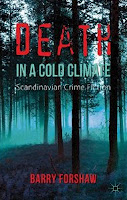
The hook for Declan's post was the publication of Barry Forshaw's Death in a Cold Climate: A Guide to Scandinavian Crime Fiction. Forshaw was kind enough to provide some advance material from the book last year when I moderated a panel full of Scandinavian crime writers at Bouchercon.   And here's a post based on some notes Forshaw sent along some months ago about the book.

*
Declan's post may be a message from above, as it comes just when I had picked up his interestingly neo-Chandlerian novel Eightball Boogie for a second reading.

© Peter Rozovsky 2012

Labels: , , , , , ,

Wednesday, November 09, 2011

The Boy in the Suitcase is released

There is much to like about The Boy in the Suitcase by Agnete Friis and Lene Kaaberbøl, out this week from Soho Press. In addition to what I wrote here, herehere and here about the book, it avoids what I've come to regard as a wearying trademark of Scandinavian crime writing: the prologue that ends with the victim dead (or with everything going black,  the smell of the damp earth then ... nothing, the rope tightening, the blade approaching,  etc.)

Yes, this book has a prologue, too, but it's gripping without graphic violence, and it involves no death. It's more akin, in a way, to a thriller than to its Scandinavian crime-fiction brothers, sisters, uncles, aunts, and cousins.

Like many a Scandinavian crime novel, this book has a social/political agenda (which its authors readily admit). But its occasional explicit "message" passages, about missing children or the treatment of immigrants, are so neatly slipped in among shifting points of view that one never minds them. [Declan Burke takes another Scandinavian crime novel to task for message-mongering over at his Crime Always Pays.]

The book's ending is heart-rending and empathetic in a way you might not expect, and the novel even has a few jokes.
***
How could I have forgotten this when listing reasons to like The Boy in the Suitcase? A late chapter refers  to a pimp especially brutal toward women as "the man with the serpent tattoo."

© Peter Rozovsky 2011

Labels: , , , ,

Thursday, August 11, 2011

Test detects a trace of humor in Swedish crime novel

Did I say Danes were the funniest of the Nordic peoples? No, not really; it was a commenter who said it, but I did not disagree.

But those tension-ratcheting Swedes, Anders Roslund and Börge Hellström, get in a good one, too, in an otherwise grim passage about prison life in their novel Three Seconds:
"Every day in every prison, every waking hour was about drugs: how to get them in, and how to use them without it being discovered by the regular urine tests. A relative who came to visit was also a relative who could be forced to smuggle in some urine, their own, urine that was clean and would test negative. Once, in his first few weeks in Österåker, some mouthy Serb got his girlfriend to piss into a couple of mugs, the contents of which was then sold for a great deal of money. None of them tested positive, despite the fact that more than half of them were under the influence, but the tests did show something else, and that was that every man in the unit was pregnant."
***
Anders Roslund and Börge Hellström will be part of my panel "A QUESTION OF DEATH: HOW IMPORTANT IS WHODUNIT?" on Thursday, Sept. 15, 10 a.m.-11 a.m., at Bouchercon 2011.

© Peter Rozovsky 2011

Labels: , , , , , ,

Wednesday, August 10, 2011

The North will rise again: Roslund and Hellström's world

Maj Sjöwall and Per Wahlöö, those progenitors of modern Nordic crime writing, sent Martin Beck to Hungary in The Man Who Went up in Smoke, but they generally kept him at home in Sweden as they probed the dark underside of that country's welfare state.

Henning Mankell, the next generation's leading light, wrote books "that connect crimes in Sweden to the rest of the world," according to one review, but there is always a sense in the books of national borders to be crossed.  The White Lioness, for example, divides its plot into two segments, one South African, one Swedish.

For the current generation of Nordic crime writers, borders might as well not exist, and not necessarily because of "globalization" either. (How quaint, naive and archaic that word sounds today.) Three Seconds, the Dagger-winning novel by the Swedish authors Anders Roslund and Börge Hellström, offers a Swedish-Polish co-protagonist of Russian/German background infiltrating the Polish mafia in a case that involves Danish as well as Swedish police. His opposite number is a police detective whose name, Grens, is the Dutch word for border. (The Swedish-Polish protagonist has twin sons whose names are those of two of the greatest Dutch Renaissance humanists. I have no idea what significance this has, but it contributes to the novel's strong pan-Northern Europe feel.)

We get ferry trips between Poland and Sweden, sudden plane trips to Denmark, and crowded scenes at Warsaw's airport, and the authors make no big deal about this. It's how their world works.

I like to think that globalization in their world (and in that of Agnete Friis and Lene Kaaberbøl, where Lithuanian streetwalkers are part of the Danish human landscape) is neither new nor monolithic, but rather a reawakening of old, even ancient economic ties previously obscured by wars and revolution. In this case, the ties are those that bind the Baltic and North Seas and the nations that surround them. Once they traded herring and salt; today's commodities are methamphetamine and hookers.

The authors rarely make this point explicitly or didactically, and that's part of what makes their books exciting. They really do take readers into a new/old world.

(For an entertaining exposition of the view that Northern Europe constitutes an overlooked cultural and economic sphere, watch Jonathan Meades' documentary Magnetic North.)
***
Anders Roslund, Börge Hellström, Agnete Friis and Lene Kaaberbøl will be part of my panel "A QUESTION OF DEATH: HOW IMPORTANT IS WHODUNIT?" on Thursday, Sept. 15, 10 a.m.-11 a.m., at Bouchercon 2011.

© Peter Rozovsky 2011

Labels: , , , , , ,

Sunday, August 07, 2011

A bit more on The Boy in the Suitcase

Two more quick observations about The Boy in the Suitcase:

1) The novel's occasional explicit "message" passages, about missing children or the treatment of immigrants, are so neatly slipped in among shifting points of view that one never minds them.

2) Though this is a grim tale of high tension (and very nicely executed), authors Agnete Friis and Lene Kaaberbøl do nothing to disprove a DBB reader's comment this week that "Danes are definitely the funniest of the Nordics."  There may be just two jokes in the novel's first 230 or so pages, but both are good.
***
Agnete Friis and Lene Kaaberbøl will be part of my panel "A QUESTION OF DEATH: HOW IMPORTANT IS WHODUNIT?" on Thursday, Sept. 15, 10 a.m.-11 a.m., at Bouchercon 2011.

© Peter Rozovsky 2011

Labels: , , , , , , , ,

Wednesday, August 03, 2011

More on "The Boy in the Suitcase"

Either Agnete Friis or Lene Kaaberbøl told an interviewer that their novel The Boy in the Suitcase is about powerless people, those who enjoy no social protection.

I'm not far enough into the book to know how this plays out, but there's a nice bit of foreshadowing early on. I'll avoid spoilers, but the punch line is a woman emerging from unconsciousness, struggling to make out a nurse's face, and seeing this:
"There was something there, in the tone of her voice, in the set of her jar, that was not compassion, but its opposite. Contempt."
Discussions of Nordic crime novels always say the books probe the ugly reality beneath the welfare state's placid surface, and they have been saying it for more than forty years.  Friis and Kaaberbøl here find a fresh way to show it.
***
Another early scene has a character recalling a doctor's rage over a rape victim's horrific injuries. The authors handle the subject with commendable restraint that only enhances the horror. The same has not always been said of, say, Stieg Larsson. So, while it's early yet to pronounce judgment on the novel, I'm developing respect for it already. Too bad the title doesn't lend itself as easily to parody as does The Girl With the Dragon Tattoo.
***
Agnete Friis and Lene Kaaberbøl will be part of my panel "A QUESTION OF DEATH: HOW IMPORTANT IS WHODUNIT?" on Thursday, Sept. 15, 10 a.m.-11 a.m., at Bouchercon 2011.

© Peter Rozovsky 2011

Labels: , , , , , , , ,

Tuesday, August 02, 2011

A good line, and goodnight!

This is an early night, so I'll leave you with just one line from the book I've begun reading along with a thought about what makes it good.

The book is The Boy in the Suitcase, the authors are Agnete Friis and Lene Kaaberbøl, and the set-up is a rich man musing upon the obstacles he overcame to have his cliffside house built. Here's the line:
"(H)e had even conquered the representative of the local Nature Society with a donation that nearly made her choke on her herbal tea."
That's not a knee-slapper, but it's a functionally amusing line that keeps the narrative going, hints at the point-of-view character's susceptibility to amusement at his own situation and, at the same time, just hints at the corrupting influence of money. That's not a bad day's work for one humble line.

Godnat!
***
A helpful commenter suggests that, given recent events in Norway, I ought to point out that the boy in the suitcase is alive.
***
Agnete Friis and Lene Kaaberbøl will be part of my panel "A QUESTION OF DEATH: HOW IMPORTANT IS WHODUNIT?" on Thursday, Sept. 15, 10 a.m.-11 a.m., at Bouchercon 2011.

© Peter Rozovsky 2011

Labels: , , , , , , , ,

Friday, July 15, 2011

A good name is better than precious ointment *

Unn the deep-minded. Thorun the Horned. Men's Wit-Breaker. And those are just the women.  The Laxdale Saga proves that if Old Norse sagas have nothing on hard-boiled crime novels when it comes to male characters' nicknames, they take the prize when it comes to distaff monikers.

Not that their male character were slouches either. Those three women are the daughters of Ketill Flatnose and the granddaughters of Bjorn the Ungartered in the  great Icelandic saga, which also mentions in passing one Ulf the Squinter. Those are right up there with Itchy Maker and the Whosis Kid.

Here's a list of Viking names and nicknames (and here's one that concentrates on the sagas). You'd probably want to cross the street if you saw Horse gelder or Blood axe coming your way, but you have to feel sorry for the Scandinavian schlemiel nicknamed Awkward poet.
***
Translator's note: Bernard Scudder, who translated crime novels by Arnaldur Indriðason and Yrsa Sigurðardóttir from Icelandic into English before he died in 2007, also translated Egil's Saga from Old Norse for the selection available in Penguin's The Saga of Icelanders. Arnaldur has said that the sagas influences his terse prose style, so if you like his work, why not grab yourself some sagas?
***
* Ecclesiastes 7:1

© Peter Rozovsky 2011

Labels: , , , , , , , ,

Monday, June 27, 2011

Nordic crime is more than just a barrel of laughs

Nordic crime fiction has been in the spotlight here at Detectives Beyond Borders, notably the question of what, if any, characteristics are common to crime writing from the Nordic countries.

With that in mind, two bits from Helsinki Homicide: Against the Wall, by Finland's Jarkko Sipila, typify what I suspect many people would regard as typically Nordic:
"Finland was home to one of the top per capita homicide rates in Western Europe, but most slayings were the result of drug and alcohol addicts solving their disputes with whatever weapons they could get their hands on."
and
"Over a million semi-trucks passed from Finland to Russia every year. It was impossible to track all the imports and exports. ... The incidents of fraud were numbered in the thousands, or tens of thousands, but investigators were numbered in the tens."
Resignation. Fatalism. What does Nordic/Scandinavian crime fiction mean to you?

© Peter Rozovsky 2011

Labels: , , , , , ,

Sunday, June 26, 2011

Nesbø in my newspaper

My review of Jo Nesbø's The Snowman appears in Sunday's Philadelphia Inquirer. I had a bit of fun writing this one, and the headline writer picked up the fun rather nicely.

Here's what Nesbø had to say about that fun topic in my interview with him:
There's a big wave of Nordic crime fiction. Do you consider yourself part of that?

I am part of that whether I consider myself part of it or not because it's sort of a commercial label. It doesn't necessarily have much to do with Scandinavian writers having the same style. When I've been asked what I think are the similarities between Scandinavian authors, I would say that they were either from Denmark, Norway or Sweden.

I think my style is probably closer to some of the American writers — Bukowski, Hemingway — than to other Scandinavian writers. Then again, I write from Oslo, so the atmosphere would probably be similar to Stieg Larsson or Henning Mankell.


For me, my inspiration doesn't come mainly from Scandinavian crime writers. It comes from Scandinavian literature, like Knut Hamsun, Henrik Ibsen, lots of other Norwegian and Danish and Swedish writers.
© Peter Rozovsky 2011

Labels: , , , , , , , , ,

Tuesday, June 14, 2011

"Why do you think Norwegians are so skeptical about George Bush?"

Jo Nesbø has called Norway "a very young nation, and it is trying very hard to find itself. Like any nation, it needs pillars to build an image of a nation on."

In The Snowman he has a character make a similar point more provocatively:
"`Why do you think Norwegians are so skeptical about George Bush, Arve Støp?'

"`Because we're an overprotected nation that has never fought in any wars. We've been happy to let others do it for us: England, the Soviet Union and America. Yes, ever since the Napoleonic Wars we've hidden behind the backs of our older brothers. ... That's been going on for so long that we've lost our sense of reality and we believe that the earth is basically populated by people who wish us — the world's richest country — well. Norway, a gibbering, pea-brained blonde who gets lost in an alley in the Bronx and is now indignant that her bodyguard is so brutal with muggers."
The passage in incidental to the story, but it adds to the novel's flavor. What are your favorite such passages? And what are your favorite bits of political commentary in crime stories?
© Peter Rozovsky 2011

Labels: , , , ,

Monday, June 13, 2011

The trouble with Hole: An interview with Jo Nesbø, Part II

In preparation for a review of Jo Nesbø's novel The Snowman upon its U.S. release, I bring back this second part of my interview with Nesbø from last year. His recent anointing in some quarters as the next Stieg Larsson makes his comments here perhaps more pertinent than ever.
==========================

In the second part of his interview with Detectives Beyond Borders, Jo Nesbø discusses future English translations of the first, second and eighth Harry Hole novels [the five translated to date are books three through seven], philosophical musings on celebrity and revenge in Nemesis, and his place in Scandinavian crime fiction. He also talks about how Hole (pronounced approximately HEU-leh in Norwegian) got his first name — and did not get his second.

(Read Part I of the interview with Jo Nesbø.)
==============================
Detectives Beyond Borders: Can you talk a little about why you chose the name Harry for your protagonist?

Jo Nesbø: It's like the most corny name you can think of. It's even an expression in Norwegian, to be Harry. It's like the cliché of a redneck.

In the Seventies what we meant with Harry was someone who dressed like Elvis. It was someone from the rural areas coming to the city not knowing how to dress. That was why I wanted the name. `How can you call somebody Harry?' It's not a funny name, but it's an uncomfortable name. It's a normal name in one way, but on the other hand, a guy living in Oslo named Harry, it gives the character character.

There was an English musician born in Norway that suggested the name really was `Hairy Hole,' that I was playing with that. I told him no, I wasn't. I really laughed hard when he suggested that. No, I didn't think about that, but I wish I had, you know.

There's a big wave of Nordic crime fiction. Do you consider yourself part of that?

I am part of that whether I consider myself part of it or not because it's sort of a commercial label. It doesn't necessarily have much to do with Scandinavian writers having the same style. When I've been asked what I think are the similarities between Scandinavian authors, I would say that they were either from Denmark, Norway or Sweden.

I think my style is probably closer to some of the American writers — Bukowski, Hemingway — than to other Scandinavian writers. Then again, I write from Oslo, so the atmosphere would probably be similar to Stieg Larsson or Henning Mankell.

For me, my inspiration doesn't come mainly from Scandinavian crime writers. It comes from Scandinavian literature, like Knut Hamsun, Henrik Ibsen, lots of other Norwegian and Danish and Swedish writers.

What have readers in English missed by not having The Batman, The Cockroaches (Books 1 and 2 in the series, which take Harry to Australia and Thailand) and The Leopard (Book 8) available in their language?

The Leopard will be translated, hopefully next year. The first two books, there are enough references to them in the third and the fourth and the fifth books. That's why we decided we can start with the third book, because you will get the rest of the story.

The series is now so established in the UK, they want to translate the first two, also.

Also by Don Bartlett?

I hope so.

Are you deliberately more philosophical in Nemesis? And do Americans prefer a simpler, more compact, less complex story like Nemesis [shortlisted for the best-novel Edgar Award for 2010]?

[Laughs] The first part of the question, the short answer is, I don't know.

Number two, no, I don't necessarily think so. I think that nominations — I have to answer this carefully — nominations sometimes tend to be the result not only of what you did in your last novel, but in the novel before that.
==============================
(Read Part I of the interview with Jo Nesbø.)

© Peter Rozovsky 2010

Labels: , , , , , , , , , , ,

Monday, January 24, 2011

The hero in the bathtub

A few months ago, I wrote about a charming tribute Andrea Camilleri paid Maj Sjöwall and Per Wahlöö in his novel The Track of Sand. Sjöwall and Wahlöö accord similar tribute to another crime writer in The Fire Engine That Disappeared (1969), fifth in the Martin Beck series:

"He also drank some coffee and cognac and watched an old American gangster film on television. Then he got his bed ready and lay in the bathtub reading Raymond Chandler's The Lady in the Lake, every now and then taking a sip of cognac which he had placed within reach on the toilet seat."
Who said Swedes don't know how to live? A recent Detectives Beyond Borders post asked "Who is the hero in a Sjöwall and Wahlöö novel?" There's your answer: If you know what a character likes to read, he's your protagonist.

***
On the other side of the Atlantic, I wonder if Every Bitter Thing, Leighton Gage's fourth novel featuring Inspector Mario Silva of Brazil's Federal Police, has been translated into Spanish and, if so, how well the book sells in Venezuela. Not that the novel names Hugo Chávez, at least not early on, but Chavistas might frown at several references to "the Clown."

How do you feel about such topical references in crime fiction? What are some of your favorites?

© Peter Rozovsky 2011

Labels: , , , , , , , , , , ,

Saturday, January 22, 2011

Colin Dexter on Sjöwall, Wahlöö, and Swedish sex

I've just has a couple of beers and a plate of fish and chips at my local, and I'm ready for a snooze, so I'll let Colin Dexter do the honors for today.

Dexter is yet another of the current crime authors who wrote introductions to the (relatively) recent editions of Maj Sjöwall and Per Wahlöö's Martin Beck mysteries (Vintage Crime/Black Lizard in the U.S., Harper Perennial in the U.K., at least in paperback).

The Fire Engine That Disappeared (1969) came fifth in the series and, writes Dexter, "My first preconception was that this husband-and-wife team, with a political stance well to the left, had become rather too bitterly cynical in the sixties and seventies of what they saw as the betrayal of many of their Socialist ideas and ideals."

We took care of that here two weeks ago; Detectives Beyond Borders readers know that strong political sensibilities do not preclude acute observation and sensitive, entertaining storytelling.

We also know about Sjöwall and Wahlöö's wit, though I am pleased to add such a distinguished witness for the defense as Dexter against the canard that Scandinavians aren't funny. "What struck me" about The Fire Engine That Disappeared, writes Inspector Morse's creator, "was the gently underplayed humour of the writing."

One of Dexter's preconceptions involved Ed McBain's influence on Sjöwall and Wahlöö, and I'll save that matter for another post. Another was his belief that anything coming out of Sweden in the 1960s must be saturated with explicit sex.

Instead, he writes, "Sex plays only a very small part in the novel; and what sex we do find is handled with an almost serene simplicity." And if that isn't a beautifully sane (and accurate) assessment, I don't know what is.

Thanks, Colin; and goodnight, readers.

© Peter Rozovsky 2011

Labels: , , , , , , , , ,

Thursday, January 13, 2011

Adverbs of gloom, or Humor in Nordic crime writing

Discussion here has turned once again to Nordic crime writers and their reputed lack of humor — on a post called What do your favorite writers do less well?, no less.

On the one hand, Maj Sjöwall and Per Wahlöö elevated the adverb to heights unseen in crime fiction since the Black Mask days, and those adverbs are generally gloomy. Characters are forever gesturing helplessly and slumping dejectedly. On the other hand are Kvant and Kristiansson:

"Outside police headquarters on Kungsholmsgatan stood two persons who definitely wished they had been somewhere else. They were dressed in police caps and leather jackets with gilded buttons, they had shoulder belts diagonally across their chests and carried pistols and batons at their waists. Their names were Kristiansson and Kvant.

"A well-dressed, elderly woman came up to them and asked, `Excuse me, but how do I get to Hjärnesgatan?'

"`I don't know, madam,' Kvant said. `Ask a policeman. There's one standing over there.'

"The woman gaped at him.

"`We're strangers here ourselves,' Kristiansson put in quickly, by way of explanation."

(Kristiansson and Kvant are officers in Solna whose eagerness to avoid work takes them over the municipal border into neighboring Stockholm and smack into the scene of the novel's central crime. Their ignorance of the lay of the land is thus plausible.)

Read more about humor in Nordic crime fiction in Mystery Readers Journal.

© Peter Rozovsky 2011

Labels: , , , , , , , , ,

Wednesday, January 12, 2011

What do your favorite writers do less well?

I've finally found something Maj Sjöwall and Per Wahlöö did not do well: routine description.

The Man Who Went Up in Smoke (1966), second of the ten Martin Beck novels, takes Beck to Budapest to look for a missing Swedish journalist. His reflections on arrival are potted history and travel-guide boilerplate, the only time I have been tempted to skim rather than read Sjöwall and Wahlöö. Apologists might call the flat prose a comment on Beck's alienation or on the economics of tourism, but that would be out of character for Beck, who we are told enjoys travelling. Besides, alienation ought not to alienate the reader.

In any case, the bad bits were brief distractions, paling next to Sjöwall and Wahlöö's compelling portrayal of Beck's feeling at a loss in a country about which he knows little, whose language he cannot speak, investigating a case as baffling as the novel's title.

But that's a distraction from the day's question: What have your favorite writers tried that did not work?
***
The Man Who Went Up in Smoke is broadly similar to Henning Mankell's The Dogs of Riga, which takes Kurt Wallander to Latvia. Each novel is the second in its series in order of original Swedish publication.

Mankell has acknowledged Sjöwall and Wahlöö's formative influence on Swedish crime writing. Could The Dogs of Riga be in part a tribute to his great predecessors?

© Peter Rozovsky 2011

Labels: , , , , , , , , ,