Thursday, October 20, 2016

Shadow Man: Dashiell Hammett, his granddaughter, and me

"Shadow Man" by Peter Rozovsky
for Detectives Beyond Borders
Shadow Man is the title both of Richard Layman's 1981 biography of Dashiell Hammett and of the self-portrait at left, which I shot last night.

Today I had lunch with Hammett's granddaughter and editor Julie M. Rivett, who is visiting my part of the world to talk to high school students and other groups about Hammett and The Maltese Falcon.

Richard Layman, Julie M.
Rivett. Photo by your humble
blogkeeper.
Rivett, who joined Layman in a discussion I moderated at Bouchercon 2015,  talked Hammett, and we discussed one of last year's best non-fiction crime books, Nathan Ward's The Lost Detective: Becoming Dashiell Hammett.  I was also tickled to learn that Rivett is a big fan of James Lee Burke, whom I've begun to read as part of my recent but abiding love affair with New Orleans. We talked at some length about Burke and his writing, which Rivett knows a lot better than I do. The woman has good taste in crime writers, whether she is their lineal descendant or not.

© Peter Rozovsky 2016

Labels: , , , , , ,

Sunday, August 07, 2016

My Bouchercon 2016 panel: Meet Peter Rabe

Peter Rabe's gangster/fixer characters seem driven toward confrontations with their bosses that do not generally end well (though Daniel Port, the political fixer of the Glass Key-like Dig My Grave Deep, [1956] survived his confrontation long enough to feature in a series of novels.)

The Box (1962), A Shroud for Jesso (1955), and, believe it or not, Kill the Boss Good-By (1956), also turn on conflicts between ambitious underlings and the top men who punish them or stand in their way.   Can you imagine what sort of father-figure  psychobabble Ross Macdonald would have wrung out of material like that?  Rabe, a trained and practicing psychologist, on the other hand, avoided Macdonald's embarrassing amateur Freudianism, concocting instead stories of men who, while not necessarily trapped, just do what they have to, as dictated by their temperament, or circumstances, or ambition.

It's harder to find crime-fiction parallels for Rabe than it is for some authors, perhaps because, with two exceptions, Rabe said his influences came from outside crime fiction. (One of those two exceptions was Dashiell Hammett, so you know he had good taste.)

If you don't know Rabe or his work, this 1989 interview with him is a good place to start. If you do know Rabe, you may find his admiring comments about Donald Westlake especially interesting. Rabe also comes across as surprisingly genial for a man whose life included escape from Germany to avoid the Nazis, a false diagnosis of a terminal disease, several marriages and divorces, and ups and downs in his writing career that eventually led him so stop writing for publication. The man seems to have been pretty well adjusted for a psychologist.

======
Rick Ollerman will talk about Peter Rabe as part of my panel called "From Hank to Hendrix: Beyond Chandler and Hammett: Lesser Known Writers of the Pulp and Paperback Original Eras" at Bouchercon 2016. It happens at 9 a.m., Thursday, Sept. 15, at the Marriott, 555 Canal St., New Orleans, Room LaGalleries 1.

© Peter Rozovsky 2016 

Labels: , , , , ,

Friday, August 05, 2016

DBB meets Dolores Hitchens

I first read Dolores Hitchens while preparing for a panel I moderated at Bouchercon 2014 in Long Beach, the first of my Beyond Chandler and Hammett sessions focusing on lesser-known crime writers from the middle of the twentieth century. Hitchens will be among the subject of this year's version of the panel at Bouchercon 2016 in New Orleans next month, and this pre-Long Breach post captures nicely why I like these panels so much: I get to read, experience, and come to grips with authors new to me.
========

A friend sent along Dolores Hitchens' 1955 novel Sleep With Strangers because of its setting in Long Beach, site of Bouchercon 2014. Indeed, the book is even more evocative of its setting than is that other great Long Beach crime novel, Paul Cain's Fast One.

Hitchens is new to me, so naturally I start out thinking of her in terms of other crime writers her work evokes, and those writers are two of the best.  Hitchens' compassion for characters who lead marginal existences reminds me of David Goodis, particularly The Street on the Corner [At this late date, I don't remember if I meant The Blonde on the Street Corner or The Street of No Return. The latter, I suspect.] and Cassidy's Girl, and her dissection of family life in California brings to mind The Big Sleep. (Ed Gorman's discussion of Sleeps With Strangers invokes Ross Macdonald. I've never warmed to Macdonald, but I suspect that what Gorman sees as Macdonaldish is what I see as Chandlerlike. In any case, that's another illustrious name associated with Hitchens.)

The novel's opening is an atmospheric, moody, tension-filled inversion of the usual scene in which a P.I. meets a client, and it hooked me on Hitchens right away. (The client is named Kay Wanderley.  "Wonderly," of course, is the name Brigid O'Shaughnessy uses when she first calls on Sam Spade in The Maltese Falcon. Homage? Coincidence? Either way, it's more good fictional company for Dolores Hitchens.)

© Peter Rozovsky 2014, 2016

Labels: , , , , , , , , , , , ,

Wednesday, July 27, 2016

Hammett wrote "It"; you should read it

Dashiell Hammett's story "It" appeared in Black Mask in November 1923, a month after "Crooked Souls," two months before "The Tenth Clew," and five months before "The House in Turk Street" kicked off the high point of Hammett's short fiction.

Three of those stories are included in the Library of America's volume of Hammett's crime stories and other writings. "It" is not included, which is one reason to look for it in Mysterious Press' reissue of all Hammett's Continental Op stories.

"It" is a bit talkier than some of Hammett's short stories, but the talk has the Op and his interlocutors trying to hash out the case in question (a man's disappearance), and Hammett makes of it a pretty good mystery. In this case, the talkiness is, arguably, a plus. The story also offers the novelty of placing the big summing-up-the-crime scene (remember Sam Spade's speech to Brigid O'Shaughnessy in The Maltese Falcon?) at the beginning of the story rather than near the end.

Throw in the deadpan wit that Hammett had already perfected from his earliest published work, plus a wry existential final line, and you have a story that deserves a place with Hammett's best short fiction.
*
“`Yes, we were pretty good friends, but not especially thick. You know what I mean: we had a lot of fun together but neither of us meant anything to the other outside of that. Dan is a good sport—and so am I.'

“Mrs. Earnshaw wasn’t so frank. But she had a husband, and that makes a difference.”
 © Peter Rozovsky 2016

Labels: ,

Monday, July 25, 2016

Rabe on (It's a crazy feeling)

I'm about to begin reading Time Enough to Die, which Donald Westlake called the only good novel of the six books by Peter Rabe that featured a tough guy and political fixer named Daniel Port. (Westlake regarded Rabe as a formative influence on his own crime writing. He just didn't like the Port books much.) In the meantime, here's a post from back when I first read Rabe.
================
 I'm a book and a half into my career as a Peter Rabe reader, and I've reached two tentative conclusions: 1) Rabe was an heir to early Dashiell Hammett, and 2) He worked psychology into his novels a hell of a lot better than Ross Macdonald did.

Rabe had a master’s and a doctorate in psychology. He incorporated psychology in his crime novels with an expert’s knowledge and an author’s restraint. Macdonald, on the other hand, at least in The Galton Case, was more like a yammering cultist on the subject.

The Hammett connection is more pertinent, though, to a discussion of Rabe’s The Box and Kill the Boss Goodbye. (I’m told that only one or two of Rabe’s novels appeared with a title he suggested. The Box is one of them. I would bet a dozen Montreal bagels that Kill the Boss Goodbye is not.) Each novel reminded me a bit of Hammett’s portrayals of men doing their jobs. More particularly, each portrays with cool detachment, deadly power struggles at the head of a criminal or quasi-criminal enterprise, in the manner of Red Harvest. But they read more like Patricia Highsmith's The Tremor of Forgery, no surprise given that both that book and The Box are set in North Africa.

(A post on the Violent World of Parker Web site discusses Donald Westlake and an essay he wrote about Rabe. Read Westlake on Rabe in the Westlake nonfiction volume The Getaway Car. Read more about Rabe at Mystery File and Stark House Press.)

© Peter Rozovsky 2015

Labels: , , , , ,

Wednesday, July 13, 2016

How a book for reluctant readers might help reluctant writers, plus a cover photo by me

My latest cover photo with accompanying novel has landed.  Linda L. Richards' When Blood Lies, like the book that supports  my previous cover shot, Reed Farrel Coleman's Love and Fear, is part of Orca Books' Rapid Reads line.

I've known the author for a few years, and I wrote about her 2008 novel Death Was the Other Woman, a Sam Spade-like story told from an Effie Perrine-like character's point of view. The Dashiell Hammett love continues here. The protagonist is named Nicole Charles, and the book's epigraph is a nod to The Thin Man.

Linda L. Richards
Rapid Reads target "a diverse audience, including ESL students, reluctant readers, adults who struggle with literacy and anyone who wants a high-interest quick read," and I can add reluctant writers to that potential audience.

I am one such, and the brevity of these books, plus their stripped-down narrative, vocabulary, or both make it easier for me to see how the authors build their plots and what they do to keep the story going. Since plot is not the strong point of my occasional efforts at fiction, I took mental notes as I read Richards' and Coleman's books. Perhaps other would-be writers who want to learn how to build a story could do the same.

© Peter Rozovsky 2016

Labels: , , , , , , ,

Friday, May 27, 2016

Happy birthday, Hammett: Three characters who stay true to their natures

On the occasion of Dashiell Hammett's 122nd birthday, I'll bring back this post a few years ago that takes a common observation about Sam Spade and the Continental Op and applies it to two of The Maltese Falcon's major supporting characters, as well. May this stimulate you to read one of Hammett's great novels or short stories. Happy birthday, Sam.
 ===============
 Trent Reynolds of the fine Violent World of Parker site mixed criticism and high compliment last month when he wrote of my Dashiell Hammett memorial post that "The Maltese Falcon is the greatest crime novel ever written. Not mentioned in this otherwise excellent post on Hammett."

I'd just read The Glass Key for the first time, so that book dominated my thinking about Hammett. And testimonials from crime writers, including Reynolds' own Donald Westlake, that I included in the post indeed did not mention Hammett's most famous work.

But I'd like to reassure Trent and everyone else that I love The Maltese Falcon, that it induces just as chilling an effect in the reader as does The Glass Key, and that I regard it as at least as great a book. (I'd also suggest that The Maltese Falcon's greatness is so universally acknowledged that the novel may simply be taken for granted in discussions of the best crime novel ever.)

And I'd like to add a thought to the discussion based on my recent rereading of the novel (I finished it last night.)

It's a commonplace that a Hammett hero is defined by his job, and that the job is more than just a way to bring in money. Here's Joe Gores, for example, in Dashiell Hammett Lost Stories:
"Hammett saw the private detective as a manhunter. ... The Hammett hero is on the side of the law but not particularly law-abiding. He has a job to do."
When it came to Sam Spade or the Continental Op, in other words, Hammett made his plan, and he stuck to it.

I realized last night that he did just the same with Brigid O'Shaugnessy and Casper Gutman in The Maltese Falcon. Brigid is a liar from the beginning, her rigid cleaving to her nature reinforced by Spade's early, pointed, and repeated assessments: "You're good." "You're very good." "You're a liar." "That is a lie." She adheres as rigidly to the degenerate moral code that Hammett has drawn up for her as Spade adheres to his more upright one.

Gutman, his composure only fleetingly shattered when he finds the falcon is a fake, is positively joyous when he realizes this means he can resume his globe-hopping quest for the real falcon. He is as true to his nature as Brigid O'Shaugnessy and Spade are to theirs. (Of course, his global quest extends no further than a few blocks from Spade's apartment on Post Street; he gets blown to hell and gone by Wilmer Cook a few pages later.)

But consistency of character, that sense that there is no escaping from one's nature, is part of what makes the book so gripping.

© Peter Rozovsky 2011

Labels: , , , , ,

Thursday, May 12, 2016

A reason I liked The Sympathizer, or diversity is unity is diversity

A big reason I liked The Sympathizer:

Author Viet Thanh Nguyen's occasional jokes about the cultural differences between the north and the south of Vietnam, including this:
"Besides the simple yet elegant cha-cha, the twist was the favorite dance of the southern people, requiring as it did no coordination."
That makes me want to know about who is what in Vietnam. There's more to the North-South dynamic than communist vs. its opposite, us vs. them, colonial vs. indigenous, or all the rest of the usual dichotomies. Portrayals of tensions and rivalries within cultures unfamiliar to me always make those cultures seem more real and more human. It's why I like Henry Chang's Chinatown novels and Joe Nazel's Street Wars, and also why I like Isaac Babel's Odessa tales and Dashiell Hammett's story "Dead Yellow Women," which, despite a title unlikely to be allowed today, says more on its first page about Chinese social and political diversity in China and in the United States than I suspect many readers are accustomed to thinking about.

 I can well imagine that a minority group might be skittish about presenting divisions to the wider world, but to me that makes those populations seem that much more human. Reminders that no group is monolithic seem especially important in a time when religious and cultural differences are so easily exploited.

Years ago, I staggered into a restaurant in London late one morning, near-exhausted by jet lag. I was the only customer at that hour, Arabic-sounding music was playing, and the waitress was a curvy, henna-haired beauty, so I chatted her up.  The encounter happened several years after after the 9/11 terrorist attacks and as the month of Ramadan drew to a close. Both facts are relevant to what followed:
Me: "What is that music?"|
Waitress: "It's Arabic music."
Me: "I know it's Arabic music. From where?"
Waitress: "It's from my country."
Me: "Where is your country?"
Waitress: "I came from Paris, actually."
Me: "Where were you before you were there?"
Waitress: "Beirut."
Me: "Christian or Muslim?" 
Waitress: (Nervously) "Muslim."
Me: "I ask because it must be hard to serve food all day while you're fasting."
Waitress: (Relaxes and bursts into hearty laughter) "I don't fast during the day, but I sure do party at night."
That might offend some Muslims and make some white liberals squirm, and I'd have hesitated to name the woman or her restaurant in a newspaper story. But I cannot imagine a better lesson in common humanity. And no, she did not party with me that night.

(Read my posts on The Sympathizer and Portnoy's Complaint: One man's squid is another man's liver and The Sympathizer, Part II: Genre, politics, and genre politics.)

© Peter Rozovsky 2016

Labels: , , , , ,

Friday, May 06, 2016

The Sympathizer and Portnoy's Complaint: One man's squid is another man's liver

The last time the question of literary vs. genre came up, I suggested that if literary has any meaning with respect to crime fiction, it might apply to crime novels that work as something else as well, whatever that something might be. Qiu Xiaolong's Death of a Red Heroine deserved its place on one recent list of "literary" crime novels, as did Hammett's Red Harvest and James Ellroy's White Jazz,  though the novels are not especially similar. (One thing I'm pretty sure literary does not mean, or at least with which it is not synonymous, is written in ravishing prose. That's why I was skeptical of one fellow commenter's suggestion that James Crumley and James Lee Burke belonged on the list.

(The Barnes and Noble nearest to me shelves Ellroy in mystery and Lee Child in fiction and literature. I'll mention that the next time anyone talks about literary and genre.)

Viet Thanh Nguyen's The Sympathizer, winner of this year's Pulitzer Prize for fiction and Edgar Award for best first crime novel, is one current Great Obliterate the Distinction Between Literary and Genre hope, championed as such in a recent piece that hyperventilated more frantically than most without—naturally—offering any definition of literary. If I can find a link to the damned thing, I'll post it here.

I'm about a third of the way through the novel, and here are some reasons I think it might qualify as something in addition to (not more than) a genre book:
1)  It works its way into its genre-like plot, in this case espionage rather than crime, only slowly, telling us much along the way about the narrator/protagonist and his adventures in Saigon and California (if you say either character-driven or plot-driven, I'll shoot you between the eyes.)

2) Its humor is not just funny, but it also sheds entertaining cultural light, Here the protagonist, a native of northern Vietnam, observing a wedding celebration in California:
"Besides the simple yet elegant cha-cha, the twist was the favorite dance of the southern people, requiring as it did no coordination."

3) It pays tribute to, or at least echoes, another novel of American ethnicity, Portnoy's Complaint, using a squid where Philip Roth used liver.
Read an interview with Viet Thanh Nguyen.

© Peter Rozovsky 2016

Labels: , , , , , , ,

Monday, February 08, 2016

William Ard, James Ellroy, and elements of crime fiction style

"She said eight o'clock in the lobby. She said bring the hundred with me, in cash. She said good-bye."
*
"Clouds imploded. Buildings weaved. People blipped."
=======
One of those passages is from James Ellroy, the other is fifty years older, but the cadences are similar, and if you don't think cadence is important, you've never read Ellroy, at least not The Cold Six Thousand, from which the second of the passages is taken.

The first is from William Ard's 1952 novel The Perfect Frame and, two books into my career as an Ard man, I begin to realize that for all the trouble he had coming up with strong endings, the man had style. His ten hard-boiled novels about P.I. Timothy Dane appeared in the 1950s, the years when Ellroy was growing from toddlerhood into early adolescence and, while I have no idea whether Ellroy read Ard, I have no doubt that he imbibed something of the way people spoke and wrote back then.

Style is a funny thing; style to me can be mere showing off to you. And it's elusive. Dashiell Hammett was the greatest of all crime writers, but what constitutes the Hammett style? 

While you ponder that unanswerable question, try these easier ones: What is style? Is good prose style necessary to good writing? Are the two synonymous?  Who are the most distinctive stylists in crime fiction? What's distinctive about their style, and what does that style add to their stories?

(By coincidence, Dana King discusses style this week at his One Bite at a Time blog. Have a stylish day.)

© Peter Rozovsky 2015

Labels: , , , ,

Saturday, December 19, 2015

A Detectives Beyond Borders best book of 2015: Nathan Ward on how Hammett became Hammett

Nathan Ward's book The Lost Detective: Becoming Dashiell Hammett proposes that Hammett's experience as a detective for the Pinkerton Agency was a formative influence on his writing.

Ward is not the first Hammett scholar/researcher to make the connection; Richard Layman titled his 1981 Hammett biography Shadow Man. Ward, too, notes Hammett's writing about being a good shadow man — that is, being good at tailing someone without himself being detected.  One key, Hammett wrote, is to note the quarry's physical attitude. The way a person moves or wears clothes can be vastly more important in identifying one's quarry than can his or her face.

Commentary on Hammett's work as a detective generally suggests that the experience lent his stories verisimilitude, that he could write more convincingly about fictional detectives because he had been a real one.  Ward is the first Hammett scholar I can remember who suggests that the most valuable lesson Hammett learned was concision. He and other Pinkertons had to be brief and no-nonsense in their reports for the agency, a contention supported by Ward's research in Pinkerton archives, and this, Ward says, helped form Hammett as a writer.

Good prose style has never been valued less than it is now, and it does not figure prominently in discussions of authors. If you have even a passing familiarity with themes in Hammett biography and criticism, you'll know that scholars have focused on his politics, his love life, and his drinking. Ward's book is not, as reviewers and others have maintained, a biography. (Layman, on our Hammett panel at Bouchercon 2015 in Raleigh, recognized this.) Rather, it is something rarer: A book about a writer that concentrates on writing. And that's why it's a Detectives Beyond Borders best book of 2015.
============================= 

Fresh off reading Ward's book, I picked up The Maltese Falcon again, to find Hammett turning his detective's eye on Sam Spade.:
"The steep rounded slope of his shoulders made his body seem almost conical—no broader than it was thick—and kept his freshly pressed grey coat from fitting very well."
You'd know that man if you saw him again* and, having shown than he can do it, Hammett puts description to brilliant thematic use right from the start. But that's a subject for a future post.
=======
* Hammett's Spade is blond and "quite six feet tall." He looks, that is, about as far from Humphrey Bogart as it is possible for a human being to look.
 
© Peter Rozovsky 2015

Labels: , , , , ,

Tuesday, September 22, 2015

My Bouchercon 2015 panels: Elisabeth Sanxay Holding, Vera Caspary, and mysteries within mysteries

"(S)he was not fond of mystery stories. Nobody in them ever seems to feel sorry about murders, she had said. They're presented as a problem, m'dear, her father said. What's more, they generally show the murdered person as someone you can't waste any pity on. I'm sorry for them, she said. I hate it when they're found with daggers sticking in them and their eyes all staring from poison and things like that."
That's from Elisabeth Sanxay Holding's novel The Blank Wall, included in the new collection Women Crime Writers: Eight Suspense Novels in the 1940s and '50s, edited by Sarah Weinman for the Library of America.  That paragraph will catch the eye of readers today, I suspect, and it makes a good starting point for discussion of the entire collection. What makes these eight writers different from their predecessors? From their successors? From their male contemporaries?  What traits do the eight share with all those groups? It might also make for interesting comparison with Raymond Chandler's famous assessment of Dashiell Hammett's contribution to crime writing in "The Simple Art of Murder."

But it's not the funniest meditation on mystery stories in Women Crime Writers. That honor goes to Waldo Lydecker's narration in Chapter II of Vera Caspary's Laura:
"I have never stooped to the narration of a mystery story. At the risk of seeming somewhat less than modest, I shall quote from my own works. The sentence, so often reprinted, that opens my essay `Of Sound and Fury' is reprinted here:

"`When, during the 1936 campaign, I learned that the President was a devotee of mystery stories, I voted a straight Republican ticket.'"
========================
Sarah Weinman will discuss Elisabeth Sanxay Holding on a panel I'll moderate at Bouchercon 2015 in Raleigh, N.C., in (yikes) two weeks. The panel is called "Beyond Hammett, Chandler, Spillane, and Macdonald," and it happens Thursday, Oct. 8, at 2:30 p.m.

© Peter Rozovsky 2015

Labels: , , , , , , ,

Sunday, September 20, 2015

My Bouchercon 2015 panels — Dashiell Hammett: A Daughter Remembers

Yesterday's reading was the most touching I'll likely do for this year's Bouchercon or maybe any other year's, as well. I'm too busy preparing to make a full post about Dashiell Hammett: A Daughter Remembers, so I'll offer a few selections from the book that seem especially pertinent to Hammett's work and life. Fuller treatment may follow next month at Bouchercon 2015 in Raleigh, N.C. , when I moderate a discussion with the book's two editors, Richard Layman and Julie M. Rivett. The discussion is called "Inside the Mind and Work of Dashiell Hammett," and happens Saturday, October 10, at 8:30 a.m.

The author of A Daughter Remembers, Jo Hammett, is Dashiell Hammett's daughter and Rivett's mother. As you might guess, the book, published in 2001, is full of family photos and recollections of family life. This is especially valuable in the case of a writer as private, as sparing of information about himself, as Hammett was.  Jo Hammett also has a better eye and ear for what made Hammett a great writer than do many who have written about him. She's also capable of an occasional flash of delightful, stinging wit, which makes her sound a bit like her father. Here's some of what she has to say in this memoir:
*
"Red Harvest comes out of Black Mask days. It's got Black Mask rough edges and give-it-all-you're got energy. The later novels are smoother, more finely tuned. But this is the one I like best, because it's hard like its people. funny and unforgiving, and sounds most like Papa."
*
"`Lock me in a room with a set of encyclopedias, and I'll come up with a plot,' [Hammett] used to say. His idea of heaven was going cross-country in a train compartment, in his pajamas, reading all the way."
*
"[Hammett] took Mary and me backstage to meet Ethel Barrymore ... She was charming to us and very regal. In a parting remark she said something to him about the play having `great social significance,' perhaps thinking that would strike a sympathetic chord with him. He was quick to agree. `Oh, yes, absolutely.'  I could tell by the look on his face he was thinking, `Yeah, about as much as Krazy Kat.'"
*
"Papa had a generally low opinion of actors. He despised their self-pre-occupation and their ruthlessness."

© Peter Rozovsky 2015

Labels: , , , , ,

Friday, September 18, 2015

My Bouchercon 2015 panels: Donald Westlake on The Thin Man

I wanted to say something about The Thin Man, but Donald Westlake said it better:
“When I was 14 or 15 I read Hammett's The Thin Man (the first Hammett I'd read) and it was a defining moment. It was a sad, lonely, lost book, that pretended to be cheerful and aware and full of good fellowship, and I hadn't known you could do that: seem to be telling this, but really telling that; three-dimensional writing, like three-dimensional chess. Nabokov was the other master of that.” 
=======
I'll discuss Dashiell Hammett in a special event at Bouchercon 2015 in Raleigh, N.C., next month.  The discussion is called "Inside the Mind and Work of Dashiell Hammett," and the featured guests are Julie M. Rivett, Hammett's editor and granddaughter; and Richard Layman, Hammett's biographer and a pioneering name in Hammett scholarship. See you there on Saturday, October 10, at 8:30 a.m.

 © Peter Rozovsky 2015

Labels: , , , ,

Thursday, September 03, 2015

My Bouchercon 2015 panels: Dashiell Hammett and Chinese-American history

Back in 2008, I wrote that Henry Chang's novel Year of the Dog
"not only introduces us to Chinatown's newer Fukienese arrivals, with their wide ideological separation from the neighborhood's longer-established residents, but [Chang] portrays dangerous criminal rivalries among these relative newcomers."
Then, as now, Chang's work led me to reflect on an aspect of Dashiell Hammett I had not thought of previously. That's timely because I'll be talking about Hammett with Julie M. Rivett and Richard Layman next month at Bouchercon 2015 in Raleigh, North Carolina. The session is called "Inside the Mind and Work of Dashiell Hammett," and it happens Saturday, October 10, at 8:30 a.m. There's still time to register, so I'll see you there, and I may even buy you a cup of coffee after the panel.
=================================
I've cited Henry Chang's crime novels for their portrayals of a New York Chinatown more complex than non-residents might think. Longtime residents are suspicious of newcomers; alliances, ethnic rivalries and cultural habits spill over from the old country; and Hong Kong Chinese restaurants are flashier than all others.

Dashiell Hammett did something similar in 1925, in a story called "Dead Yellow Women." That's not a title one would see today unless it was intended with irony, and it may make readers in 2015 cringe. But take a look at what Hammett does at the beginning of the story:
"The San Francisco papers had been full of her affairs for a couple of days. They had printed photographs and diagrams, interviews, editorials, and more or less expert opinions from various sources. They had gone back to 1912 to remember the stubborn fight of the local Chinese—mostly from Fokien and Kwangtung, where democratic ideas and hatred of Manchus go together—to have her father kept out of the United States, to which he had scooted when the Manchu rule flopped. The papers had recalled the excitement in Chinatown when Shan Fang was allowed to land—insulting placards had been hung in the streets, an unpleasant reception had been planned.

"But Shan Fang had fooled the Cantonese. Chinatown had never seen him. He had taken his daughter and his gold—presumably the accumulated profits of a life-time of provincial misrule—down to San Mateo County, where he had built what the papers described as a palace on the edge of the Pacific."
I don't know about you, but that makes me curious about who made up the population of America's Chinatowns and how those populations changed after the Qing dynasty, China's last, fell in 1912. And that's a lot of history to pack into a humble pulp story.

© Peter Rozovsky 2010, 2015

Labels: , , ,

Tuesday, September 01, 2015

A wandering granddaughter job: My Bouchercon Hammett panel

Here's a post from December 2013 that is more relevant today than ever. I'll be discussing Dashiell Hammett with Julie M. Rivett and Richard Layman at Bouchercon 2015 in Raleigh, N.C., next month in a session called "Inside the Mind and Work of Dashiell Hammett."  The Bouchercon schedule calls it a special event, and I agree. Hammett was the best ever, and Julie and Rick know more about him than just about anyone else. See you there; the fun starts at 8:30 a.m., Saturday, Oct. 10.
 ==========
Julie M. Rivett, co-editor of The Hunter and Other Stories, the new volume of previously uncollected and unpublished work by Dashiell Hammett, drove up from Orange County to chat with Detectives Beyond Borders about the book, Hammett, the movie interpretations of his work, his critical reception at home and abroad, and other subjects—including some of her favorites among current crime writers.

Rivett is not just a Hammett scholar and researcher, she's also the daughter of Hammett's daughter Jo (she met her grandfather once, when she was 3 years old) and, she says, "What I want to come from this is that people will read [Hammett's work] as literature. I want to make him a rounder character."  Your humble blogkeeper says the book, co-edited with the noted Hammett biographer and scholar Richard Layman, will do just that, especially in the form of "The Secret Emperor."

Rivett says the combination of her personal contacts and Layman's professional ones strengthens their partnership. (They also worked together on Return of the Thin Man, which brought together two previously unpublished stories about Nick  and Nora Charles.) And, asked about the portrayals of Hammett as a communist, a drunk, or a bad family man, Rivett rebuts some of the stories, concedes others, and says: "It's always a difficult thing for me when people co-opt my actual grandfather."

Her list of favorite contemporary crime writers includes Declan Hughes, Dennis Lehane, Michael Koryta, and George Pelecanos, and if I were a crime writer favored by a descendant and scholar of the greatest of all crime writers, my sinews would come unstrung and my tongue would cleave to the roof of my mouth for a few minutes before I was able to resume writing.

Coming soon: Rivett on Hammett's reception in France and Italy, and the possibility of more Hammett material to come.
***
Rivett and I met for tea and a wine chaser at the Musso & Frank Grill on Hollywood Boulevard, close to stars on the Walk of Fame that honor several figures prominently connected with Hammett's life, career, and interests. Mary Astor's, Myrna Loy's, and Fatty Arbuckle's stars are within a block and a half of the restaurant, and later I found Peter Lorre's and also the one that honors some guy named Bogart. Lorre and Sydney Greenstreet were perfect for their roles in John Huston's celebrated film version of The Maltese Falcon, Rivett said, and Bogart, she added, while not physically perfect for the role, did marvelous things with the character.

© Peter Rozovsky 2013

Labels: , , , , , , , , , ,

Monday, August 31, 2015

My Bouchecon 2015 panels

The Bouchercon 2015 schedule is up, and I'll be moderating a couple of good panels, including one special event.  On Thursday, October 8 (Thursday, 8 October, for our English friends) I'll moderate "Beyond Hammett, Chandler, Spillane, and Macdonald," in which authors, editors, and other experts in present-day crime fiction talk about their favorite lesser-known, less-remembered crime writers of the past.

This year's lineup includes Sarah Weinman on Elisabeth Sanxay Holding, Kevin Burton Smith on Norbert Davis, Jordan Foster on Ted Lewis, and, Mark Coggins on Paul Cain in a late-breaking addition, Laura Lippman, who will discuss that mysterious writer TBA.

On Saturday, October 10, at 8:30 a.m., I'll discuss the greatest crime writer ever with two of the people who know his work and life best. The discussion is called "Inside the Mind and Work of Dashiell Hammett," and the two insiders are Julie M. Rivett, Hammett's editor and granddaughter; and Richard Layman, Hammett's biographer and perhaps the leading name in Hammett scholarship.  This is an especially good time to talk about Hammett, what with Nathan Ward's new book and this past spring's donation of two major collections of Hammett's papers to the University of South Carolina. Layman donated one of the collections, Hammett's family the other, so this panel will be the center of the Hammett universe, and I hope you'll all attend.

Bouchercon 2015. The time: Oct. 8-11, 2015. The place: Raleigh, North Carolina. See you there.

© Peter Rozovsky 2015

Labels: , , , , , , , , , , ,

Saturday, August 22, 2015

A book (about Hammett) and a picture (by me)

Discussion to come about The Lost Detective, Nathan Ward's fascinating new book about how a tubercular ex-detective with an eighth-grade education made himself into the greatest crime writer who has ever lived. In the meantime, here's a recent example of work by a copy editor with an education of uncertain utility who has made himself possible the greatest photographer on his block.


© Peter Rozovsky 2015

Labels: , , ,

Thursday, July 23, 2015

Dashiell Hammett, father of the wisecrack, plus questions for readers

Dashiell (accent on the second syllable)  Hammett was not the first to introduce humor; Edgar Allan Poe had already done that by 1844, in "The Purloined Letter." (First publication in December of that year, right here in Philadelphia.)
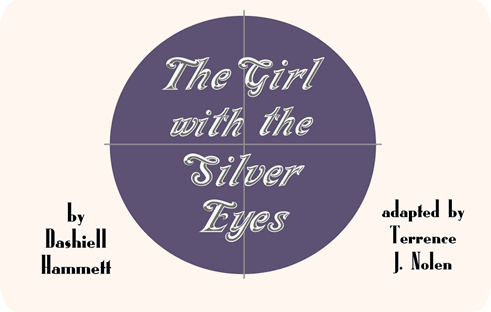
But Hammett may have been the first to incorporate wisecracks, and he was almost certainly the best.

The scene in "The Girl with the Silver Eyes" in which the  Continental Op tries to pry information about the vanished Jeanne Delano from her would-be lover Burke Pangburn ought to be read in its entirety, but this excerpt gives something of the flavor:
"`What color hair?' 
"`Brownso dark that it's almost blackand it's soft and thick and 
"`Yes, yes. Long or bobbed?'
"`Long and thick and'
"`What color eyes?'
"`You've seen shadows on polished silver when' 
"`I wrote down gray eyes ... '"
Hammett's wisecracks are entertaining for their own sake, wittier than most, and, unlike most wisecracks by the generations of hard-boiled writers who have followed, they are always thematically apt. They advance the story; they never seen designed to attract attention for their own sake. Hammett did it first, and Hammett did it best.

And now, readers, who are your favorite wisecracking hard-boiled writers? Why? What do wisecracks contribute to a story? What makes for a good wisecrack in the context of a story, as opposed to a mere funny line?

© Peter Rozovsky 2015

Labels: , ,

Tuesday, July 21, 2015

Dashiell Hammett, copy editor's friend

Dashiell Hammett is better known these days for his novels and the movies made from them than he is for his short stories. But he had established himself as one of the great crime writers ever at least six years before his first two novels appeared. While I delve once again into the Library of America's volume of Hammett's Crime Stories and Other Writings, here's an old post about just one more reason to admire Hammett.
==========

In recent posts, I've taken one book to task for misusing a word, another for its surfeit  of dialogue tags, and a third for using a word not coined until the 1960s though its story takes place in 1953.

More recently, I picked up a book that uses a word in a sense it did not acquire until years after the date when the book is set, and last night, a misused homophone/heterograph  momentarily marred my enjoyment of one of the most moving, exciting crime novels I have read in years.

Since you're likelier to hear tales of ludicrous copy editing changes than thanks for errors caught before publication, we proofreaders and copy editors must blow our own horns or rely on critics to say what we would say if we thought anyone would listen.

Discovering the Maltese Falcon and Sam Spade, another invaluable book about Dashiell Hammett from the good folks at Vince Emery Productions, offers some delightful examples from Hammett's days as a mystery-fiction reviewer for the Saturday Review of Literature and the New York Evening Post.

Here's Hammett on The Benson Murder Case by S.S. Van Dine:
"This Philo Vance is in the Sherlock Holmes tradition and his conversational manner is that of a high-school girl who has been studying the foreign words and phrases in the back of her dictionary. He is a bore when he discusses art and philosophy, but when he switches to criminal psychology he is delightful. There is a theory that any one who talks enough on any subject must, if only by chance, finally say something not altogether incorrect. Vance disproves this theory: he managed always, and usually ridiculously, to be wrong."
Can you imagine caring enough about what you read that you would write something like that?

Here's Hammett on Sydney Horler's 1926 novel False-Face. Besides lampooning Horler's ludicrous plot and his contempt for seemingly every nationality but his own, he makes fun of Horler's sloppy sentences:
"Scotland Yard promises to `safeguard the safety' (page 29, if you think I spoof) of an American inventive genius who has business with the British government."
Now, what is a reader to do, especially if that reader happens to be a copy editor in his professional life and, moreover, a copy editor who has heard authors complain that publishers expect authors to pay for editing that publishers would have paid for twenty years ago? Shrug off mistakes with the bland acceptance that nothing is perfect? Bang one's head against the wall and shout that the world is going to hell?

I don't know the proper course, but I sure wish reviewers and critics would follow Hammett and highlight defects in the form as well as the substance of books they write about, because there really is no difference between form and substance when it comes to writing.

© Peter Rozovsky 2011

Labels: , , , , , , , , ,