Wednesday, January 25, 2017

Stop the presses: Crime stories are no longer just whodunits, or crime novels that transcend transcending the genre

Professor David Schmid has posted a link to an interview whose headline announces that "there's nothing crime fiction can't do." The statement came from Ian Rankin, who proceeds to offer some interesting thoughts on his evolution as a crime novelist, notably his coming more and more to ponder what makes humans commit crimes:
“I think at first my books were whodunits, but as I got more confident about the form and about what the crime novel could do, I thought, ‘Well there’s nothing it can’t do.’ If you want to talk about politics, if you want to talk about society, if you want to talk about good and evil, if you want to talk about big moral issues, big moral questions: here’s the perfect form for doing that.” 
That's an unexceptionable thought, but why, fifty-two years after Maj Sjöwall and Per Wahlöö's Roseanna first appeared, after decades and decades and decades of Dominique Manotti and Jean-Claude Izzo and Andrea Camilleri and Manuel Vázquez Montalbán and Didier Daeninckx and Carlo Lucarelli and Adrian McKinty and Jean-Patrick Manchette and Leonardo Sciascia and Ross Thomas and Garbhan Downey and Stuart Neville and John McFetridge and Gary Phillips and Alan Glynn, do the article's author, Daneet Steffens, and publication, Lit Hub, think crime novels' ability to do more than tell a whodunit story is so newsworthy as to be the story's main subject and the subject of its headline? And that's not even to mention, say, Georges Simenon, who probed human psychology and the margins of society long before Daneet Stevens discovered that crime stories can be more than whodunits.

This is no knock on Rankin, who singles out some of the authors on my list as noteworthy practitioners of the crime story. The problem is that Steffens and Lit Hub are either ignorant of crime novels' evolution over the past fifty or or so years, or, worse, assume that their readers are so ignorant. At least Lit Hub did not tell us that Rankin's work transcends its genre.

Much more interesting are those crime novelists whose books work as character studies and dissections of society and all those things that intellectually respectable crime novels are supposed to do these days and at the same time are so confident of their writerly chops that their books work as locked-roomed mysteries or whodunits or some other traditional form at the same time. You might say that they transcend transcending the genre.  Adrian McKinty does this in In the Morning I'll Be Gone and Gun Street Girl, part of his Sean Duffy novels.

Or take the traditional English mystery, a genre so out my wheelhouse that I was surprised when I discovered that Martin Edwards, that award-winning practitioner of and expert on traditional mysteries, dealt with certain social problems much more subtly than, say, Stieg Larsson.
"I've just opened Martin Edwards' Waterloo Sunset," I wrote a few years ago, "and I've noticed reflections on urban growth and boosterism, not to mention a character who just might be disturbingly demented. I hadn't expected this from an author who has proclaimed his allegiance to traditional mysteries. Heck, the man even named his novel for a song by the Kinks. 
What are your favorite crime novels that are thoroughly contemporary in subject and tone yet brave enough to explore traditional crime fiction forms at the same time?

© Peter Rozovsky 2017

Labels: , , ,

Wednesday, April 13, 2016

Photos from the 2015 Edgar Awards banquet

James Ellroy
The Edgar Awards, given by the Mystery Writers of America, are coming up April 28, 2016, and this year two friends and associates of Detectives Beyond Borders' are up for awards: Adrian McKinty, up for Best Paperback Original Novel for Gun Street Girl, and Duane Swierczynski, nominated in the best novel category for Canary.

Ian Rankin, Stephen King,
Karin Slaughter, Stuart Neville
I'll be there taking pictures, schmoozing, and maybe asking a question or two of 2016 MWA Grand Master Walter Mosely.  In the meantime, some photos I took at the 2015 Edgars.

Stephen King, Hilary Davidson
© Peter Rozovsky 2016
Sara Paretsky
Stephen King, Karin Slaughter
James Ellroy
Sara Paretsky

Labels: , , , , , , , , , , , ,

Thursday, April 30, 2015

I shot Stephen King: Photos from the Edgar Awards dinner 2015

Stephen King (All photos by
your humble blogkeeper.
List of winners and
nominees
at the Mystery
Writers of America Web site.)

Charles Ardai
Sara Paretsky, Hilary Davidson
James Ellroy

Jon and Ruth Jordan
Ian Rankin, Stephen King, Karin
Slaughter, and Stuart Neville
Sara Paretsky and her shadow
© Peter Rozovsky 2015

Labels: , , , , , , , , , , , ,

Monday, October 28, 2013

Strange Loyalties: William McIlvanney in words and a picture

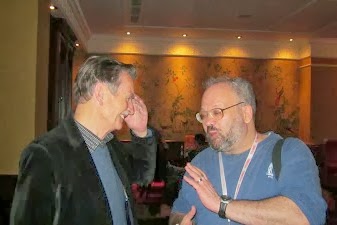
Your humble blog keeper (right) explains things
to William McIlvanney at Crimefest 2013
, Bristol.
Photo courtesy of Ali Karim
. Once again I'm rereading a novel by William McIlvanney, and once again I am struck immediately by how different he is from the legion of crime writers who acknowledge his influence.

This time the novel is Strange Loyalties (1991), third of McIlvanney's three Laidlaw novels and, like its predecessors, Laidlaw and The Papers of Tony Veitch, rereleased in trade paperback by Canongate.

A hard-drinking detective or police officer comes slowly to himself after a binge and boy, does his head hurt. You're read that scene a few hundred times, but probably not the way McIlvanney writes it. Here's the opening of Strange Loyalties:
"I woke up with a head like a rodeo. Isn't it painful having fun? Mind you, last night hadn't been about enjoyment, just whisky as anaesthetic. Now it was wearing off, the pain was worse. It always is."
First, McIlvanney comes with a funny, inventive, eye-catching way of saying, "I was drunk, and my head hurt." That's a good way to grab a reader's attention, a good thing to do in a novel's first sentence. Second, the humor is a welcome change from the pain and self-pity with which many another crime writer endows such first-person hangovers.

Third, McIllvanney immediately leavens the fun with somber self-realization that to me, at least, tugs at the heartstrings without getting maudlin.  If you've never read the Laidlaw novels, read that opening again. Don't you want to know the character who thinks those lines? Doesn't that mix make Laidlaw seem more real, more human?

So, who is like unto William McIlvanney? Allan Guthrie probably comes closest in his mix of humor and compassion, but even that top-flight crime writer doesn't do it with the concentration of his fellow Scotsman McIlvanney. Ken Bruen does something like it in Priest, though its characters lean more toward martyrdom and away from humor.

Ian Rankin calls it doubtful that he'd be a crime writer without McIlvanney's influence but, other than that McIlvanney's Laidlaw and Rankin's Rebus both work the streets of a tough Scottish city, I don't see striking similarities between the two. So I'll dump the question in your laps, dear readers: Which crime writers best combine humor and compassion? Which authors, if you want to put the question this way, will make you laugh and cry in the same book?

© Peter Rozovsky 2013

Labels: , , , , , , , ,

Tuesday, May 17, 2011

Detectives Beyond Borders on the radio — again

My 2009 appearance on Wisconsin Public Radio's Here on Earth program will be rebroadcast today at 4 p.m. Eastern Daylight Time. Dig that nifty opening theme, and find out what kind of voices the show's host, Jean Feraca, likes! In honor of WPR's rebroadcast, I'm bringing back a blog post I made after the show first aired.

Here's a summary of  what we talked about and what I would have liked to talk about had we had more time. (If you're just tuning in now, the Here on Earth link should still allow you listen to the archived program.)
=====================
I'm back from talking international crime fiction on the Here on Earth radio program, and how about a huzzah for Wisconsin Public Radio for hosting a show on that entertaining, enlightening topic? The broadcast is available for listening or downloading here or here.

I learned that radio is an astonishingly compressed medium. I was worried we'd run out of things to discuss, but we got to barely a tenth of the authors and subjects I'd prepared. So in the coming days, I'll post a series of outtakes, things I'd have discussed had there been time.

I did get to tout Ireland as a hotbed of crime fiction, to offer my definition of noir and to talk about Yasmina Khadra, Seicho Matsumoto, Henning Mankell, Patricia Highsmith, David Goodis, Ian Rankin, Matt Rees, Ken Bruen's Jack Taylor and Jo Nesbø's Harry Hole. My fellow guest and I both like Jean-Claude Izzo, so we talked about him awhile. (That fellow guest was Hirsh Sawhney, editor of Akashic Books' Delhi Noir, about which he made some interesting remarks.)

But, oh, the things I didn't get to: Corporate villains. Humorous Swedes. Canadian borders. Northern Ireland. Irish odysseys. Hard-boiled crime as America's gift to the world. Translation. Miscellaneous exotica. The world of publishing.

More to come. Oh, and the show's host, Jean Feraca, with whom I had never spoken before, said on air that I had a "nice voice." Bless you, Ms. Feraca.
==================
P.S.: Feraca gave me credit for a statement that I was only quoting. It was the Edgar Allan Poe scholar Shelley Costa Bloomfield who suggested that the French were ready and waiting for what Poe had to offer before Americans were: "Maybe it takes an older civilization to feel comfortable with the dark side and be able to enjoy it." I wish I'd said that, but Costa Bloomfield said it first.

P.P.S: Before anyone can point this out to me, I realize that I said, "If you will" once on the air. I shall suffer the consequences in the next life.

P.P.P.S. Finally, I think I got Seicho Matsumoto's death date wrong. That fine Japanese crime writer died in 1992. I think I killed him off twelve years prematurely.

© Peter Rozovsky 2009, 2011

Labels: , , , , , , , , , , , ,

Sunday, November 18, 2007

Ian Rankin and Shane Maloney on stage

I wasn't there, but Karen Chisholm of Aust Crime Fiction was. Read her entertaining and informative report here. One pleasant surprise for this casual Rankin reader is that the man apparently has quite a sense of humor. Anyone who can swap jokes with Shane Maloney must be quick-witted indeed.

© Peter Rozovsky 2007

Technorati tags:

Labels: ,

Wednesday, July 11, 2007

More on music

Sandra Ruttan posts a detailed, thought-provoking reply to yesterday's post about Ian Rankin, rock and roll and crime fiction. She jumps all over the Telegraph article that criticized Rankin's radio show about music and crime fiction, and she makes a persuasive case that the article's author did not do his or her homework.

Sandra is a bigger Rankin fan than I am. She also uses music in her own fiction, so her words carry extra weight. "To me, anyway," she writes, "music is natural atmosphere." She's right, of course. The question is whether fiction — an artificial creation, after all — has a natural atmosphere.

© Peter Rozovsky 2007

Technorati tags:

Labels: , , ,

Tuesday, July 10, 2007

Not-so-Sweet Jane

I've posted about mystery and music several times, occasionally chiding Ian Rankin for unimaginative use of the Rolling Stones as a character marker for John Rebus. But Rankin offered some amusing comments on rock music and crime fiction in the Guardian last month.

The article, Sgt Pepper must die!, asked musicians, producers and others to name "the supposedly great records they'd gladly never hear again." It says much about Rankin's popularity that he was the only non-music figure in the article. Here's part of what he had to say about The Velvet Underground and Nico:
"The back of the album says it was produced by Andy Warhol alongside the Velvets, so straight away I'm annoyed. ... And Nico's voice is flat throughout - she sings English the way I sing German. Talk about looks being everything: she was a supermodel trying to sing in a rock band, but she couldn't sing ... "

I also found a critical article in the Telegraph from 2006 about Rankin's radio series Music to Die For. In the series' three programs, Rankin talked about the role of music in his own writing and interviewed other crime writers who make music a part of their work. Here are some selections from the Telegraph piece:

'Extraordinary how potent cheap music is.' Sadly, this was not how Ian Rankin opened Music to Die For (Radio 4, yesterday), his series about the way crime writers are using music in their novels these days. He was rather more vainglorious.
and

... the harder questions, such as whether the use of music is not sometimes just lazy piggybacking, if not product placement, and whether or not resorting to it so readily further suggests that crime fiction as a genre is condemned never to be much more than mood music itself, were not raised.
© Peter Rozovsky 2007

Technorati tags:

Labels: , ,

Thursday, June 28, 2007

Ian Rankin finds an outlet for his writing

The Times' online edition publishes Rankin's foreword to The Rough Guide to Crime Fiction, in which he explores the appeal of crime writing. Among his thoughts:

I continue to find the crime novel the perfect vehicle for an unflinching discussion of contemporary issues. After all, the detective has an “all-areas pass” to every aspect of the contemporary urban scene, and this is a way for the crime writer to take the reader into forbidden territory.

That resonates here, where two recent posts discussed killings that may have changed the course of crime fiction in Ireland and Sweden.

Read the complete foreword/article, in which Rankin invokes Dostoevsky, Dickens and Ian Rankin, here. (Hat tip to The Rap Sheet.)

© Peter Rozovsky 2007

Labels:

Friday, February 23, 2007

Reviews in the news

Matilda links to this review of novels by Andrea Camilleri, Peter Corris and Ian Rankin. Among the comments that caught my eye:

"Corris employs great skill in choosing the physical settings for [Cliff] Hardy’s adventures, especially those around inner Sydney suburbs such as Glebe, where Hardy lives, and Newtown, where he has an office."

This tallies with Corris' oft-remarked pioneering use of Australian settings.

"World literature is much richer for the input of Italian Andrea Camilleri (translated by Stephen Sarterelli), Australian Peter Corris and Scot Ian Rankin. Indeed, their contributions are so diverse that confining them to a genre seems arbitrary."

"Rounding the Mark differs in tone from the earlier Montalbano novels, and it seems likely that Camilleri has modified the character so that he resembles more closely the television Montalbano played so superbly by Luca Zingaretti."

© Peter Rozovsky 2007

Technorati tags:


Labels: , , ,

Thursday, February 15, 2007

Mystery music

What kind of music does your favorite fictional detective listen to? What sounds course through the pages of your favorite crime fiction?

Sherlock Holmes liked to play the violin, even if Watson did not always enjoy listening. Thanks to technology and economics, today's protagonists are spared the effort of learning and practicing an instrument. They can listen to records, tapes and CDs, and I suppose younger fictional crime-solvers are hooking themselves up to their MP3 players even as we speak because their creator wants to set a mood or to reveal something about a character that only Tom Waits or Tupac or Nirvana can say.

Uriah at Crime Scraps notes that Ake Edwardson's Erik Winter likes jazz and asks: "will it be my kind of jazz, Armstrong, Basie, Hawkins, Spanier and Goodman or more modern stuff ?" I'm sure a toot of Ornette Coleman would not put Uriah off a novel he was otherwise enjoying, but his post did get me thinking about how an author uses music to build a fictional world.

Jean-Claude Izzo's Fabio Montale listens to music as hot, as rich, as spicy and as varied as his hometown of Marseilles. That works for me in part because I know some of the music Montale likes, I'm intrigued by the music I don't know, and in large part because his tastes are distinctive. And it's not just newer writers. Jonathan Latimer made sparing and effective use of radio music in his William Crane novels in the late 1930s.

Then there's Ian Rankin, whose detective, John Rebus, listens to the Rolling Stones, sometimes in books that share titles with Stones albums: Let it Bleed, Black and Blue, Beggars Banquet. I don't begrudge Rebus his love of the Stones, but their popularity is so widespread that a taste for their music is not unusual enough to serve as a distinctive character marker. Maybe that's supposed to be part of Rebus' everyman charm. It won't work for me until Rankin can tell me why Rebus' reaction to the Stones is different enough from yours or mine to hold my interest.

The same goes for Ken Bruen's protagonists. Rock and roll is so mainstream these days that it's tough for an author to use it as a mark of distinctiveness, despair or much of anything, really. It's as banal as using brand names to set the tone of a place and time.

N.B. I've had to amend my comment on Ken Bruen. He actually does some nice things with music in his books, and I've mentioned them in comments to this post. I'm still no big fan of the epigraphs from songs and crime novels that he uses as chapter headings. If I recall correctly, Bust, Bruen's hilarious collaboration with Jason Starr, even uses a quotation from another Starr novel as a chapter heading. That doesn't seem quite right, somehow. Of course, it doesn't have anything directly to do with music, either.

© Peter Rozovsky 2007

Technorati tags:


Labels: , , , ,

Saturday, November 25, 2006

Australian crime novelists and humor

I don't want to get weighty and sociological, but it certainly seems as if Australian crime writers are more willing than Americans or even the British to suffuse a crime novel with humor. I've just finished Shane Maloney's Something Fishy. Recently I read The Big Ask by the same author, and I'll soon begin X and Y, part of David Owen's Pufferfish series. I even noted that Garry Disher's Kickback, for all its debts to Richard Stark's Parker novels, has moments of humor that a Parker book would never have.

I can't think of any American counterparts off the top of my head, not the excellent and sometimes hysterical Janet Evanovich; her Stephanie Plum novels seem more like picaresque romance novels to me -- comedies that happen to have something to do with crime, as opposed to crime novels written with humor. And not Parnell Hall. I tried one of his novels, but the yuk-yuk, aren't-I-droll? first chapter left me cold.

Among British crime writers, Ian Rankin can write with wit and sly humor in a short story, but he turns grim and weighty when it comes to novels. Bill James can be howlingly funny, but his are not primarily humorous novels. The Long Firm? Well, maybe. And cozies and academic mysteries, with their built-in drolleries, don't count. I'm talking about a full-bore, hard-boiled, action-packed detective story that just happens to be funny from beginning to end.

I'm not the first to speculate about American unease over humorous crime writing. At least one critic wrote that the 1940s writer Norbert Davis was cursed with a sense of humor. That, the critic said, may have accounted for the relative scarcity of his publications in Black Mask, the premier pulp magazine of the time -- just six stories, if I recall correctly.

I'd be especially interested in having Australian readers weigh in on this. I'm not sure Australians are naturally funnier than anyone else. But they certainly seem more willing to stretch that humor out over a few hundred pages. Or maybe Australian readers are responsible for this state of affairs. God bless them for being more willing than readers elsewhere to accept humorous crime novels!

© Peter Rozovsky 2006

Technorati tags:


Labels: , , , , , ,

Thursday, October 26, 2006

A new kind of protagonist and a familiar kind of blurb

I posted a while back about amateur sleuths in unusual professions. I have just started Shane Maloney's The Big Ask; Maloney's Murray Whelan is the first political-operative crime-fiction protagonist I know of -- and he has a sense of humor.

Here's a detail I forgot to mention earlier. Stop me if you've heard this before, but a cover blurb compares Maloney's protagonist to Ian Rankin's:

"Whelan is like an Aussie Rebus."
Sunday Herald

© Peter Rozovsky 2006

Labels: , , ,

Sunday, October 15, 2006

Ian Rankin comparison, part CCCLXXIV

The lengths to which publishers and reviewers stretch to compare writers to Ian Rankin has been noted here occasionally. I thought I'd post examples of such comparisons when I find them, and I invite you to offer your own. Today's example is from a blogger's comment on Qiu Xiaolong's excellent Death of a Red Heroine:

I'd recommend the book to anyone who enjoys writers like Ian Rankin strong on personal back story, human relationships and evocative place settings.

Labels: , ,

Sunday, October 08, 2006

Crime writers are denied prizes . . .

. . . by literary snobs, according to Ian Rankin, last year in the Independent.

Labels:

Friday, September 22, 2006

Ranking on Rankin ...

... or, What the heck is "Celtic noir," anyhow?

I've read and heard some harsh opinions of Ian Rankin's writing recently, notably on The 10 Greatest Detective Novels, and, to tell the truth, I'm not the world's biggest fan of his novels. They can be plotty, joyless, willfully morose, and glutted with detail. Oddly enough, the first Rankin that I read, the short story "The Dean Curse," was precisely the opposite: pointed, witty and sharp. I mean, you can tell by the title that the man has a sense of humor. That tells me he's capable of wonderful things.

So, Rankin fans, what's the deal with him? Has he been writing so prolifically with so much success for so long that he sometimes feels an irrepressible urge to try something different? Is the wit of "The Dean Curse" an occasional break from the gloom and detail that he shovels on elsewhere? Or is the reverse the case? And what is Celtic noir, anyway? Does the term have any meaning beyond the blurbs? If I recall correctly, I've seen the term applied to Rankin, to Ken Bruen and maybe even to Bill James, and I don't see a heck of a lot in common among those writers.

Is there an anti-Rankin backlash? I mean, we couldn't possibly be jealous of the man because he's been an acclaimed novelist since he was in his mid-twenties and has already won an award for lifetime achievement and is still probably younger than a lot us are, could we?

© Peter Rozovsky 2006

Labels: , ,