Friday, April 29, 2016

What they said at the 2016 Edgar Awards, or Paretsky-Mosley for president

All photos by your humble blogkeeper, Peter Rozovsky
Star systems sometimes work. Two of the biggest stars at the Mystery Writers of America's 2016 Edgar Awards dinner also cut two of the evening's most impressive figures. Walter Mosley, honored as the organization's 2016 grand master, spoke with exemplary humility, passion, and great good humor, often about subjects this country finds it difficult to discuss.

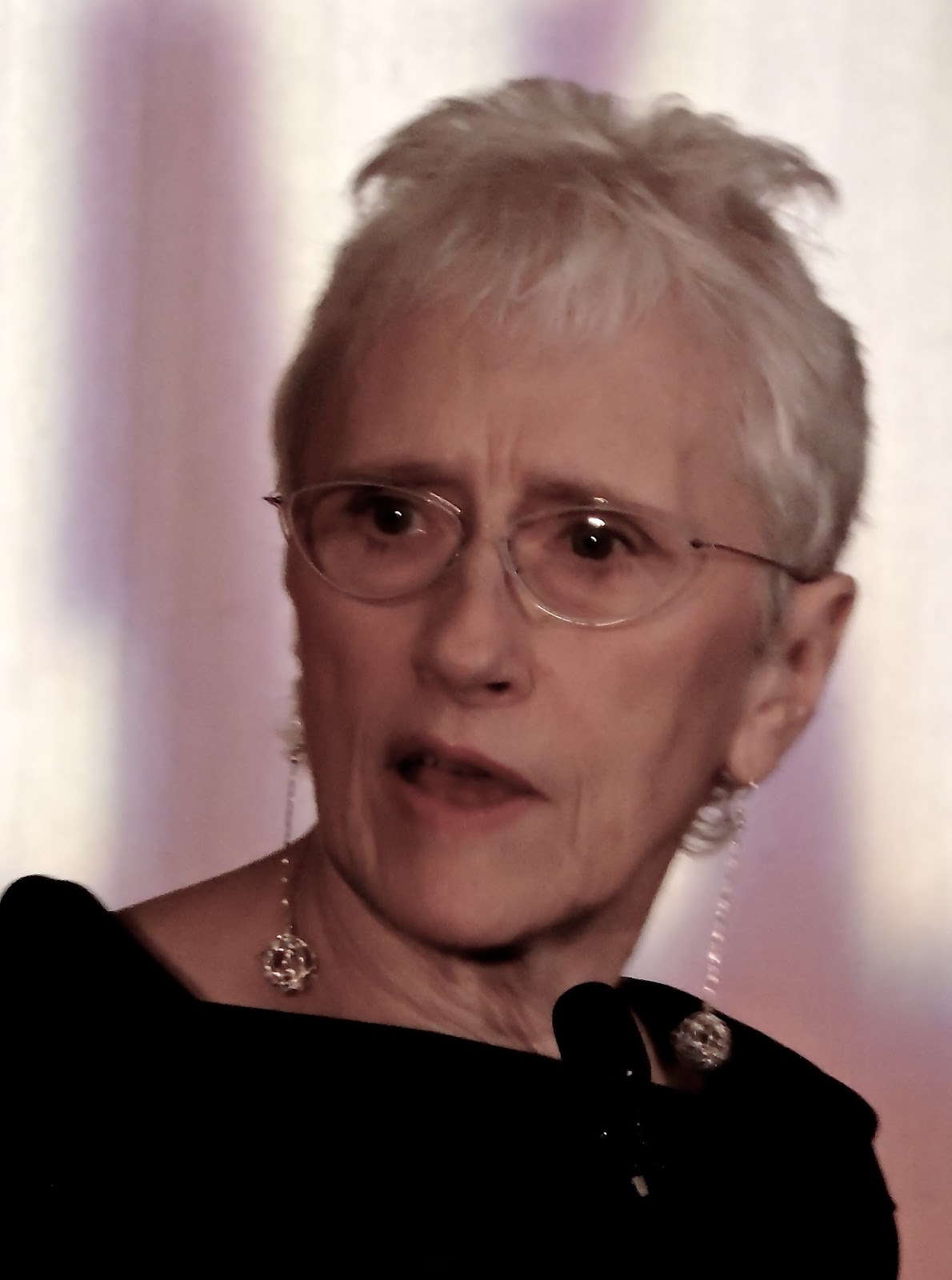
Sara Paretsky
And Sara Paretsky, named a grand master five years ago and the MWA's outgoing president, reported on her term in a way that suggested she could run any damned thing she wanted to.  I was even more impressed after a discussion with her at a post-awards party. Mosley and Paretsky would make a dynamic, popular, and, for all I know, capable presidential ticket. They could flip a coin to decide who would be president and who vice. W. Paul Coates, who introduced Mosley, would make a fine press secretary.

Martin Edwards
Other speakers were thought-provoking and inspirational in the best possible non-maudlin way. Margaret Kinsman, a scholar who received the MWA's Raven Award, said: "I would like you storytellers to know we in academics are some of your biggest fans."

Martin Edwards, whose book The Golden Age of Murder won the Best Critical/Biographical Edgar, said he had "tried to address the rather patronizing attitude ... to these thoughtful mysteries of the 1920s."

Janet Rudolph
It was good to see Janet Rudolph receive the Ellery Queen Award. I've written for her Mystery Readers Journal, and she's been a friend to Detectives Beyond Borders for going on 10 years and to the crime fiction community at large for two decades before that.  And it was pleasant to see that Reed Farrel Coleman took the loss of his status as crime fiction's best basketball player with something like good grace.

Kareem Abdul-Jabbar, Walter Mosley
(Find a complete list of the 2016 Edgar Award nominees and winners at the Edgars Web site.)

Duane Swierczynski
Megan Abbott
© Peter Rozovsky 2016

Labels: , , , , , , , , , , ,

Wednesday, April 13, 2016

Photos from the 2015 Edgar Awards banquet

James Ellroy
The Edgar Awards, given by the Mystery Writers of America, are coming up April 28, 2016, and this year two friends and associates of Detectives Beyond Borders' are up for awards: Adrian McKinty, up for Best Paperback Original Novel for Gun Street Girl, and Duane Swierczynski, nominated in the best novel category for Canary.

Ian Rankin, Stephen King,
Karin Slaughter, Stuart Neville
I'll be there taking pictures, schmoozing, and maybe asking a question or two of 2016 MWA Grand Master Walter Mosely.  In the meantime, some photos I took at the 2015 Edgars.

Stephen King, Hilary Davidson
© Peter Rozovsky 2016
Sara Paretsky
Stephen King, Karin Slaughter
James Ellroy
Sara Paretsky

Labels: , , , , , , , , , , , ,

Saturday, February 20, 2016

Black Hood and the real Philadelphia

I read Black Hood #5 this week (and bought issues 6 thorough 9), written by Philadelphia's own Duane Swierczynski and set in his home city, where I also live. I am happy to report that none of the first five issues mentions gentrification, home prices, real estate development, gastro-pubs, East Passyunk, craft beers, charter schools, Stephen Starr, the renaissance of Fishtown, boutique distilleries, entrepreneurship, restaurants with cute one-word names, start-ups, the University of Pennsylvania,  or Comcast.

It's a relief to escape from the ludicrous fantasy of civic greatness that constitutes public discussion in this city and find reality in a comic book.

© Peter Rozovsky 2016

Labels: , , , ,

Tuesday, May 05, 2015

Tumor: How a crime fiction cliché gets knocked on the head and doesn't recover

I bought the graphic novel Tumor on the strength of its introduction by Duane Swierczynski, who begins by noting the absurd prevalence in hard-boiled crime fiction of one-punch knockouts, speedy recoveries, and meticulous recollection by the victims:
"Even modern-crime writers can't resist a good cosh to the brainpan. Check out George Pelecanos' Nick Stefanos in Down By the River Where the Dead Man Go:

"`I felt a blunt shock to the back of my head and a short, sharp pain. The floor dropped out from beneath my feet, and I was falling, diving toward a pool of cool black water.'

"The problem, of course, is that such blows to the head are completely ridiculous. It's not easy to bounce back from a severe concussion, And even if you do, it's unlikely that you'll remember the blow in any kind of detail. ... Plus, it's kind of hard to knock someone out with a single blow."
The center of Tumor, by Joshua Hale Fialkov and artist Noel Tuazon, is a broken-down Los Angeles private investigator named Frank Armstrong who must solve one last case before the book's titular malady kills him. The client is a gangster and the case is to find his daughter, and if that all sounds conventionally Chandlerian, keep your eye on the tumor.

Armstrong blacks out, his sense of time is compressed, stretched, and fragmented in ways that seem far more convincing a rendering of brain injury or disease than one finds in most crime writing. And, through the book's first three chapters, at least, there is no hint of excessive cleverness, no evidence that Fialkov is doing anything so conventional as straining to defy convention. I'm not sure I could say the same for most comics since, say, 1987.

Tumor reminds me in this regard of a comment by Detectives Beyond Borders friend Linda L. Richards when I wrote about her novel Death Was the Other Woman in 2008. The novel's protagonist is a secretary/assistant to a PI, like Effie Perrine in The Maltese Falcon.  Here's the the pertinent part of Richards' reply to my review:
"For me, there was never a nudge, nudge, wink, wink. I wasn't trying to be clever or find a new place from where I could spin on an old tale. As I wrote the book, it seemed to me I was merely stating the obvious. The between-the-wars PIs were so damaged. And they were drunks. There was simply no logical way they could be ingesting all that good Prohibition booze in the quantities stated and still be getting through their cases as calmly as it appeared to happen."
© Peter Rozovsky 2015

Labels: , , , , , ,

Thursday, April 30, 2015

Detectives Beyond Borders puts the comics in the Philadelphia Inquirer

The Black Hood. (Courtesy of Dark Circle Comics)
My article on Duane Swierczynski's Black Hood comic appears in Thursday's Philadelphia Inquirer  (along with one of my photos). See what Duane has to say, along with comments from his editor, Alex Segura of Dark Circle comics; and props to artist Michael Gaydos and colorist Kelly Fitzpatrick.

Duane Swierczynski. Photo
by your humble blogkeeper.
"David Goodis was a huge inspiration," Swierczynski says. "His doomed characters roam the dark Philly streets after a major fall from grace. That's pretty much what happens to Greg Hettinger, the man under the hood."
Read the full article.

© Peter Rozovsky 2015

Labels: , , , , , , ,

Thursday, March 26, 2015

The Black Hood, or how comics tell stories

(Clockwise from upper
left: Black Hood #1,
Black Hood #1, Black
Hood #1, and Black
Hood #1)
I almost never buy individual issues of comics because I don't like working myself into a state of excitement over something that will take me five minutes to read, then having to wait a month before I can resume the story. That's why I prefer trade paperbacks that compile five or six or eight issues. (Most recently I bought and read the two books that collect the 11 final issues of Jason Aaron and R.M. Guera's awesomely good Scalped.)

Philadelphia's own Duane Swierczynski and his artist collaborator Michael Gaydos compensate for the small number of pages in a typical comic by packing a whole lot of beautifully spare storytelling into those pages. The climax of the opening scene in their new Black Hood series, for example, is one panel, one color, and 19 words: "And as the dark came down over my head, I couldn't help but wonder: Would anyone give a shit?"

That's a lot of storytelling, mood-setting, and existential-doubt establishing for one little panel about two inches high and three inches wide, and Gaydos and the colorist didn't have to vary their palette much; the panel's all black, except for the two little white rectangles where the character's thoughts appear.

As often with good comics, I like the way the two media — words and pictures — play off one another, sometimes together, sometimes one (usually the picture) offering ironic commentary on the other. The Black Hood is something like a masked-avenger tale, the story of a guy, here a wounded police officer, who dons a mask and assumes a new identity before going out into the world to attack criminals, but the first glimpse of the protagonist in his hood is anything but heroic.

And Swierczynski is a hell of a technician and craftsman if he can get the hero to refer to "the 15-year-old inside my head" without even coming close to breaking the dark mood.

© Peter Rozovsky 2015

Labels: , , , , , , , ,

Monday, December 22, 2014

Sights and sounds of crime fiction

Sarah Weinman. Photo by Peter Rozovsky
Erik Arneson has uploaded three podcasts (Parts 1, 2, and 3) of the Noir at the Bar readings for which I was MC at Noircon 2014. Readers include Duane Swierczynski, Sarah Weinman, Jonathan Woods, Jon McGoran, and Arneson himself, who weighs in with a killer cat story.

Erik Arneson. Photo
by Peter Rozovsky
I introduced the authors and shot pictures of them as they read.
*
Photo by Peter Rozovsky
Over at the Off the Cuff Web site, meanwhile, Dietrich Kalteis and Martin J. Frankson get crowded, bringing in authors Samantha J. Wright and Sam Wiebe for a discussion of short stories and debut novels.  Once again, Dietrich illustrates the post with one of my shadowy shots, this one a late-afternoon view outside an exhibition hall at Bouchercon 2014 in Long Beach.
© Peter Rozovsky 2014

Labels: , , , , , , , , , , , ,

Wednesday, December 03, 2014

Noir at the Bar: The History

Over at LitReactor, Keith Rawson presents an oral history of Noir at the Bar-- interviews with me and with some of the people who took the N@B idea and ran with it: Jed Ayres in St. Louis, Todd Robinson and Glenn Gray in New York, Eric Beetner in Los Angeles. Duane Swierczynski, the reader at the first Noir at the Bar ever, right here in Philadelphia, weighs in with a highly entertaining excerpt from the piece he read at the first L.A. N@B.

The photo above, from October 2008, which I sent Keith for inclusion with his article, captures a seminal moment in Noir at the Bar history.  Scott Phillips (lower left, miming the theft of a bicycle) had dropped in to the fourth Noir at the Bar to hear John McFetridge (top left) and Declan Burke (center) read. (That's me behind the perp.)  Scott liked the idea, took it back to St. Louis, where he organized a Noir at the Bar with Jedidiah Ayres, and the rest is history, Noir at the Bar spreading across North America like a slow-moving, persistent, incurable virus.

It's nice to see how much the event has meant to writers all over North America, and the Noirs at the Bar Keith writes about were just some of the early ones. Toronto. Vancouver. New Hope. Texas. New Jersey. Portland. Baltimore. You name it, Noir at the Bar has conquered it.  And, like the Constitution and the Declaration of Independence, it started here in Philadelphia.

© Peter Rozovsky 2014

Labels: , , , , , , ,

Wednesday, October 22, 2014

NoirCon 2014 is almost here // Noir at the Bar comes back home

I'll be part of another con before Bouchercon, the fourth incarnation of the event that introduced me to the joys of the con, Philadelphia's own Noircon.

This year's event happens Oct. 30-Nov. 2, and it has a more international flavor than the versions in 2008, 2010, and 2012, including several authors who will be part of my Bouchercon panels two weeks later in Long Beach. Stuart Neville will be here. So will Paul Charles, who will join Stuart, Adrian McKinty, and Gerard Brennan on my Bouchercon "Belfast Noir" panel.  Sarah Weinman and Charles Kelly will be here, sharpening their oratorical skills for their appearances on my "Beyond Hammett, Chandler, and Spillane: Lesser Known Writers of the Pulp and Paperback Eras" panel in Long Beach.

The gang from Soho Press is coming to Noircon to receive awards. The delegation will include author Fuminori Nakamura and Paul Oliver, whose current reissues of Ted "Get Carter" Lewis' novels are an event of high importance to noir readers. Trust me: You want to read these books.

I'll be doing my part by MC'ing a NoirCon edition of Noir at the Bar as N@theB returns to the city where I staged the very first ones in 2008.    The list of readers includes several of the original Noir at the Bar authors and moderators, so here's a special thank you to Duane Swierczynski, Jon McGoran (who set this event up), Dennis Tafoya, and Sarah Weinman. Welcome back.

NoirCon 2008 was my first convention, my first chance to meet authors and others in the profession. It's where I met Ken Bruen and Christa Faust and Scott Phillips and Sarah Weinman and Reed Farrel Coleman and Ed Pettit and Charles Ardai and Megan Abbott and more, and not just met them, but hung out with them and talked with them. The experience was so much fun that I signed up for that year's Bouchercon almost immediately, and the rest is history. 

NoirCon: Because Not Everything Great That Started in Philadelphia Was Run By Guys Who Have Their Faces on Money.

© Peter Rozovsky 2014

Labels: , , , , , , ,

Tuesday, November 20, 2012

Hammett and Hollywood

Reeder
Waded into a sea of wankers at Toronto's Eaton Centre this afternoon, including one who talked and looked like Oliver Reeder from The Thick of It. Of course, we were at an espresso bar called Aroma, so what does that make me?
***
My favorite part of Richard Layman's introduction to Return of the Thin Man is its reference to Hammett during his time in Hollywood as a "stylish moneymaker."

The volume's two stories, After the Thin Man and Another Thin Man, are not novels but rather Hammett's screen stories for what became the movies of the same names (for which Hammett did not write the screenplays). Indeed, the beginning of the former reads like directions from a screenplay:
"A train whistle sounds as the Chief arrives slowly in the Santa Fe Station in San Francisco. A stateroom in the train is stacked high with hatboxes, and suitcases, books, flowers, magazines, half-empty boxes of fruit. Although it is afternoon, the stateroom is not yet made up."
And that reminds me of Lawrence Block's comment during his interview with Duane Swierczynski at Noircon 2012 in Philadelphia about Hammett as a seminal figure in the influence of the movies on novel writing. Said Block:
"I think it started the most obviously with Dashiell Hammett. He wanted to write screenplays."
© Peter Rozovsky 2012

Labels: , , , , ,

Sunday, November 11, 2012

Lawrence Block's joyous Noircon elegy

I had about a month's worth of experiences yesterday alone at Noircon 2012, which has just ended, but I'll need some sleep, a good meal, and some fresh air before I can post comprehensively on this eccentric, variegated, highly enjoyable yet intellectually intense conference.

For now, a bit about the convention's highlight: Duane Swierczynski's keynote interview with Lawrence Block. Block was a fount of entertaining and instructive stories from a writing career that has spanned at least fifty-four years, and Swierczynski combined a fan boy’s enthusiasm, an archivist’s knowledge, and a Borscht Belt comic's flair for showing off.

I’ll likely have more to say about the interview in future posts, but what I found most moving was Block’s recognition that the end of his writing career may be near, that it will likely come on his own terms, and that he seems to look back with great satisfaction on his prolific and highly accomplished output. I’d call what he had to say a joyous elegy, if there’s such a thing.

He did say once, “I’m tired,” but mainly he said things like this, in reply to a question about whether he had more novels planned beyond the hundred or so he’s already written:
”Anything I’ve wanted to share with the world, I’ve long since committed, so, while I wouldn’t rule [it] out…
and
”If I’d had stellar success early on, I’m sure I would have written a lot less. I’m happy with the way things turned out”
So, I’m sure, are crime readers everywhere.
***
Cullen Gallagher offers a chronicle in words and pictures of Friday's Noircon panels.

© Peter Rozovsky 2012

Labels: , , ,

Sunday, May 08, 2011

Car chases and the ‘70s: What's your favorite?

(Starsky and Hutch's Gran Torino)
I’ve invoked the 1970s from time to time, usually in snide remarks about the decade’s crappy haircuts. But Saturday’s post and the discussion that follows (it’s still going on; weigh in!) remind me that the era was a high point for chase scenes, too.

One reader posted a clip of a car chase from Le Casse (1971) that included oil slicks, Greek dancers, applauding spectators, and Fiats and Opels shooting down staircases. It was well-crafted, it was a lot more exciting than the computer-generated stuff we get today, and it reminded me of the car chases of my youth. And that got me thinking that if the 1970s were not the high-water mark of car chases, they probably did mark car chases' leap into both the mainstream (The Streets of San Francisco) and the artistic zeitgeist (in the form of J.G. Ballard's Crash).

(Coincidentally, an excerpt from Duane Swierczynski’s forthcoming novel Fun and Games also recaptured some of that 1970s car-chase excitement. And that raises the question of which crime writer's name you'd least like to be asked to spell: Swierczynski’s or Didier Daeninckx's?)

So, a few questions: 
  • What are your favorite scenes involving cars driving fast or dangerously? Movie scenes are welcome, but I'll be especially curious to see if you come up with scenes from books.
  • When did cars first become places of danger and excitement in  fiction and in movies? (Here's a favorite example: Raymond Chandler's 1935 story "Nevada Gas.")
  • Why did car chases go mainstream in the 1970s?
  • What's the attraction of car chases?
  • Are all the good ones in American and French movies?
***
Here's another post I made about a movie with a car chase in it.

© Peter Rozovsky 2011

Labels: , , , , ,

Wednesday, May 04, 2011

Fatale by Manchette

I learned from the introductory material to Jean-Patrick Manchette's 1977 novel Fatale, newly published in English translation by NYRB Classics, that Manchette translated Donald Westlake, Margaret Millar, Ross Thomas, and Alan Moore's Watchmen into English.
I also learned that Jean Echenoz, who wrote an afterword to the novel, considers it perhaps the darkest of Manchette's works.  This surprised me, because I found comic touches of the kind I did not remember from Three to Kill and The Prone Gunman, the other two Manchette novels available in English. And those comic touches helped me understand why Duane Swierczynski likes Manchette so much. (Swierczynski is quoted on the back cover of Fatale, and he named a character — or part of one — after Manchette in his own novel The Blonde.)

The humor is always gleeful, even when politically pointed. (I continue to be surprised by humor, zest, and good old storytelling from European crime writers of the left. You'd think I'd by used to it by now, but what can I tell you? I've been in America too long.) To wit:
"She thumbed through the Paris papers but failed to find what she was looking for. She turned to the local publications. One of them championed a left-capitalist ideology; the other championed a left-capitalist ideology."
This brief roman noir tells the story of Aimée, a hitwoman who comes to a French town to sniff out the money and stir things up. Not especially cold or distant, she nonetheless finds just one kindred spirit, an old baron off his nut who scandalizes the town while nonetheless remaining part of it.

Manchette's protagonists don't end happily, and this one is no exception. But she does manage some acerbic humor along the way:
"I've been wasting time. I didn't know whom to kill. For a moment I thought of suggesting to Sinistrat's old lady that her wretch of a husband could be done in. Or proposing to Sinistrat and his little Julie that old Lenverguez be bumped off. But it was no good. These people are too dumb."
© Peter Rozovsky 2011

Labels: , ,

Tuesday, May 03, 2011

The end of Twitter as a source of news

Nothing in recent memory has made me feel better about newspapers than Twitter's reporting of Osama bin Laden's death.

Like much of the world, I learned of bin Laden's death on Twitter, and that initial excitement carried the thrill of a whispered rumor. But that's all it carried. It took me about thirty seconds to realize that nothing I wanted to know about his death — its consequences and ramifications, primarily, but also its circumstances and, secondarily, the reactions in the U.S. of people most affected by the 9/11 attacks — could or would ever be available on Twitter in a form useful to me.

For that I'll have to turn to newspapers, magazines (television, too, I suppose) and their online imitators. So, while social media may be a useful canary in a coal mine for news organizations and for the reading, listening and watching public, they're nothing more than starting points for news. If Twitter offers news, I want something else. I want the story.
***
I am reading or have just read two novels from the 1970s that turn at least in part on disillusionment with the degree to which life has become a big spectacle. One is J.G. Ballard's Crash, and the other is Fatale by Jean-Patrick Manchette, newly available in English translation  from New York Review of Books (and including a blurb from Philadelphia's own Duane Swierczynski).

I thought of both as I read an article in my newspaper about Twitter and bin Laden's death that quotes a social news editor of the Huffington Post thus:
“At one time, they all would have had to go the White House or ground zero or a baseball game. But now people could stay at their houses and be part of this outpouring of emotion and the conversation.”
Ballard would have shuddered — if he didn't laugh his ass off.
***
Just had a chat with two colleagues about the bogus Martin Luther King quotation. Back when Twitter was taken seriously, we would have had to exchange Tweets. But now we could gather together, for real, in person, and talk about how the entire world has been suckered by social media.

© Peter Rozovsky 2011

Labels: , , , , , , ,

Thursday, June 04, 2009

Graphic Manchette

With hat tips to Pulpetti and Duane Swierczynski comes news that Jean-Patrick Manchette's novel Le petit bleu de la Côte Ouest, previously available in English translation as Three to Kill, will appear in a graphic-novel version called West Coast Blues. This version, adapted and illustrated by the French cartoonist Jacques Tardi, is to appear this summer as the beginning a series devoted to Tardi and published by Fantagraphics.

Here's what I wrote about Three to Kill and Manchette's other novel available in English, The Prone Gunman:

"Manchette reinvigorated noir, inventing what French critics call the néo-polar, or neo-whodunnit, and if all that neo stuff makes you roll your eyes, stop and think for a minute: How many of the old-time hard-boiled writers make your blood run cold the way they presumably did for readers in the 1930s and 1940s? How mean, in other words, are Raymond Chandler's mean streets today?

"Certainly Manchette's time, an age that saw assassinations, cover-ups at the highest levels, and revelations of the violence that attended colonialism and its end, could no longer be shocked by small-town or even big-city corruption of the Hammett and Chandler kind. Manchette restored that ability to shock, with tales of what power can do to those it finds convenient to crush. And he did it while remaining true to the roots of pulp. Heck, the guy even loved American movies and played the saxophone. How much more genuine can you get?"
Click on the Jacques Tardi link above, and you'll see why I'm excited about this Fantagraphics release.

Here are some previous Detectives Beyond Borders posts that mentioned Manchette, who figures — or at least part of him does — in Swierczynski's novel The Blonde.

© Peter Rozovsky 2009

Labels: , , , , , , , ,

Wednesday, March 18, 2009

More Moore

I've been surprised from time to time by the popularity that crime fiction enjoys among graphic-novel readers. Based on nothing other than guesswork and prejudice, I once would have associated comics more with fantasy than with crime. But no longer.

First, cover copy on one of the Batman collections referred to the story's murder mystery. Then a staffer at my local comics shop, as slacker-like a slacker as any who ever called a customer "Dude," surprised me when he said he wished the Watchmen movie had played up the story's murder mystery more. And then there are writers like Duane Swierczynski, who write both novels and comics.

My latest eye-opener in this regard is Alan Moore's Top 10, which I discovered thanks to the comic-store dude cited above. The story has a typically fantastic Moore premise: A city called Neopolis is built after World War II to house a population that consists entirely of superheroes. Their population explodes. Unemployment and associated social problems proliferate. And a wild squad of cops with odd superpowers of their own is charged with keeping order in this messy world.

Moore, I have read, cited Hill Street Blues as an influence, which means that Ed McBain's 87th Precinct novels were an influence, too. The books have extensive fantasy and science fiction trappings, but at their heart they're ensemble police stories. That an imaginative writer such as Moore finds this time-honored form fertile ground speaks well for the vitality of crime fiction.

The books are vehicles for Moore's humor and social commentary, and the fantastic setting makes a wonderful background for the stories. That setting? Think of the bar scene in Star Wars, with all those weird creatures drinking and socializing. That's a nice set piece, right? Imagine all those creatures with lives and problems of their own, inhabiting a New York-like city, trying to survive, committing crimes or trying to solve them. That's Top 10.

I expect I'll have more to say once I've read all of the books. For now, though, I'll share a snippet of dialogue from The Forty-Niners, a Top 10 prequel:

"`Uh, say, buddy, excuse me? This'll sound kinda nuts, I know, but ... are you a vampire?'

"`I'm a Hungarian-American with an inherited medical condition.'"

© Peter Rozovsky 2009

Labels: , , , , , , ,

Saturday, January 10, 2009

What's your favorite caper? Any why?

Duane Swierczynski loves to pay tribute to his favorite crime writers and characters, everything from Jean-Patrick Manchette's head to Philip Marlowe's socks. But there's no one he loves better than Richard Stark's Parker, and no tribute more thrilling than the topographical accuracy of The Wheelman:

"Lennon took a hard right onto Twentieth Street, going north, then a quick left down a tiny side street that ran parallel to JFK.

"Now, here's where Philadelphia geography gets interesting. Even after ripping out the Chinese Wall, some bits of the old city remained. Tiny streets and alleys that used to run through the industrial blocks sat right next to the new thoroughfares. One of those alleys was the key to the getaway plan."
Man, I loved that. There's something seductive about planning a score on that big a scale, about making not just a bank vault, not just a building, but a whole city part of the plan. Stark did that in my favorite of the Parker novels, The Score, and what can give a crime-fiction reader a bigger vicarious rush?

Now, what about you? What's your favorite caper novel, movie or story? Why? And why do we love crime capers?
======================
The new University of Chicago Press edition of The Score comes with a foreword by John Banville (a.k.a. Benjamin Black), which ought to be interesting.

© Peter Rozovsky 2009

Labels: , ,

Saturday, November 15, 2008

Comics, comics, comics

I've spent two days surrounded by more comics than at any other time since I was 10 or 11 years old. And guess what? Some of this stuff is pretty good.
***
As I was saying before I was distracted by an evening of wholesome family fun, Duane Swierczynski and Michel Lacombe's The Punisher opens with a disquisition on spearing a human being:

"Harpooning a man isn't as easy as you think. ... You've got to catch bone. ... Otherwise the hook will just rip away. ... So you aim for the ribs. ... Avoiding the heart. ... Especially if you want your catch ... to make it back to shore."
Makes you want to keep reading, doesn't it? And that's what a good prologue ought to do. Oh, and the first three panels are wordless. Lacombe's art carries the action alone and does so as simply, dramatically and economically as one could imagine: nothing but a rope unfurling against an aquamarine sky.
===============
Jason Aaron's Scalped both updates and remains staunchly faithful to noir. Updates? The story takes place on an Indian reservation, a category of setting largely if not entirely unexplored in noir. Faithful? The protagonist is named Dashiell Bad Horse, and the tribute to Dashiell Hammett has not a trace of the cute or the nostalgic about it. This is dark stuff: violent, full of the hardest kinds of choices between bad and worse, and all richly abetted by R.M. Guera's dark art work, redolent of night, blood and arid plains.
===============
Part III of my Great Comics Adventure was a visit to Geppi's Entertainment Museum in Baltimore, a vast repository of American cultural artifacts from the dawning of the mass-media era. That era started earlier than one might think, but that's material for another post. For now, I noted with interest the occasionally dark shadows amid the garish colors and sharp, stiff lines on comic-book covers as early as the 1930s. Noir influence found its way into comic book early on.

© Peter Rozovsky 2008

Labels: , , , , , , , ,

Thursday, September 04, 2008

Good craic, No Alibis

How plugged-in are David Torrans and his Belfast house of books, No Alibis?

I learned from Torrans this afternoon that Philadelphia's own Duane Swierczynski, who had an actress friend read for him at Philadelphia's first Noir at the Bar reading in June, could probably be persuaded to do the job himself if offered enough beer.

"What kind of beer does he like?" I asked.

"Anything," Torrans said.

Now, I don't know Swierczynski's drinking habits, but I am impressed that Torrans was conversant enough with crime fiction and the people who write it that he could even feel comfortable discussing such matters. (Torrans had a copy of Swierczynski's novel The Wheelman on a shelf of signed books in case you wonder how the subject came up.)

So, how plugged-in is Torrans? "He knows guys that haven't even written yet," said a customer whom Torrans pointed in my direction.

That same customer, "A Tyrone man," gave a rousing big-up to Declan Burke's The Big O, a copy of which he was buying for a friend and whose dialogue he loved, especially that between its male and its female characters, with a special hosannah for co-protagonist Karen: "This is the way real men and women talk over breakfast," he said.

© Peter Rozovsky 2008

Labels: , , , , , , , ,

Thursday, June 05, 2008

The most influential crime writer? — Jean-Patrick Manchette plus a question for readers

A year ago, I asked readers to name their choices for the most influential crime writer ever. Here's another name for the list: Jean-Patrick Manchette.

Manchette reinvigorated noir, inventing what French critics call the néo-polar, or neo-whodunnit, and if all that neo stuff makes you roll your eyes, stop and think for a minute: How many of the old-time hard-boiled writers make your blood run cold the way they presumably did for readers in the 1930s and 1940s? How mean, in other words, are Raymond Chandler's mean streets today?

Certainly Manchette's time, an age that saw assassinations, cover-ups at the highest levels, and revelations of the violence that attended colonialism and its end, could no longer be shocked by small-town or even big-city corruption of the Hammett and Chandler kind. Manchette restored that ability to shock, with tales of what power can do to those it finds convenient to crush. And he did it while remaining true to the roots of pulp. Heck, the guy even loved American movies and played the saxophone. How much more genuine can you get?

I was reminded of Manchette twice recently. The first reminder came in Duane Swierczynski's novel The Blonde, which names a character, or rather a part of a character, after Manchette. I suspect Swierczynski would not call himself a political writer. Still, he was attracted by Manchette's non-stop, man-on-the-run plots, and something of their energy infuses Swierczynski's own work.

The second arrived this week in the form of a tribute on the encyclopedic Ile noire blog on the thirteenth anniversary of Manchette's death. The article, in French, discusses the rage Manchette felt at political repression in the time after the political and social upheavals of 1968. The author himself coined the term néo-polar, according to one critic quoted in the article, not because he wanted to introduce a new school of French crime writing, but to emphasize that he was parodying the traditions of the genre's classics. The Ile noire article links to a Manchette Web site, also in French, that is as comprehensive as any I have seen. For a beautifully written appreciation, try this piece by James Sallis. (It's in English.)

As for Manchette's influence, how about Carlo Lucarelli's De Luca novels? And here's an open-ended set of questions for you, readers: If you've read Manchette, what's your take on him? If not, let's revive the old question of who the most influential crime writer is, only with a twist: Who is the most influential crime writer since the end of World War II? And why?

© Peter Rozovsky 2008

Technorati tags:

Labels: , , , ,