Saturday, February 17, 2007

Seicho Matsumoto's trains of thought

Seicho Matsumoto (1909-1992) may be one of the more subtle political crime writers ever. His narrative technique is so absorbing that it took this essay to remind me of political dimensions to his work I had forgotten about. The piece also sheds lights on political dimensions that may be unfamiliar to readers who know Matsumoto only for his crime fiction.

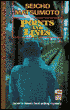
I knew Matsumoto from his novels Points and Lines and Inspector Imanishi Investigates, the stories collected in The Voice, and the movie Zero Focus, based on a Matsumoto novel. I learned from these that Matsumoto wrote somber, swiftly paced crime stories notable for sundered lovers, apparent suicides, and, most noticeably, an unusual emphasis on trains. Protagonists travel the country by train. Bodies are found under railway cars, solutions depend on railroad timetables, and clues turn up in dining cars.

I learned from the essay cited above that Matsumoto, "obsessed with conspiracies," was "a radical" and "a keen left-wing observer of his society who knew where the levers of power were located."

Trains, as it turns out, had something to do with all this: According to the essay's author, Wolcott Wheeler, Matsumoto published a nonfiction exposé of a string of violent events in post-World War II occupied Japan and traced these events to the occupation authorities. Wheeler says these events included, among others, "the mysterious and violent death of Japan Railways chief Sadamori Shimoyama in June 1949, run over by a train; the runaway train caused by sabotage in Mitaka in July 1949; and the notorious Matsukawa train wreck of August 1949, an act of sabotage that was blamed on the Japanese Communist Party (resulting in the banning of the party), for which the Communists were completely exonerated by the Tokyo Supreme Court in 1961."

Further, Wheeler writes that Japan "wholly depends on trains for public transportation; trains are to Japan what automobiles are to the United States. Just as cars represent personal freedom to Americans, railways represent to the Japanese a shared, communal existence based on mutual cooperation."

So, in the work of this excellent Japanese mystery writer, a train may be more than just a train.

© Peter Rozovsky 2007

Technorati tags:

Labels: , , ,

Sunday, April 29, 2012

東野 圭吾's tribute to 江戸川 乱歩 and 松本 清張

It may be coincidence, but a district and a park on the first page of Keigo Higashino's The Devotion of Suspect X bear the names of two pioneering Japanese crime writers.

The page takes a character on a walk to Seicho Garden Park that passes a road leading to Edogawa. Edogawa is one of Tokyo's twenty-three special wards. More to the point, Seicho Matsumoto (1909-1992) and Edogawa Rampo (1894-1965) were two of the most popular and influential crime writers in twentieth-century Japan. Edogawa Rampo (it's a pen name, and yes, it really is a Japanese rendering of Edgar Allan Poe) promoted Japanese crime fiction tirelessly and founded the group that later became Mystery Writers of Japan.  He admired Arthur Conan Doyle in addition to Poe, and his fiction, criticism, and organizing "played a major role in the development of Japanese mystery fiction," according to Wikipedia.

Seicho Matsumoto was a kind of Jean-Patrick Manchette, a writer of spare, bleak, socially acute narratives credited with breaking new ground in narrative technique:
"Dispensing with formulaic plot devices such as puzzles," Wikipedia says, "Seichō incorporated elements of human psychology and ordinary life. In particular, his works often reflect a wider social context and postwar nihilism that expanded the scope and further darkened the atmosphere of the genre. His exposé of corruption among police officials as well as criminals was a new addition to the field."
Seichō Matsumoto memorial museum,
Fukuoka Prefecture, Japan
The solitary walker of Higashino's opening chapter is a mathematics teacher who engages in amateur sleuthing that will remind readers of Edogawa Rampo's man Sherlock Holmes. And his profession just might mark another point of affinity with Matsumoto, who wrote a novel called in English Points and Lines. (How much more mathematical can one get?) Higashino's emphasis on geography may also bring Matsumoto to mind.

If all this is mere coincidence, the coincidence is suggestive. Let's assume it's deliberate and once again ask this diverting question: How have crime writers paid tribute in their stories to predecessors and colleagues?
***
The Devotion of Suspect X was shortlisted for best novel at this week's Edgar Awards from the Mystery Writers of America, one of four books by a non-American author on the five-book shortlist and one of two translated novels. The winner was Gone by Mo Hayder.

(Here's an old post about Seicho Matsumoto, my reading of whom predates this blog. Rereading the post reminds me of what a bracing writer Matsumoto was.)

© Peter Rozovsky 2012

Labels: , , , , , , , , ,

Thursday, June 02, 2016

A Quiet Place: More Matsumoto to be released in English this summer

Too many invocations of one crime writer to describe another are silly, but Seicho Matsumoto really is reminiscent of Georges Simenon. This is true especially in his portrayals of dogged, unexceptional characters, bewildered, sometimes to the point of pathos, as they navigate the consequences of crimes they understand only dimly.

Matsumoto died in 1992, and little of his large output has been translated into English, so any new publication is welcome. A Quiet Place, out this summer from Bitter Lemon Press, is a noirish tale full of sparing but sharp observations and pointed critiques of postwar Japanese society.

The novel is reminiscent in that respect of Matsumoto's Points and Lines, which I named as one of my favorite international crime novels in the first Detectives Beyond Borders post back in 2006.

© Peter Rozovsky 2016

Labels: , , ,

Wednesday, June 08, 2016

What Kirkus didn't tell you: Three more new crime novels you can read this summer

Kirkus Reviews recently published a list of twenty crime novels due for publication this summer and recommended for your consideration. It's not a bad list, but here are three novels that it missed:

1) Paradime, by Alan Glynn (Picador U.S. August/Faber U.K. May) Reviewers have invoked James Ellroy and John le Carré when discussing Alan Glynn, and if I squint and hold my head at the right angle, I can see resemblances. But Glynn's new novel is a lot more like David Mamet's 1997 movie The Spanish Prisoner than it is like anything by Ellroy and or le Carré. The novel's fever-dream narration is intoxicating, its first section in particular a kind of contemporary nightmare picaresque. (A worker for a private military contractor in Afghanistan witnesses a shocking incident, comes back to New York City, discovers that the incident won't leave him alone, and finds aspects of the result a strangely attractive escape — addictive, even.)

The novel shares some themes with Glynn's previous books, The Dark Fields (also published as Limitless), Winterland, Bloodland, and Graveland: alienation, paranoia, helplessness in the face of corporate and government power, and the uncertainty of boundaries between the two. But the action centers more on the protagonist than it does in the earlier novels, with distant but distinct echoes of mid-twentieth-century American noir. The book also seems carefully constructed, full of epiphanies that shed shocking new light on earlier scenes. And that may be one more mark of its kinship with The Spanish Prisoner.

2) One or the Other, by John McFetridge (ECW Press, August). I know of no crime writer who writes about suburbs and people who live there with the respect that McFetridge does, even though his books are set mostly in cities: Toronto and, in his three most recent novels, Montreal. But I also know of no crime writer who writes more vividly about cities, and who integrates character, crime, and history as seamlessly as McFetridge.

McFetridge's empathy with his protagonist, a young police constable named Eddie Dougherty, may remind readers of Ed McBain's 87th Precinct novels, but McBain never had anything like McFetridge's eye for the way big events and individual lives intersect, the lives always more important than the events. McFetridge's Dougherty books, of which One or the Other is the third, following Black Rock and A Little More Free, don't try to transcend any genre, but I can easily imagine that they would appeal to readers who love to empathize with characters and wonder about everyday lives lived in tumultuous times, whether or not the stories involve crime.

3) A Quiet Place, by Seicho Matsumoto (Bitter Lemon Press, August U.S./June UK) Too many invocations of one crime writer to describe another are silly, but Matsumoto really is reminiscent of Georges Simenon. This is true especially in his portrayals of dogged, unexceptional characters, bewildered, sometimes to the point of pathos, as they navigate the consequences of crimes they understand only dimly.

Matsumoto died in 1992, and little of his large output has been translated into English, so any new publication is welcome. A Quiet Place is a noirish tale full of sparing but sharp observations and pointed critiques of postwar Japanese society. The novel is reminiscent in that respect of Matsumoto's Points and Lines, which I named one of my favorite international crime novels in the first Detectives Beyond Borders post back in 2006.  The novel's close examination of a setting observed by the protagonist as he travels through it may remind readers of Akira Kurosawa's classic crime movie Stray Dog or of work by the contemporary Japanese crime writers Keigo Higashino and Fuminori Nakamura.

© Peter Rozovsky 2016

Labels: , , , , , , ,

Thursday, November 08, 2007

Calling all sociologists …

… especially if your area is East Asian studies. After a long, drama-packed, psychologically compelling buildup, a murder has finally been committed in Akimitsu Takagi’s The Informer. The first named police officer on the scene is a chief detective, followed only afterward by the homicide inspector who takes charge of the investigation.

Here is where the sociology comes in. The motif of a superior officer given unexpected priority repeats a pattern I’ve noticed in my admittedly limited experience of Japanese crime stories. In Akira Kurosawa’s movie Stray Dog, the senior officer, played by Takashi Shimura, guides the junior, played by Toshiro Mifune, investigating with him, interrogating with him, and keeping him in line. If my memory serves me well, a senior officer also plays an especially prominent role in at least one of Seicho Matsumoto’s novels as well.

These instances all seemed a contrast to what I'm accustomed to, in which a police novel has one lead investigator. In the case of The Informer, the contrast with American and British police procedurals seemed especially marked. In murder mysteries from the U.K. or America, if any police are named as appearing on the scene before the lead homicide investigator, they are likelier to be of lower rank, a patrolman or a constable, rather than higher.

Your job, readers, is to help me figure out if this means anything and, if so, what? Does it reflect differences between Japanese and Western police procedures? Differences in the way Japanese storytellers think about authority? Is it even typical of Japanese stories at all, or is it just a quirk of the few that I know?

© Peter Rozovsky 2007

Technorati tags:


Labels: , , , ,

Wednesday, June 27, 2007

What real-life events have inspired waves of crime fiction?

This blog is a "fine interweb yokeybus," or at least Crime Always Pays says so, for which, thanks. The real point of the yokeybus comment, though, was a reply to my post about the current wave of Swedish crime fiction and its roots in the 1986 assassination of Swedish Prime Minister Olof Palme.

The crux of C.A.P.'s comment is that a similar crisis may lie behind the current burst of Irish crime writing: the 1996 killing of the investigative reporter Veronica Guerin. That's a provocative thesis about a chilling case, and it leads me to throw the floor open to readers:

What real-life cases have sparked explosions of crime fiction, especially outside the traditional detective-story big three of the United States, Great Britain, and France? Back in February, I linked to a discussion of post-war violence and corruption in Japan that may have inspired Seicho Matsumoto. Can you think of any others?

© Peter Rozovsky 2007

Technorati tags:


Labels: , , , , , ,

Saturday, September 15, 2007

History, mystery, and crime in Japan

History and crime fiction have been topics of discussion here in recent days, and the trend continues thanks to an interview included with a review copy of Tokyo Year Zero.

Author David Peace talks about the novel and two further novels on which he is working, each of which was inspired by real crimes that happened during the American occupation of Japan after World War II. Peace says the second of those two books is based on the Shimoyama incident of 1949, in which the head of the Japanese National Railroad was found dead next to train tracks in Tokyo.

And that's where I felt I'd gained a bit of insight into modern Japanese history. Seicho Matsumoto, the celebrated Japanese crime novelist, wrote non-fiction works about the Shimoyama case, and his novels are marked by train trips and by bodies found under trains.

Peace also talks about the title Tokyo Year Zero and the dual sense it conveys of utter devastation but also of a new beginning. This and the criminal subject matter conjure inevitable memories of Akira Kurosawa's great crime movie Stray Dog.

© Peter Rozovsky 2007

Technorati tags:


Labels: , , , , ,

Tuesday, May 17, 2011

Detectives Beyond Borders on the radio — again

My 2009 appearance on Wisconsin Public Radio's Here on Earth program will be rebroadcast today at 4 p.m. Eastern Daylight Time. Dig that nifty opening theme, and find out what kind of voices the show's host, Jean Feraca, likes! In honor of WPR's rebroadcast, I'm bringing back a blog post I made after the show first aired.

Here's a summary of  what we talked about and what I would have liked to talk about had we had more time. (If you're just tuning in now, the Here on Earth link should still allow you listen to the archived program.)
=====================
I'm back from talking international crime fiction on the Here on Earth radio program, and how about a huzzah for Wisconsin Public Radio for hosting a show on that entertaining, enlightening topic? The broadcast is available for listening or downloading here or here.

I learned that radio is an astonishingly compressed medium. I was worried we'd run out of things to discuss, but we got to barely a tenth of the authors and subjects I'd prepared. So in the coming days, I'll post a series of outtakes, things I'd have discussed had there been time.

I did get to tout Ireland as a hotbed of crime fiction, to offer my definition of noir and to talk about Yasmina Khadra, Seicho Matsumoto, Henning Mankell, Patricia Highsmith, David Goodis, Ian Rankin, Matt Rees, Ken Bruen's Jack Taylor and Jo Nesbø's Harry Hole. My fellow guest and I both like Jean-Claude Izzo, so we talked about him awhile. (That fellow guest was Hirsh Sawhney, editor of Akashic Books' Delhi Noir, about which he made some interesting remarks.)

But, oh, the things I didn't get to: Corporate villains. Humorous Swedes. Canadian borders. Northern Ireland. Irish odysseys. Hard-boiled crime as America's gift to the world. Translation. Miscellaneous exotica. The world of publishing.

More to come. Oh, and the show's host, Jean Feraca, with whom I had never spoken before, said on air that I had a "nice voice." Bless you, Ms. Feraca.
==================
P.S.: Feraca gave me credit for a statement that I was only quoting. It was the Edgar Allan Poe scholar Shelley Costa Bloomfield who suggested that the French were ready and waiting for what Poe had to offer before Americans were: "Maybe it takes an older civilization to feel comfortable with the dark side and be able to enjoy it." I wish I'd said that, but Costa Bloomfield said it first.

P.P.S: Before anyone can point this out to me, I realize that I said, "If you will" once on the air. I shall suffer the consequences in the next life.

P.P.P.S. Finally, I think I got Seicho Matsumoto's death date wrong. That fine Japanese crime writer died in 1992. I think I killed him off twelve years prematurely.

© Peter Rozovsky 2009, 2011

Labels: , , , , , , , , , , , ,

Saturday, December 08, 2007

Some sensible words about crime fiction and a question for readers

I generally squirm at discussions of genre vs. “serious” fiction, especially when it comes to my genre, crime. Anti-genreists are snobs, pro-genreists exaggerate their claims. More to the point of these debates, what’s their point? I can enjoy Fred Vargas or Ken Bruen or Ruth Rendell without agonizing over whether they are as worthy as James Joyce or Tolstoy or Ralph Waldo Emerson.

James Fallows’ recent posting on The Atlantic’s Web site, though, held my interest, and not just because he singled out some crime novelists whose work I especially enjoy. No, what makes Fallows’ essay stand out is that he bases his assessment on the actual experience of reading the books:

“I've figured out a way to tell the books I can feel good about reading from the ones I should wean myself from. The test is: can I remember something from the book a month later – or, better, six months or a year on. This is the test I apply to `real' fiction too: surprisingly often, a great book is great because it presents a character, a mood, a facet of society, a predicament that you hadn't thought of before reading the book but that stays with you afterwards. Rabbit Angstrom, Captain Ahab, and Clyde Griffiths (of An American Tragedy), to choose the first three examples that pop into my mind from American fiction.

“I say that `genre' fiction, like spy and crime novels, ascends into the `real' fiction category when the world it presents can exert the same tenacious hold on your mind.”

Among the crime novels that Fallows says meet that standard are Janwillem van de Wetering’s early “Amsterdam Cops” books (though he cites an odd reason for liking them, and he misspells van de Wetering’s name), and Inspector Imanishi Investigates by Seicho Matsumoto.

I agree with those choices, and I would add a few that present “a character, a mood, a facet of society, a predicament that you hadn't thought of before reading the book but that stays with you afterwards”: Yasmina Khadra’s novels about life in war-torn 1990s Algeria, the delicious social comedy of Bill James’ middle-period Harpur & Iles novels, and perhaps the yearning hope and despair of Jean-Claude Izzo’s Marseilles trilogy.

OK, readers, what crime writing does the same thing for you? From which books can you “remember something from the book a month later – or, better, six months or a year on”? (Hat tip to Sarah Weinman.)

© Peter Rozovsky 2007

Friday, August 07, 2009

Here's a better idea

Instead of discussing what I didn't have time for on the radio Wednesday, here are the notes I carried with me into the studio. I guess this would have been a bit much to get to in one hour.

Listen here to hear what we did get to.
==============================

Latest Here on Earth notes
Date: Wednesday, August 05, 2009 12:06 AM

Seicho Matsumoto: Inspector Imanishi Investigates, Points and Lines. Trains and their role in Japanese society.

Jakob Arjouni: Plight of Turkish gastarbeiter in Germany.

Matt Beynon Rees: The Arabic review that explained an investigator's job is to find out the truth.

Post-Troubles and Troubles off-shoots in Northern Ireland: How does one cope? a) Garbhan Downey b) Adrian McKinty, who penetrates into the heart of America. c) Brian McGilloway, who sets novels on the border, Borderlands. d) Stuart Neville, Ghosts of Belfast.

Arnaldur Indriðason: Takes superb advantage of setting in Jar City, The Draining Lake. "One problem for Icelandic crime writers is that we have almost no crime."

Manuel Vazquez Montalban: Has a private cook, Biscuter. Was jailed under Franco. The Buenos Aires Quintet. (Political. Mediterranean. Food.)

Andrea Camilleri: Salvo Montalbano (named for Montalban) loves food, prickly but increasingly tender as the series goes on. Excursion to Tindari, Smell of the Night, Patience of the Spider. (cf. Simenon) (Political. Mediterranean. Food.)

Jean-Claude Izzo: Loves food, music, poetry, Marseilles. Predicted the riots in the banlieues. The Marseilles Trilogy (Political. Mediterranean. Food.)

Humor and Scandinavians: Jo Nesbø (The Redbreast, Devil's Star, Nemesis); Håkan Nesser (The Return); Karin Fossum (He Who Fears the Wolf)

Qiu Xiaolong: Death of a Red Heroine. Slow buildup through pollution of Shanghai. Anti-climax of the perps' hasty execution.

Canadian setting and the border: John McFetridge (Everybody Knows This Is Nowhere, Dirty Sweet); Howard Shrier (Buffalo Jump, High Chicago); Boldness of a Canadian setting: Sandra Ruttan: What Burns Within. Arson. Ensemble cast.

Fred Vargas: Slow buildup. Wash This Blood Clean From My Hand.

Pierre Magnan: Rural life, slow pace, neuroses, acceptance. Death in the Truffle Wood.

Irish writers and Americans: Ken Bruen ("All my influences are American. That's how to I learned to read. That's how I learned to write.") Declan Burke loves Chandler. Brian McGilloway on the American West. Declan Hughes loves Margaret Millar, Ross MacDonald.

Yasmina Khadra: (Army officer, self-imposed exile, wrote in French because his teacher encouraged him)

Bill James, Peter Temple: Best prose stylists.

Clive James:

" . . . there are only so many storylines and patterns of conflict. The only workable solution has been to shift the reader's involvement from the center to the periphery: to the location. In most of the crime novels coming out now, it's a matter not of what happens but of where. Essentially, they are guidebooks."

Misc. exotic settings: Eliot Pattison (Tibet). Double outsider: Exiled Han Chinese prisoner in Tibet. Michael Walters (Mongolia)

Translation: Stephen Sartarelli on the richness of Camilleri's language. Sian Reynolds on translating wordplay. Mike Mitchell on Glauser's dialects. Don Barlett on Vibes gate. Janwillem van de Wetering: Translating canals' names to show their silliness.

Crime fiction crossed borders from the beginning:

"One should remember also that crime fiction was international from its beginnings. Poe's C. Auguste Dupin was a French crime solver created by an American. This is no mere accident of history. There is reason to believe, as one Poe scholar says, that an older society such as France was more prepared than the young United States to accept a writer who probed the dark side the way Poe did."

Chinese crime plays that became novels in the 18th century. Robert Van Gulik.

Crime fiction as a key to history: Carlo Lucarelli's De Luca novels

Crime fiction as a key to politics: Jean-Patrick Manchette's political noir (The Prone Gunman, Three to Kill.); Helene Tursten, Kjell Eriksson

Exotic locations (with respect!): Colin Cotterill and Dr. Siri.

Timothy Hallinan: Struggles as an outsider.

Brazil: Luiz Alfredo Garcia-Roza, Leighton Gage

Publishers: Bitter Lemon, Serpent's Tail, Quercus, Harvill Secker. Vertical (Japan, Korea)

Dominique Manotti: Corporate villains.

Stieg Larsson + Michael Jackson: Together in Borders window
#
© Peter Rozovsky 2009

Labels: , ,

Tuesday, June 15, 2010

The Group of Death

Jeff VanderMeer has organized a World Cup of Fiction, which groups the thirty-two nations of this year's soccer World Cup and asks readers to handicap the field in fiction instead of football. I'm refining his terms and restricting myself to crime writing.

Group A is the tournament’s Group of Death (and where is that term more meaningful than in a crime-fiction competition?)

For South Africa, Roger Smith, Deon Meyer, Margie Orford, Richard Kunzmann, James McClure (no one said the players had to be alive), Michael Stanley and Jassy Mackenzie head a lethal group of strikers that could be deep for years.

The French have Dominique Manotti, Fred Vargas and Tonino Benacquista in a midfield that plays a less attacking style than the vuvuzela-tooters but is capable of deadly surgical strikes.

France could wangle for Yasmina Khadra on its side, too, though he could make a dangerous striker for Algeria in Group C.

In Group D, Peter Temple, Shane Maloney, Leigh Redhead, David Owen, Chris Nyst, and Adrian Hyland are just a few of the names on an Australian side that is a strong dark-horse contender, just as the Socceroos were in the real World Cup – at least until the competition started. (Temple, by the way, was born in – you guessed it – South Africa.)

Italy has Group F wrapped up, and I'll tab New Zealand to sneak into the knockout stage.

The Netherlands and Japan should fight it out in Group E of the Crime Fiction World Cup, hampered only by the fact that their stars, Janwillem van de Wetering and Seicho Matsumoto, are both dead.

England and the United States could make some noise in Group C.

Who do you think wins the 2010 World Cup of Crime Fiction?

© Peter Rozovsky 2010

Labels: , , , , , , , , , , , , ,

Sunday, April 01, 2007

The mystery of the missing mountain

I posted a comment about Seicho Mastumoto in February, sparked in part by my viewing of the movie Zero Focus (Zero no shoten), based on one of his novels. Now comes the surprising news that the cliff that was a dramatic focus of the highly dramatic movie is no more. Sic transit gloria monti.

© Peter Rozovsky 2007

Technorati tags:

Labels: , ,

Wednesday, November 14, 2007

Japanese “New Traditionalism,” plus the traditional question for readers

I’ve just read another intriguing story in the Passport to Crime collection, assembled by Ellery Queen Mystery Magazine from the magazine’s feature of the same name. The story, “An Urban Legend Puzzle” by Norizuki Rintaro, much-honored in Japan, is billed as an homage to Ellery Queen and an example of a “New Traditionalist” movement in Japanese crime writing “in which puzzle construction is key.”

It’s a beautifully paced story, the father-and-son, police inspector-and-mystery writer team playing off one another, their successive accounts and theories of a murder at a student party building toward the theory that proves correct. That's apparently the way it was done in the Ellery Queen stories, which I may just have to investigate now that I've read one of their descendants. More broadly, the crime tale whose action consists in characters telling a story goes back before Ellery Queen to Poe’s C. Auguste Dupin. This site proposes yet another plausible influence on “An Urban Legend Puzzle”: Seicho Matsumoto.

I found the blend of venerable technique and thoroughly modern characters (cell phones, drugs, stress) bracing, and if that’s what “New Traditionalism” means, I want to read more of it. And here’s your question, readers: What crime stories can you think of, thoroughly modern stories, not deliberate nostalgia pieces, that nonetheless hark back in some way to older crime fiction?
====================

Competition update: A reader from the Isle of Wight is the first winner of Jo Nesbø's The Redbreast. You can win a copy, too, simply by telling me which Norwegian politician's name became a synonym for traitor thanks to his collaboration in the Nazi occupation of Norway. Read more about The Redbreast — and find a clue to the competition question — here. (Geographical restrictions apply. Winners must have postal addresses in the UK, Europe, the Commonwealth or Canada.)

Send your answers to detectivesbeyondborders("@" symbol)earthlink.net.

© Peter Rozovsky 2007

Technorati tags:


Labels: , , ,

Friday, August 17, 2007

A top-ten list of crime fiction from Asia

I meant to post this one a week ago. Catherine Sampson, who knows something about the subject, writes in the Guardian about her ten favorite crime novels set in Asia. Tops on her list: Death of a Red Heroine by Qiu Xiaolong. She also includes the worthy Inspector Imanishi Investigates by Seicho Matsumoto, whom I've mentioned several times here and whose novel Points and Lines I discussed, with Death of a Red Heroine, in the very first Detectives Beyond Borders post.

© Peter Rozovsky 2007

Labels: , , , ,

Thursday, September 21, 2006

Detectives Beyond Borders

Welcome to my new forum devoted to international crime fiction – "international" in my case meaning outside the United States. The Web is all about openness and freedom of information, so I have no compunction about taking David J. Montgomery's 10 Greatest Detective Novels idea, ringing some changes on it, and coming up with a debate/discussion of my own. He focuses on American writers; I'll take the rest of the world and ask these questions:

What are your favorite crime novels and stories set in countries other than your own?

– Why do you like these stories?

– Is living in a country a prerequisite for writing a successful crime story set in that country?

– What makes crime stories especially attractive to the armchair traveler?

– Do people even read in armchairs anymore?

Setting has been integral to some of the finest crime fiction through all periods. Think the misty docks and streets of Conan Doyle's London. Think Hammett's San Francisco, Chandler's Los Angeles, Lawrence Block's New York. Or think Georges Simenon's Paris, its suburbs, and the villages where Maigret loves to relax, drink white wine, and play cards. Given the importance of setting, it seems natural that crime stories should prove especially attractive to those of us who like to travel in our minds as well as in trains, planes, cars, buses and boats. Indeed, this is a good time for such readers, with Soho Crime, Bitter Lemon Press and Serpent's Tail, among others, offering much of interest.

I'll begin with some of my favorites, along with a few books I don't much like. Feel free to disagree with me, especially on the latter. Nothing would please me more than to be talked into recognizing virtues I had not seen before in an author – or to be forced to better understand and justify my dislike.

In no particular order, here is some of my favorite non-American crime fiction:

1) Lovely Mover, by Bill James, though several of the other novels from the middle of James' Harpur & Iles series are about as good. The series hits its stride around its seventh book and becomes a kind of grand and cracked portrait of Britain's shifting urban and social landscape, of the murky boundaries between police and criminals, of suburban social climbers who happen to be killers and drug dealers, of the strange ways people build families in changing times. The books are violent, dark, and often very funny. And James just happens to be the best prose stylist who has ever written crime fiction in English.

2) Death of a Red Heroine, by Qiu Xiaolong. A clear-eyed view of 1990s Shanghai that meets every traditional requirement for a full-blooded crime novel. The setting is evocative, the protagonist is unusual (though not the strongest feature of the book), the supporting characters are compelling, and the story has a surprise ending that could only have happened in China.

3) Cosi Fan Tutti, by Michael Dibdin, is an exception to my general distaste for novels set in "foreign" countries by writers not from those countries. Such books often degenerate into travelogues. This novel is formally daring, and talk about surprise endings! Dibdin, an Englishman, spent several years teaching in Italy, according to various accounts, and his charmingly named protagonist, Aurelio Zen, offers a kind of Baedeker's guide to official Italian corruption and internecine rivalry, each novel set in a different region: Naples here, the Vatican, Venice, the south in other books. And Rome. Always Rome. "Zen" is a name characteristic of the protagonist's native Venice, but it also has overtones of the detachment with which this Zen moves through the sometimes deadly worlds of Italian officialdom and gangsterdom. Of course, the character's other name, Aurelio, is another clue that he is wise and given to occasional musing, if not outright meditation.

4) "Brown Eyes and Green Hair," a short story by Pentti Kirstila available in "The Oxford Book of Detective Stories (An International Selection)." This delightful, deadpan, at times almost surreal story by the Finnish Kirstila is an exception to the rule that writers from Scandinavia, the Baltic countries and Iceland are morose -- and is the only Kirstila to have been translated into English. Let's raise a fuss and get more of his work translated and published. (Some of his writing is available in German and in some less widespread European languages.)

5) Points and Lines, by Seicho Matsumoto. This Japanese police procedural is a kind of road movie on the rails, a look at people and places in 1960s Japan through the eyes of a police inspector who travels the length and breadth of the country by train as he tracks down clues to a young couple’s death.

6) No Happy Ending, by Paco Ignacio Taibo II. The protagonist shares a cramped Mexico City office with a plumber, an upholsterer and a sewer engineer. The book begins with a Roman soldier found dead in a bathroom. What more could you ask for? Like Dibdin's Aurelio Zen, Taibo's one-eyed hero, Hector Belascoaran Shayne, bumps up against official corruption and violence. Unlike Zen, Shayne attacks it headfirst. He also has a profound sympathy with victims of police and other official and corporate brutality.

7) The Prone Gunman, by Jean-Patrick Manchette. Another author with a distinct political viewpoint. His short, grim novels have a certain formal similarity to Jim Thompson's. But Manchette's protagonists are not fortunate enough to die. Rather, they are brought low, chewed up, and spit out, destroyed or disoriented but still alive, by powerful forces who use them to achieve their own ends before discarding them.

8) Thumbprint and Fever, by Friedrich Glauser. This 1930s Swiss writer, translated and brought back into print by Bitter Lemon Press, offers that rarest of detective protagonists: a man who has hit rock bottom professionally without lapsing into alcohol and self-pity. Sgt. Studer works in small corners of a big world: Villages, prison cells, cramped apartments. An insane asylum. An isolated Moroccan Foreign Legion post. He is mordant and humane in a world of which his creator takes a deadpan view. Some say Glauser influenced his countryman Friedrich Dürrenmatt. Maybe, but Glauser was better.

9) The Amsterdam Cops series, by Janwillem van de Wetering. This Dutch author has been a businessman, a world traveler, a reserve Amsterdam police officer, and a student at a Zen monastery in Kyoto. All, especially the last three, figure prominently in this series, which includes 14 novels and two overlapping short-story collections. Detective twosomes are a nickel a dozen; Van de Wetering offers the only three-headed protagonist I can think of: the grumpy Adjutant Henk Grijpstra, the younger and sometimes vain Sgt. Rinus de Gier, and their unnamed commissaris, or chief, an elderly mentor with sometimes excruciating knee pains who is a sly collaborator and a kind of guru to Grijpstra and de Gier. Start with Hard Rain, in part for the larger role it gives the commissaris. Van de Wetering has an interesting approach to translation: He does his own, and he regards the results as versions, rather than translations, of the original. The one book in the series that I read in Dutch has slightly different chapter divisions from the English version and an opening chapter with more physical description. And the first in the series, An Outsider in Amsterdam, reflects the Dutch language's more frequent use of the present perfect where English would use the simple past. This results in occasional odd sentences such as "I wonder if he has done it."

10/11) Tales From Two Pockets by Karel Capek and The Mournful Demeanour of Lieutenant Boruvka by Josef Skvorecky. These books of tales are full of sharp observation, wry and wistful humor, and detection of the classic and other kinds. Both just might lay to rest the notion that "literary" crime fiction equals bad crime fiction.

=======

OK, what do these stories have in common, other than that none is set in the United States or in an English village and each offers a vivid sense of place? Damned if I know. Maybe I'll know better once I hear from you.

What about books that didn't make my list? Ruth Rendell's superb The Veiled One seems far more interested in its killer's psyche than in the story's setting. The great Ken Bruen's Brant and Roberts novels are like Ed McBain 87th Precinct gang whacked out on beer and cocaine. Their violent, good-hearted, hilarious characters clang and crash together in stories that are all action, all character, without much focus on the setting. By all means, read them. (Bust, on the other hand, Bruen's excellent collaboration with Jason Starr, could qualify for this list with an asterisk, as an Irish writer's view of New York.)

Two books I did not care for helped form my thoughts on international crime fiction. The one Magdalen Nabb "Marshal Guarnaccia" story that I read got the details of its Florence-area setting convincingly right, but the story could have happened anywhere. John Burdett's Bangkok 8, on the other hand, was all local color, all weird exotica, all too much like a travelogue, albeit an especially weird one, for my tastes.

A last note: I've omitted Murder Must Advertise, the one Dorothy Sayers novel that I've read, though it is set in a country where I've never lived. Yet I might include Peter Lovesey's fine The Last Detective, which takes place in the same country. The reason is simple: In crime fiction, the past is not a foreign country. Sayers, and perhaps Christie, Chesterton and all the rest, created worlds so familiar to crime-fiction readers that they are no longer foreign.

Thanks, and keep those posts coming,

Peter

© Peter Rozovsky 2006

Labels: , , , , , , , , , , , , , , ,