Thursday, March 07, 2013

DBB in Nordic Noir book

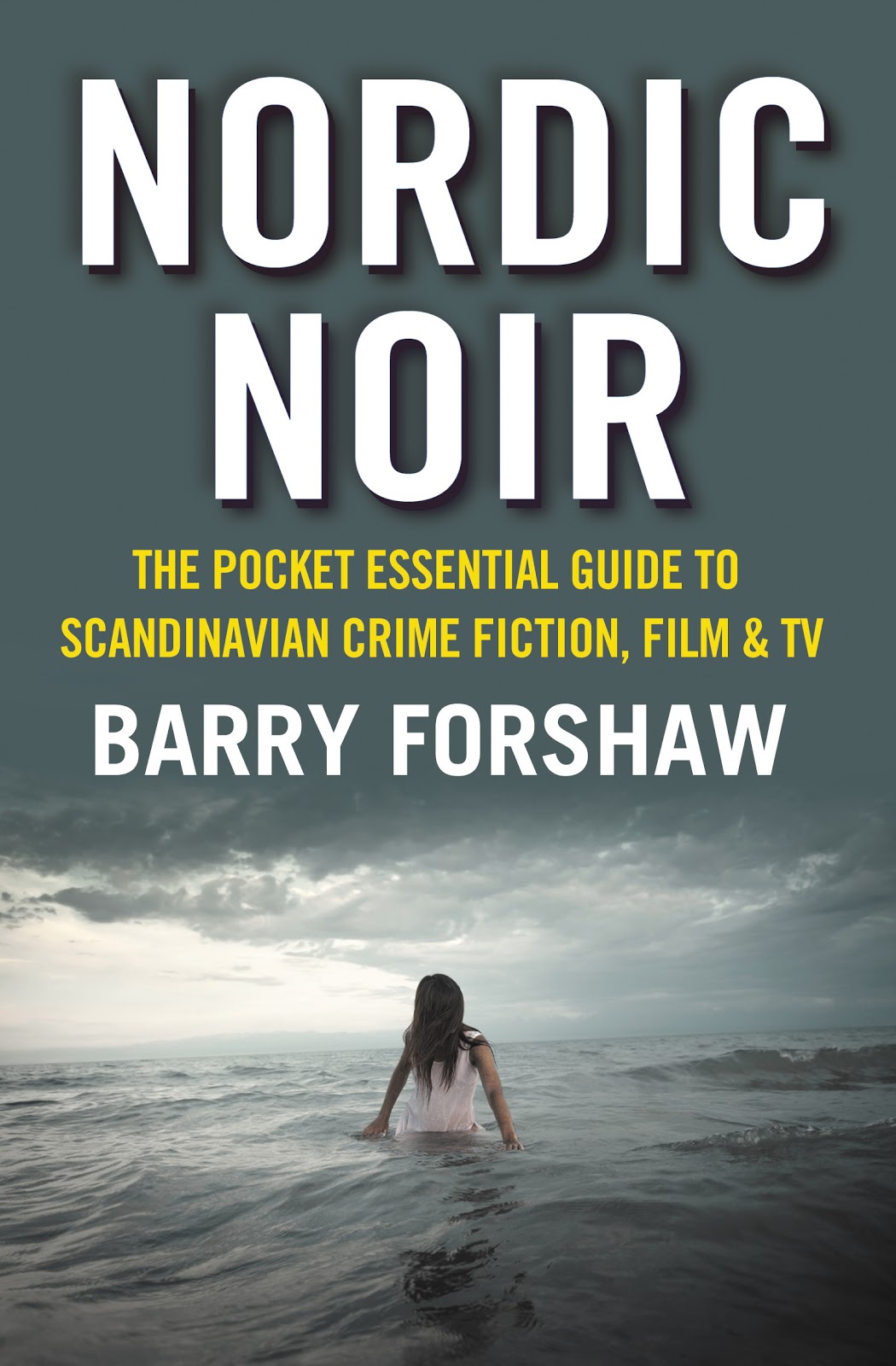
Nordic Noir: The Pocket Essential Guide to Scandinavian Crime Fiction, Film & TV has lots of Swedes and Norwegians, roving gangs of Danes and Icelanders. a smattering of Finns, and a Faroe Islander or two.

It also has me, holding forth on Stieg Larssonism on Page 38 and Harri Nykänen's Raid and the Blackest Sheep on Pages 107 and 108, and I admit it was fun to see my name in the index.

The book's author, Barry Forshaw, is probably best known for his biography of Stieg Larsson, but he writes all over the crime fiction, film, and television map. He's the man behind British Crime Writing: An Encyclopedia, Italian Cinema: Arthouse to Exploitation, and British Crime Film, for instance, and I was chuffed when he asked me to take part in this project.

Nordic Noir: The Pocket Essential Guide is out now in the U.K. in paperback and e-book formats, with a U.S. edition to follow in September. As always, Forshaw packs lots of information into a compact space (I have just verified that the book does indeed fit in a pants pocket.) He brings a light, conversational touch to a subject not always celebrated for such qualities, and I'd call the book a good choice if you want to know what the Scandinavian fuss is about and who the up-and-comers are.
© Peter Rozovsky 2013

Labels: , , , , , , , , , ,

Sunday, April 08, 2012

Nykänen in my newspaper

My review of Harri Nykänen's novel Nights of Awe appears in Sunday's Philadelphia Inquirer under the headline "A Finnish thriller stars a Jewish cop."

Click the link to find out why I call Nykänen
"part of the blinding ice storm of Nordic crime writing that has buffeted the world since Stieg Larsson died and went to publishing heaven"
and add that
"he stands out from the crowd for at least two reasons: his deadpan humor, and his thrilling ability to sustain narrative pace on little but routine details, personal interactions, and professional observations over the course of a police investigation."
© Peter Rozovsky 2012

Labels: , , , ,

Saturday, February 18, 2012

Nights of Awe

The protagonist of Harri Nykänen's Nights of Awe is named Ariel Kafka, and he's one of two Jewish police officers in Helsinki.

Now, Finland's entire Jewish population is no bigger than a couple of good-sized Long Island bar-mitzvahs, so it's no shock that Jews would be somewhat exotic figures there. Nykänen has Kafka react with head-shaking amusement to well-meaning questions about Jews, and the deadpan humor is of a piece with what Nykänen did so well in Raid and the Blackest Sheep.

Kafka's Jewish identity figures also in the crimes that drive this story, a series of killings of Arabs that eventually involves drugs, trains, cars, Israeli diplomats, the Mossad intelligence service, and friends and others from Kafka's own past. To say too much more would risk spoilers, except that things, as in all good mysteries, are not what they seem, even when you think you've figured out what's what and who's who.

The novel's title refers to the Jewish high holidays, the Days of Awe, when observant Jews repent of their sins. Nykänen presumably intends moral weight, but a character named Kafka needs no help from the calendar to get introspective. The story could have been set any time in the year.
***
The book was smoothly translated into English by Kristian London, an American who lives in Helsinki. The fluency of the translation is especially noticeable in the novel's first half, which consists largely of routine police detail and dialogue, where the prose, and not the action, must hold readers' attention.

© Peter Rozovsky 2012

Labels: , , , , , , , ,

Monday, June 27, 2011

Nordic crime is more than just a barrel of laughs

Nordic crime fiction has been in the spotlight here at Detectives Beyond Borders, notably the question of what, if any, characteristics are common to crime writing from the Nordic countries.

With that in mind, two bits from Helsinki Homicide: Against the Wall, by Finland's Jarkko Sipila, typify what I suspect many people would regard as typically Nordic:
"Finland was home to one of the top per capita homicide rates in Western Europe, but most slayings were the result of drug and alcohol addicts solving their disputes with whatever weapons they could get their hands on."
and
"Over a million semi-trucks passed from Finland to Russia every year. It was impossible to track all the imports and exports. ... The incidents of fraud were numbered in the thousands, or tens of thousands, but investigators were numbered in the tens."
Resignation. Fatalism. What does Nordic/Scandinavian crime fiction mean to you?

© Peter Rozovsky 2011

Labels: , , , , , ,

Thursday, June 23, 2011

A Finnish crime novel that's all deadpan, all the time

I like my cold, gray Nordic crime fiction sprinkled with a bit of humor, and Harri Nykanen obliges in Raid and the Blackest Sheep.

Deadpan humor is plentiful in crime fiction from countries in the Scandinavian cultural sphere, but the first third of this Finnish crime novel  is all deadpan, and the effect is novel, as if a joke is liable to break out at any moment.

One nice touch: Further evidence that Nordic writers' are willing to poke fun at their countries' reputations for vigorous good health. Here's Helsinki Police Lt. Jansson moping his way through a stay at a health center:
"The decision to stay in bed had nothing to do with a hangover. Having only drunk moderately, he felt reasonably alert. He simply had no desire to submit to the hazing of another physical therapist. `Doesn't Jansson's back bend?'  `Jansson, tuck in your belly.' `Jansson, breathe deeply.'"
That's a nice companion piece to the stone-massage ordeal Iceland's Yrsa Sigurðardóttir puts her protagonist through in My Soul to Take.
***
Raid and the Blackest Sheep come from the commendable newish publishing house Ice Cold Crime, an American publishing house dedicated to translating and promoting Finnish fiction,

© Peter Rozovsky 2011

Labels: , , , , , , , ,

Friday, November 27, 2009

Finnish lines


An American Detectives Beyond Borders favorite makes it into the Finno-Ugric language family. Read an interview (in English) with the author here.

© Peter Rozovsky 2009

Labels: ,

Wednesday, July 01, 2009

Finnish crime comes to America

Readers in the English-speaking crime-fiction world like to gripe about the dearth of translated fiction in their language. Over at Pulpetti, Juri Nummelin reports on a Finnish crime writer who took matters into his own hands and, with his brother who works on Wall Street, started his own publishing house to get his work out in America.

First up from their new Ice Cold Crime is founder Jarkko Sipilä's own Helsinki Homicide: Against the Wall. And more is on the way. Says Juri:

"Ice Cold Crime is publishing next another book by Sipilä, whose work is strictly rooted in the police procedural and its hardboiled subgenre. Then they'll probably publish something by Harri Nykänen. Nykänen is slightly better known in the US, since the Raid TV series made from his novels was shown in some cable channels there."
See Sipilä's Web site for more info. Read a summary of Helsinki Homicide: Against the Wall here.

© Peter Rozovsky 2009

Labels: , , , , , ,

Wednesday, November 07, 2007

Cold-weather crime, real-life division

As in the U.S., so in Finland, where an 18-year-old opened fire at his high school in a "placid town" in southern Finland today, killing seven fellow students and the principal before mortally wounding himself in a rampage that stunned a nation where gun crime is rare:

http://enews.earthlink.net/article/top?guid=20071107/47314650_3421_1334520071107237156427

© Peter Rozovsky 2007

Labels: ,

Monday, November 05, 2007

Cold-weather crime

I'm back in Scandinavia and in the countries that Scandinavians settled for this post. First, another brief passage from Iceland's great Njal's Saga, composed around 1280, set about three hundred years before then, and full of more killings in any number of its short chapters than contemporary Iceland probable sees in a year.

Here, I bring back Hallgerd, headstrong and vengeful instigator of the killing that occasioned Thjostolf's laconic account of a killing, cited here. This time, two of the saga's doomed heroes discuss her in terms that might remind readers of many a femme fatale:

"Skarp-Hedin said, `Hallgerd does not let our servants die of old age.'

`Your mother,' said Gunnar, `will no doubt see to it that this game is played by two.'"

Back in the present, to the the Fall 2007 issue Mystery Readers Journal. Editor Janet Rudolph made a decision that makes the issue an especially interesting experience for readers of international crime fiction: She does not restrict herself to fiction that has been translated into English.

Thus, for example, Paula Arvas offers insights that may help readers develop a sense of Finland and its fiction even if they can't read the language. "Finnish crime fiction," she writes, "differs from Swedish crime fiction typically in that Finnish writers often use criminals, like small time crooks, as their central characters." That might make sense to anyone who remembers my comment about Tapani Bagge. Some of his short fiction is available online; Arvas discusses his novels, not yet published in English.

Elsewhere in the issue, you can read about a very early crime novel set in the very far north, and the amusing lament of an author who bemoans "A Depressing Lack of Crime" in her native Iceland. Perhaps the biggest treat for the many fans of translated Swedish crime fiction are two bibliographies, one of Swedish crime fiction translated into English, another of reference sources about Nordic crime fiction. Lots of people in lots of places, it's nice to see, take Nordic crime fiction seriously.

P.S. One of the issue's articles is called "Have You Driven a Fjord Lately?" If you can resist that, you are made of stronger stuff than I.

© Peter Rozovsky 2007

Technorati tags:


Labels: , , , , , , , ,

Monday, October 01, 2007

What's so funny about Scandinavian crime fiction?

My article about humor in Nordic crime fiction, "Dry Humor in a Cold Climate," appears in the Fall 2007 issue Mystery Readers Journal, now available from Mystery Readers International. The issue is devoted to Scandinavian mysteries, and it includes Håkan Nesser's thoughts about writing, contributions from several other top Swedish authors, a roundup of contemporary Finnish crime fiction, and quite a bit more in addition to my piece.

You'll also find articles about Danish crime fiction, Maj Sjöwall and Per Wahlöö, Karin Fossum, and the Scandinavian touch in American crime writing and one by Yrsa Sigurðardóttir that bears the intriguing title "A Depressing Lack of Crime." See a complete table of contents, full versions of selected articles, and information about the print version of the magazine at the Mystery Readers Journal link in the above paragraph.

© Peter Rozovsky 2007

Technorati tags:


Labels: , , , , , , , , ,

Sunday, July 22, 2007

A fun Finn

Way back in this blog's very first post, I lamented the unavailability of Finland's Pentti Kirstilä in English translation, with the exception of one exceptional story. His work is no more available now than it was then, but I have found another funny Finnish writer. Tapani Bagge's Onni Syrjänen, a "not very successful lawyer, is too poor to hire a detective, so he does his own gumshoeing." That lets you know right away that something funny is going on.

Bagge's short story "The Face in the Concrete" is full of sharp description, endearing characters, clever twists on perennial P.I. motifs, and the intimate humor of a small town where everyone knows everyone else and where the possibility of tragedy always lurks. Best of all, the story has been available online for two years at the Thrilling Detective Web site.

Among my favorite snippets is this, from an exchange between Syrjänen and his two luckless cousins, Jampaa and Make, concerning a burglary that did not go as planned:

"The old man started boohooing right in the middle of cracking the safe, starting blubbering about how Granny used to send him Christmas trees we made outta paper."

"It was you?”

Jamppa nodded eagerly

“Granny did help Make a bit, he was only three, but I – ”

“I mean, was it you that broke into Riipinen's?” I specified.

“Ya think I'm lying?” Jamppa got upset.

“I didn't mean it like that. I was just wondering what you're still doing here, then.”

“Should we be off to the Canary Islands, then?” Make seemed exasperated. “Two fellas with nuthin' but stinkin' holes in our pockets?”

"I would think that a couple of million would fix just about any hole."

"Ya would, wouldn't ya?" Jamppa grumbled and swallowed what was left in his mug. “That's 'cactly why we gave ya a holler."

“Or I did," Make corrected. “Jamppa just gave me a fiver.”

“It was my last fiver," Jamppa said and looked at me gloomily, like a landlady who'd just served a sixth useless eviction notice. “We didn't get a friggin' penny outta that friggin' job.”
Finnish author and blogger Juri Nummelin reported earlier this year that he was working on a translation of one of Bagge's novels for publication by Point Blank Press. Here's hoping the project comes to a timely fruition.

© Peter Rozovsky 2007

Technorati tags:

Labels: , , ,

Tuesday, July 03, 2007

Finnish crime fiction on U.S. TV

Yesterday's post about What German crime-fiction readers read lamented the unavailability in English translation of Finland's Harri Nykänen. It transpires that the television series based on Nykänen's comic novels about the hitman Raid was made available to at least a segment of the U.S. television-watching public.

Read some good things about the series Raid and Kai Lehtinen's performance in the title role here.

© Peter Rozovsky 2007

Technorati tags:

Labels: , , ,

Monday, June 11, 2007

Finnish crime online

Words Without Borders, an online magazine for international literature, has been commendably open to crime fiction, devoting issues to noir fiction in May and August 2006. The current issue, which features literature from the Nordic countries, gets criminous again, with a story by Finland's Matti Joensuu. (Hat tip to Karen at Euro Crime.)

© Peter Rozovsky 2007

Labels: , ,

Monday, April 09, 2007

A handy checklist of Nordic mysteries

I've just found this list of Nordic mysteries, published last year by the Marin County Free Library. It's almost a year old so not quite up to date, but it makes a nice shopping and reading list for crime fiction from Norway, Denmark, Sweden and Iceland.

It states that no Finnish mysteries are available in English translation, which is not quite the case. Some of Matti Joensuu's work is available, at least in used copies, and there is always my man Pentti Kirstila, whose deadpan short story "Brown Eyes and Green Hair" is available in The Oxford Book of Detective Stories (An International Selection).

© Peter Rozovsky 2007

Labels: , , , , , , , ,

Thursday, September 21, 2006

Detectives Beyond Borders

Welcome to my new forum devoted to international crime fiction – "international" in my case meaning outside the United States. The Web is all about openness and freedom of information, so I have no compunction about taking David J. Montgomery's 10 Greatest Detective Novels idea, ringing some changes on it, and coming up with a debate/discussion of my own. He focuses on American writers; I'll take the rest of the world and ask these questions:

What are your favorite crime novels and stories set in countries other than your own?

– Why do you like these stories?

– Is living in a country a prerequisite for writing a successful crime story set in that country?

– What makes crime stories especially attractive to the armchair traveler?

– Do people even read in armchairs anymore?

Setting has been integral to some of the finest crime fiction through all periods. Think the misty docks and streets of Conan Doyle's London. Think Hammett's San Francisco, Chandler's Los Angeles, Lawrence Block's New York. Or think Georges Simenon's Paris, its suburbs, and the villages where Maigret loves to relax, drink white wine, and play cards. Given the importance of setting, it seems natural that crime stories should prove especially attractive to those of us who like to travel in our minds as well as in trains, planes, cars, buses and boats. Indeed, this is a good time for such readers, with Soho Crime, Bitter Lemon Press and Serpent's Tail, among others, offering much of interest.

I'll begin with some of my favorites, along with a few books I don't much like. Feel free to disagree with me, especially on the latter. Nothing would please me more than to be talked into recognizing virtues I had not seen before in an author – or to be forced to better understand and justify my dislike.

In no particular order, here is some of my favorite non-American crime fiction:

1) Lovely Mover, by Bill James, though several of the other novels from the middle of James' Harpur & Iles series are about as good. The series hits its stride around its seventh book and becomes a kind of grand and cracked portrait of Britain's shifting urban and social landscape, of the murky boundaries between police and criminals, of suburban social climbers who happen to be killers and drug dealers, of the strange ways people build families in changing times. The books are violent, dark, and often very funny. And James just happens to be the best prose stylist who has ever written crime fiction in English.

2) Death of a Red Heroine, by Qiu Xiaolong. A clear-eyed view of 1990s Shanghai that meets every traditional requirement for a full-blooded crime novel. The setting is evocative, the protagonist is unusual (though not the strongest feature of the book), the supporting characters are compelling, and the story has a surprise ending that could only have happened in China.

3) Cosi Fan Tutti, by Michael Dibdin, is an exception to my general distaste for novels set in "foreign" countries by writers not from those countries. Such books often degenerate into travelogues. This novel is formally daring, and talk about surprise endings! Dibdin, an Englishman, spent several years teaching in Italy, according to various accounts, and his charmingly named protagonist, Aurelio Zen, offers a kind of Baedeker's guide to official Italian corruption and internecine rivalry, each novel set in a different region: Naples here, the Vatican, Venice, the south in other books. And Rome. Always Rome. "Zen" is a name characteristic of the protagonist's native Venice, but it also has overtones of the detachment with which this Zen moves through the sometimes deadly worlds of Italian officialdom and gangsterdom. Of course, the character's other name, Aurelio, is another clue that he is wise and given to occasional musing, if not outright meditation.

4) "Brown Eyes and Green Hair," a short story by Pentti Kirstila available in "The Oxford Book of Detective Stories (An International Selection)." This delightful, deadpan, at times almost surreal story by the Finnish Kirstila is an exception to the rule that writers from Scandinavia, the Baltic countries and Iceland are morose -- and is the only Kirstila to have been translated into English. Let's raise a fuss and get more of his work translated and published. (Some of his writing is available in German and in some less widespread European languages.)

5) Points and Lines, by Seicho Matsumoto. This Japanese police procedural is a kind of road movie on the rails, a look at people and places in 1960s Japan through the eyes of a police inspector who travels the length and breadth of the country by train as he tracks down clues to a young couple’s death.

6) No Happy Ending, by Paco Ignacio Taibo II. The protagonist shares a cramped Mexico City office with a plumber, an upholsterer and a sewer engineer. The book begins with a Roman soldier found dead in a bathroom. What more could you ask for? Like Dibdin's Aurelio Zen, Taibo's one-eyed hero, Hector Belascoaran Shayne, bumps up against official corruption and violence. Unlike Zen, Shayne attacks it headfirst. He also has a profound sympathy with victims of police and other official and corporate brutality.

7) The Prone Gunman, by Jean-Patrick Manchette. Another author with a distinct political viewpoint. His short, grim novels have a certain formal similarity to Jim Thompson's. But Manchette's protagonists are not fortunate enough to die. Rather, they are brought low, chewed up, and spit out, destroyed or disoriented but still alive, by powerful forces who use them to achieve their own ends before discarding them.

8) Thumbprint and Fever, by Friedrich Glauser. This 1930s Swiss writer, translated and brought back into print by Bitter Lemon Press, offers that rarest of detective protagonists: a man who has hit rock bottom professionally without lapsing into alcohol and self-pity. Sgt. Studer works in small corners of a big world: Villages, prison cells, cramped apartments. An insane asylum. An isolated Moroccan Foreign Legion post. He is mordant and humane in a world of which his creator takes a deadpan view. Some say Glauser influenced his countryman Friedrich Dürrenmatt. Maybe, but Glauser was better.

9) The Amsterdam Cops series, by Janwillem van de Wetering. This Dutch author has been a businessman, a world traveler, a reserve Amsterdam police officer, and a student at a Zen monastery in Kyoto. All, especially the last three, figure prominently in this series, which includes 14 novels and two overlapping short-story collections. Detective twosomes are a nickel a dozen; Van de Wetering offers the only three-headed protagonist I can think of: the grumpy Adjutant Henk Grijpstra, the younger and sometimes vain Sgt. Rinus de Gier, and their unnamed commissaris, or chief, an elderly mentor with sometimes excruciating knee pains who is a sly collaborator and a kind of guru to Grijpstra and de Gier. Start with Hard Rain, in part for the larger role it gives the commissaris. Van de Wetering has an interesting approach to translation: He does his own, and he regards the results as versions, rather than translations, of the original. The one book in the series that I read in Dutch has slightly different chapter divisions from the English version and an opening chapter with more physical description. And the first in the series, An Outsider in Amsterdam, reflects the Dutch language's more frequent use of the present perfect where English would use the simple past. This results in occasional odd sentences such as "I wonder if he has done it."

10/11) Tales From Two Pockets by Karel Capek and The Mournful Demeanour of Lieutenant Boruvka by Josef Skvorecky. These books of tales are full of sharp observation, wry and wistful humor, and detection of the classic and other kinds. Both just might lay to rest the notion that "literary" crime fiction equals bad crime fiction.

=======

OK, what do these stories have in common, other than that none is set in the United States or in an English village and each offers a vivid sense of place? Damned if I know. Maybe I'll know better once I hear from you.

What about books that didn't make my list? Ruth Rendell's superb The Veiled One seems far more interested in its killer's psyche than in the story's setting. The great Ken Bruen's Brant and Roberts novels are like Ed McBain 87th Precinct gang whacked out on beer and cocaine. Their violent, good-hearted, hilarious characters clang and crash together in stories that are all action, all character, without much focus on the setting. By all means, read them. (Bust, on the other hand, Bruen's excellent collaboration with Jason Starr, could qualify for this list with an asterisk, as an Irish writer's view of New York.)

Two books I did not care for helped form my thoughts on international crime fiction. The one Magdalen Nabb "Marshal Guarnaccia" story that I read got the details of its Florence-area setting convincingly right, but the story could have happened anywhere. John Burdett's Bangkok 8, on the other hand, was all local color, all weird exotica, all too much like a travelogue, albeit an especially weird one, for my tastes.

A last note: I've omitted Murder Must Advertise, the one Dorothy Sayers novel that I've read, though it is set in a country where I've never lived. Yet I might include Peter Lovesey's fine The Last Detective, which takes place in the same country. The reason is simple: In crime fiction, the past is not a foreign country. Sayers, and perhaps Christie, Chesterton and all the rest, created worlds so familiar to crime-fiction readers that they are no longer foreign.

Thanks, and keep those posts coming,

Peter

© Peter Rozovsky 2006

Labels: , , , , , , , , , , , , , , ,