Tuesday, June 02, 2015

Indian crime and proto-crime

(Eighteenth- or nineteenth-century painting
from a classic Hindu proto-crime story
.)
I've neglected crime fiction recently in favor of Indian history in the form of Ramachandra Guha, both his essays about important persons and themes in India's 20th-century history and his fat, highly readable volume India After Gandhi. (Is it enough for weighty volumes of history to be "fat" and "highly readable," or is it mandatory that they be called "magisterial"?) In any case, while I burrow deeper into Guha's highly readable majesty, here's an old post about a prolific Indian crime writer that includes some thoughts on his country's literary classics.
===============
 More good ancillary material from The Blaft Anthology of Tamil Pulp Fiction, this time from a Q&A with Rajesh Kumar:
"Some people don't think crime novels count as literature. My answer to them is that the first crime novel in this world is the Mahabharatham — which has every imaginable sort of intrigue — and the next is the Ramayanam. The great epics themselves depend on rape, molestation, abduction and murder for their plots. It makes me laugh when I am accused of spoiling society with my crime novels."
It is nice to see that an Indian crime writer faces the same moralistic scorn that some of his Western counterparts do. It's nice, too, to see two Hindu epics in the ranks of the world's great proto-crime stories (click link, then scroll down).

Kumar also laments India's poor performance in the country's favorite sport ("Our cricket team is too busy advertising soft drinks, having affairs with film actresses and abandoning their families. Where is the time for practice?") and offers a disarming answer to questioner who asks: "I am suffering from hair loss due to stress. Do you worry about such things?"

"Why should I worry," Kumar replies, "about you losing your hair?"

© Peter Rozovsky 2010

Labels: , , , , , , , ,

Saturday, March 08, 2014

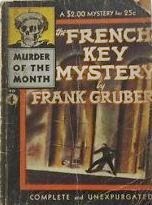
Frank Gruber's The French Key Mystery: There's more than a mystery between those covers

Frank Gruber (1904-1969) has to have been one of the most thoroughly professional of all pulp writers. The French Key Mystery hits hard without wallowing in shadows or violence. Its characters are entertaining without being clowns. A gritty undercurrent runs through the book without, however, degenerating into preachy social realism. In short, Gruber knew how tell a story.

At least as fascinating, however, is the supplementary matter in my edition of the novel, another fine purchase last week from the Bucks County Bookshop in Doylestown, Pa. And I don't mean just the cover's calling the book "A $2.00 Mystery for 25¢."

There are the exhortations to "brighten the lives of those who are giving their all" by sending them books and to buy U.S. war stamps and savings bonds because "It will cost money to defeat Germany, Italy and Japan."

The book's more straightforwardly commercial appeals have an earnestness that reads like innocence:
"MURDER OF THE MONTH titles are printed on good paper with bold, clear type and strongly bound with a decorative cover in full color, finished off with a hard, glossy surface. A further innovation are the unusual illustrations throughout each volume by world-famous artists, to add to your enjoyment whilst reading the story."
 They just don't write promotional copy like that anymore. Just try finding all this in a chain bookstore or on an e-reader.

© Peter Rozovsky 2014

Labels: , , , ,

Tuesday, November 26, 2013

Find Skuld! and find McKinty

Matteo Strukul's and Marco Piva Dittrich's Find Skuld! has an opening paragraph that should grab your attention:

"Call me fuckin’ Ishmael."

If that opening suggests American-style hard-boiled attitude and sullen slacker wiseassery on the part of the novella's Italian creators, its subtitle evokes over-the-top new-pulp sensibility with a touch of the old-time British adventure story. That subtitle is Chimaera: Anti Nazi Squad. The story, in other words, is a fine piece of global genre-hopping.

Find Skuld! takes a two-man commando squad deep under a castle hideaway to rescue Skuld from the Nazis. What is Skuld? Read the book to find out.

If this suggests Indiana Jones to you, know that the imprint of which the novella is a part is called Popcorn, and its slogan is "When reading a book is like watching a movie with some pop corn and a coke!" (Other Popcorn authors include Victor Gischler and Anthony Neil Smith.)
***
Over at Adrian McKinty's place, McKinty jumps the gun and links to the first review of his In the Morning I'll Be Gone, third of the Sean Duffy novels, following Cold Cold Ground and I Hear the Sirens in the Streets.

I've read the book in galley form, too, and I'll add to the reviewer's comments that it reminds me in a small way of Dashiell Hammett's story "Fly Paper."  It's no wandering daughter job but, like Hammett's story, McKinty's novel embraces a hoary murder-mystery motif and works it with great success into a story that is far from a traditional mystery.

© Peter Rozovsky 2013

Labels: , , , , , , , , ,

Sunday, August 25, 2013

Pulp in the paper: I review Day Keene in the Philadelphia Inquirer

My review of The Case of the Bearded Bride and Other Stories: Day Keene in the Detective Pulps, Vol. #4 (Ramble House) appears in today's Philadelphia Inquirer.

The book is a collection of stories that originally appeared in pulp magazines covering two periods in the prolific Keene's career: 1931-35 and 1942-1950. 

The first group, written under Keene's real name, Gunnard Hjerstedt (spellings of both names vary by source), shows affinities with the wisecracking, fast-talking detective tales that had become popular in the late 1920s, such as Frederick Nebel's long-running Kennedy and MacBride tales. The later stories, written as John Corbett, move in darker territory that may evoke Cornell Woolrich and David Goodis.

That facility in widely different styles will likely be the most fascinating aspect of the volume for crime readers in today's era of specialization: Keene could write anything for a market that demanded everything. He was an earlyish representative of a crime fiction tradition whose last examples include Donald Westlake and Lawrence Block.

That's one reason this review, though a bit out of my territory, was among the most fun I've written. A tip of the battered old fedora to the editor who asked me to write it.

Here, again, is the review, And here are the Keene entries at Gold Medal Corner and the Thrilling Detective Web Site. Not only did the man write everything, he wrote lots of it and for a long time.

© Peter Rozovsky 2013

Labels: , , , ,

Thursday, June 03, 2010

Tamil pulp

The Blaft Anthology of Tamil Pulp Fiction promises "mad scientists!", "hard-boiled detectives!", "vengeful goddesses!", "murderous robots!", "scandalous starlets!" and "drug-fueled love affairs!", and if that doesn't sound like hours of innocent springtime pleasure, I don't know what does.

I'll get to the authors later, the prolific Rajesh Kumar among them. For now, some highlights of translator Pritham K. Chakravarthy's immensely informative introduction. The author Sujatha's detectives, she writes, "were suddenly speaking a kind of Tamil that was much closer to our Anglicized language than anything we had seen before on paper."

Tamil pulp stories were published in weekly magazines, and "households would meticulously collect the stories serialized in these weeklies and have them hard-bound to serve as reading material during the long, hot summer vacations."

The introduction takes brief excursions into the ancient history of the Tamil language, its revival in a twentieth-century literary renaissance, and separate traditions of the British "penny dreadful" and the American crime novel that all contribute to the Tamil pulp tradition.

"From the days when our English reading consisted of Enid Blyton, Nancy Drew and the Hardy Boys up until we grew out of Earl (sic) Stanley Gardner, Arthur Hailey, and Hadley Chase," Chakravarthy writes, "we also had a parallel world of Ra. Ki. Rangarajan, Rajendra, Kumar ... "

Parallel worlds. Literature that readers like so much, they collect and bind it themselves. An ancient language revivified by contact with English. Sounds to me as if interesting things are happening in Tamil fiction.
==========
(Read an excerpt from The Blaft Anthology of Tamil Pulp Fiction and browse Detectives Beyond Borders' discussion of Surender Mohan Pathak's The Sixty-Five Lakh Heist.)

© Peter Rozovsky 2010

Labels: , , , , ,

Wednesday, May 19, 2010

Rajesh Kumar: Man of (more than) a thousand novels

(Detectives Beyond Borders is not an official site for Rajesh Kumar's novels; the photo is from emagaz.in)

Monday's post about Surender Mohan Pathak's The Sixty-Five Lakh Heist led to a nice note from Rakesh Khanna of Blaft Publications about a truly prolific author.

Rajesh Kumar is said to have written more than 1,500 short novels and 2,000 stories. Here are some snippets from an article about “the superstar of the Tamil pulp fiction industry”:
"The classic Tamil pulp novel runs between 100 pages and 150 pages and is printed on cheap paper as a monthly magazine. ... The flavours of this genre are uniformly sensational but otherwise eclectic. They can include the science-fiction thrillers—more fiction than science—of Kumar, the romances of Ramani Chandran, the detective knockabouts of Pattukottai Prabhakar and Suba, the religious tales of Indira Soundara Rajan and the social dramas of Pushpa Thangadorai.

“`But many authors have, of late, shifted to writing for films and television,' Kumar says. `Not me, though. I’m allergic to cinema, and I don’t want to move to Chennai. Plus, I find these movie producers highly immoral people.'”
And, perhaps most interesting:
"For those treading water financially, a teashop will even act as an informal lending library, charging Rs2 to take a book home for a day or two.

"It is heartening that people who cannot afford a Rs15 novel are still willing to put down Rs2 to read, and Kumar takes no little pride in that fact. `It was us writers who made sure that there were books hanging from shop ceilings instead of shampoo sachets,' he says. We led people to read, he preens ..."
Imagine that: Popular books at affordable prices in handy formats where readers can find them. Radical!

© Peter Rozovsky 2010

Labels: , , , ,

Monday, May 17, 2010

विमल, or meet Vimal, India's pulp hero

Oh boy, have I learned a lot from The Sixty-Five Lakh Heist, fourth of Surender Mohan Pathak's many Vimal novels.

I have learned that the author tired of his first series after the first hundred books or so before he created Vimal. I have learned that Vimal is an elusive thief and a master of disguise, a kind of Punjabi mix of Richard Stark's Parker and Frank McAuliffe's Augustus Mandrell.

I have learned, among many new words, dacoit: "robber, usually one who attacks in broad daylight, in a group." I have learned that lakh in the novel's title means hundred thousand; the title refers to the 6.5 million-rupee bank robbery in which Vimal is stiffed by a colleague before embarking on a violent quest to recover what's his.

And I have learned that Surender Mohan Pathak had better slow down to a stately Simenon-like pace, or he'll soon have to express his own output in lakh. At age 70, he has written about 300 novels and translated Ian Fleming and James Hadley Chase into Hindi, the latter while working full-time for the Indian phone company.

Check out Vimal and more at the publisher's Web site, Blaft Publications. And check out this essay on Vimal by Brian Lindemuth, to whom I owe my acquaintance with Vimal.

ਬੱਲੇ!, which means, roughly speaking, "Vimal is one righteous dude!"

P.S. Vimal apparently means "clean, pure, spotless" in Sanskrit, and yet Vimal is just one of the hero's many names ...

© Peter Rozovsky 2010

Labels: , , , , , , , ,