Tuesday, July 27, 2010

Jason Goodwin's The Bellini Card has a nose for the truth

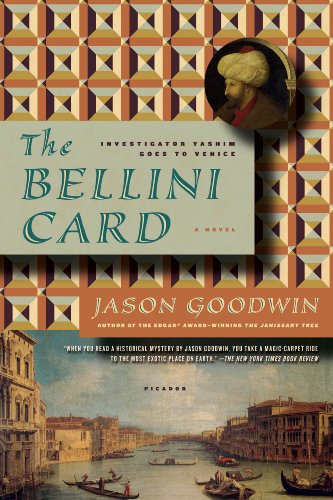
My favorite line of the day is from The Bellini Card, Jason Goodwin's third novel featuring the most thoughtful, brooding polyglot late-Ottoman eunuch investigator in all of crime fiction:
"The sultan screwed up his face and opened his mouth as if to scream, then whisked a handkerchief from the desk and sneezed into it loudly and happily.

"Yashim blinked. In the Balkans, people said you sneezed whenever you told a lie."
For more on the Edgar Award-winning author, click here and scroll down.

© Peter Rozovsky 2010

Labels: , , , , ,

Wednesday, April 14, 2010

Life on the road

My current reading is not crime, but it shares a striking sentiment with one of the great espionage adventure novels.

The current book is Nicolas Bouvier's The Way of the World; the classic adventure tale is John Buchan's Greenmantle, about which I wrote here.

Buchan's Richard Hannay, exhausted when he reaches Constantinople, finds the city
"a mighty disappointment. ... I had forgotten that winter is pretty much the same everywhere. It was a drizzling day, with a south-east wind blowing, and the streets were long troughs of mud. The first part I struck looked like a dingy colonial suburb — wooden houses and corrugated iron roofs, and endless dirty, sallow children."
Later, cleaned up and rescued, Hannay sees the city differently and draws a lesson from this:
"What had seemed the day before the dingiest of cities now took on a strange beauty ... A man's temper has a lot to do with his appreciation of scenery. I felt a free man once more, and could use my eyes."
Bouvier is brought to similar reflections by bouts of dysentery in Macedonia:
"With sweating foreheads, we'd rush to the Turkish-style toilets and resign ourselves to staying there, despite hammering on the door, because dysentery grants only brief respites.

"When I found myself in this low situation, the town would get me down. It was very sudden; it was enough to have a lowering sky and few drops of rain for the streets to be transformed into quagmires ... Everything in it that was misshapen, nauseating and deceptive would emerge with ightmarish clarity. ... In my mind I poured acid over the street, cauterizing it. ...

"When I got over that, I would see through the window, in the evening sunshine, the white houses still steaming from the downpour, the mountain chain spread out beneath a washed sky and the army of tobacco plants, which surrounded the town with their reassuring sturdy leaves. Once again I would find myself in a solid world, at the heart of a gilded lion. The town had revived. I could dream."
© Peter Rozovsky 2010

Labels: , , , ,

Tuesday, August 25, 2009

Flight dreck

Another bit from my current crime reading, Selçuk Altun's Songs My Mother Never Taught Me, dovetails nicely with a non-crime post I had planned to make. Here's Altun:

"The stewardess of the `business class' section was presenting the flight security precautions with the usual repulsive mimicry."

Here's me:
"A train journey begins with a thrilling lurch into motion. A plane journey begins with the slightly nauseating whiff of filtered, pressurized air.

"You squeeze past your rowmates' knees to get up. You squeeze past their knees to get back. (Just don't drop anything, because good luck squeezing down between rows to pick it up.) You contemplate the condensation between the windows. You choose from a wide range of entertainment options. You enjoy the easy-going conversational genuineness of the crew ..."
Coming soon: More from Selçuk Altun, plus my theory about why flight crews, so rigidly cheerful in the air, can be so obnoxious once they land.

© Peter Rozovsky 2009

Labels: , , , , , , ,

Monday, August 24, 2009

A novel from Turkey that won't leave me cold

Here's a bit from the second chapter of Selçuk Altun's Songs My Mother Never Taught Me:

"Today your humble servant Bedirhan Öztürk is thirty-seven years old! Instead of buying myself a birthday present I've come to a crucial decision. God willing, I'm going to break away from the business I've undertaken so patiently for the last twelve years.

"Please don't let the fact that I'm a hired killer alarm you. ...

"But retirement will come to pass, by the grace of God! Listening reverently to the evening ezan and eating my blessed pomegranate, I'll say my prayers and go to sleep, if you'll allow me. I'm sure that you've already begun to realize that your humble servant is no ordinary gun-toting operator."
I think I'll enjoy this novel's amiable tone. As a bonus, my alma mater gets a prominent mention in the third chapter.

© Peter Rozovsky 2009

Labels: , ,

Friday, July 10, 2009

A new blog about international crime fiction from folks who write the stuff

It's International Crime Authors Reality Check, a cooperative effort from Christopher G. Moore, Colin Cotterill, Matt Beynon Reese and Barbara Nadel, each of whom plans one post a week.

The opening lineup includes How the Devil Lost its Vagina from Cotterill, Quick, woman, go and get the Koran! from Rees, The Elements of Crime Fiction in Foreign Settings from Moore, and a modest greeting from Nadel.

The site also includes short biographies, information about the authors' books, and news links. I've written about three of the authors here on Detectives Beyond Borders, most recently about Cotterill's Curse of the Pogo Stick last week, and I'll look forward to adding Nadel to the list.

© Peter Rozovsky 2009

Labels: , , , , , , , , , ,

Thursday, June 11, 2009

4x4: The meme

My fellow award-winning blogger J. Kingston Pierce has tagged me with a meme tailor-made for Detectives Beyond Borders. The meme is built around questions involving the number four, and I especially liked the ones that involved travel and places where one has lived.

Since Jeff expanded the list of questions from eight to ten, I don't feel too badly about making my own adjustments. And you can do the same.


Four places I'd like to go or things I'd like to do:

1) Visit the Angkor temple complex in Cambodia

2) Visit the Ajanta caves in India

3) Hike the length of Hadrian's Wall

4) Complete a short walk I began a few years ago, along the West Kennet Avenue from Avebury to the Sanctuary


Four places I've lived:

1) Montreal

2) Rome

3) Philadelphia

4) The Boston area, which leads to my own category of ...


Four places I've lived in the Boston area:

1) Waltham

2) Brookline, whose no-overnight-parking regulations seemed intended to keep out the folks from ...

3) Brighton

4) Somerville


Four places I've been on vacation:

1) Split, Croatia. By the shimmering blue Adriatic Sea, in a hotel within the precincts of Diocletian's Palace. One of the places that has inspired me with a desire to live there.

2) 桂林 (Guilin, China.) Sweaty, hot, amid spotty air-conditioning and other trappings of a section of China making the uncertain transition to Western-style consumer capitalism. Also home of the near-hallucinogenic beauty of the sandstone natural spires, and the only place I have seen anyone playing a guitar while passenger on a bicycle.

3) Israel/Palestinian territories. Alas, it's not as easy as it once was to visit the Tomb of the Patriarchs to see blind old Muslim sage-like men praying at a site so fundamental to our sense of our own culture.

4) Istanbul, in particular Hagia Sophia, quite possibly the most influential building in the history of the world, and certainly one of the most beautiful. One can see the gallery mosaics up close, and there is something special about seeing and touching the rough, unfinished stone that lines the spiral stairways to the upper levels.


Four foods or drinks I have liked:

1) A nice, medium-rare steak

2) A good Brunello da Montalcino

3) Fresh raspberries

4) Deviled eggs


Four (with ties) books or movies I could read or watch again:

1)
Pride and Prejudice, Emma, Sense and Sensibility

2) Roughing It

3) Any of books 7 through 16 of Bill James' Harpur and Iles novels

4) Seven Samurai, Stray Dog and, appropriately for repeated viewing, Rashomon


Four works of art before which I have stood (or sat) either in deep relaxation, as close as I get to a meditative state, or with a profound sense of receptiveness:

1)
Piero della Francesca's Resurrection and Montefeltro Altarpiece (Scan by Mark Harden)

2) Velázquez's Las Meninas

3) Rembrandt's Bathsheba at Her Bath

4) Trajan's Column


Four literary, scientific, artistic or political figures from the past whom I'd like to watch at work or meet for dinner and drinks:

1) Giotto

2) Jane Austen

3) Mark Twain

3a) Charles Darwin

4) Jawaharlal Nehru. Anyone who can write a book of world history from memory and addressed as a series of letters to his daughter is a man to be reckoned with. Anyone who can write a book about his own country and call it The Discovery of India has a passionate intellect that's worth anyone's interest. And the man had a few practical accomplishments as well, I think.


Answers have begun to arrive from four people I think might take it upon themselves to answer these questions:

1) Sucharita Sarkar (yet another evocative post from one of my favorite writers in blogland.)

2) Seana Graham (good reading!)

3) Adrian McKinty (good reading about bridges and food!)

4) Maxine Clarke

and

5) Kerrie, who stepped in graciously for Maxine and talks about her journey from Paradise to Hell and back. Thanks!

© Peter Rozovsky 2009

Labels: , , , , , , , , , , , , , , , ,

Saturday, January 31, 2009

More Somer breeze

A few outtakes from this week's interview with Mehmet Murat Somer touched on setting, exotic and otherwise, a matter of occasional interest here at Detectives Beyond Borders.

"My books are not tourist guidebooks," Somer declared. Some crime novels, he said, express their sense of place through description, but "Istanbul is a personality in my books. It reflects ideas, feelings." To that end, he said he once turned down a request to give a visitor a tour of his novels' Istanbul and took the visitor for coffee instead. "What am I going to do, take them to transvestite nightclubs?"

At the same time, Somer appreciates the eye that a tourist or traveller can bring. "An observing eye," he said. "Even what we observe going for one day is valuable." This reminds me of Michael Genelin's remark at Bouchercon this year that a visitor may sometimes pick up details that a resident would miss because they are so commonplace.

With Somer's remark about Istanbul in mind, how can an author create a sense of place other than by taking readers sightseeing?

© Peter Rozovsky 2009

Labels: , , , ,

Wednesday, January 28, 2009

An interview with Mehmet Murat Somer

Imagine a crime series written by a management consultant trained as an engineer. Odds are you'll conjure up something quite different from Mehmet Murat Somer's Turkish Delight mysteries (published as the Hop-Çiki-Yaya series in the United Kingdom).

Somer's hero manages a transvestite club in Istanbul by night and works as a computer security consultant by day. He (or she) is also an expert in aikido and Thai kick-boxing. Somer, both a canny businessman and angry over media and entertainment depictions of transgendered people, says: "A transvestite detective was a marketing niche." He also acknowledges frustration with depictions of transvestites as freaks or jokes. And, he says, "I always have my criminals from the `white' society ... in
The Kiss Murders right-wing nationalists, in The Gigolo Murder the finance world." ("Hop-Çiki-Yaya," the series' name in the U.K., originated as a cheerleaders' cry and came to be a sly or snide term for gay men, Somer says.)

Penguin has just issued
The Kiss Murder, the first of the series to be published in the United States, and plans to bring out The Gigolo Murder in October. The Prophet Murders had appeared earlier in the United Kingdom. Somer has published six novels in the series in Turkish along with an additional book featuring some of the series' minor characters. In a chat with Detectives Beyond Borders, Mehmet Murat Somer talks about his work and its background and reception. He also offers a brief lesson in Turkish etiquette.
======================

Detectives Beyond Borders: Mehmet effendi ...

Mehmet Murat Somer: Well, thank you, but that "effendi" addressing sounds a bit out of fashion, left in the 1920's. Now only janitors are called "effendi." [Ed. note: Here, as elsewhere in this interview, the reader must imagine the smiley icons Somer included in his reply.]

DBB: Jason Goodwin's novel The Snake Stone, also set in Istanbul, includes some köçek girls as minor characters, yet his book is set in the Istanbul of 1838. Are your characters part of that same tradition? If so, how far back does the tradition go in Turkey? What role do transvestites occupy in Turkish culture?

MMS: A lot!!! We have a tradition of men or boys dressing like females and entertaining other men, either dancing (çengi, köçek), or drink servers (saki). And still, the star status in the music industry is occupied by a transsexual, Ms. Bülent Ersoy.

DBB: Your first novel to be translated into English was published with the title The Prophet Murders. Is this a translation of the Turkish title? What is the reaction among Muslims to a title such as that?

MMS: Yes, the title is translated correctly. Although there were some fears before publication, nothing happened. They just raved about the book, possibly because my Turkish publisher was a prestigious one like Penguin here. It acted like a protective shield.

DBB: You set your books in one of the most crowded and most historically cosmopolitan cities in the world, yet they share characteristics with traditional English village mysteries: You gather a group of characters in a small setting (the nightclub), and your narrator/protagonist loves to comment on their quirks. Have village mysteries by authors such as Agatha Christie influenced your work? What crime fiction have you read and enjoyed? Which crime writers, if any, do you feel produce work similar in spirit to yours?

MMS: Naturally I adore the queen of crime fiction, Dame Agatha. My Gigolo Murder is a kind of ode to her style. My all-time favorite is Patricia Highsmith. Also my compatriot Perihan Magden's Escape.

DBB: Why did you choose crime fiction as a vehicle for writing about these characters and their world?

MMS: I like crime fiction. I consider myself a good reader. And I have the idea that crime fiction should and could be also fun, joyful.

DBB: The Prophet Murders and The Kiss Murder are full of explicit, matter-of-fact and often very funny discussions of sex. What reaction has this caused?

MMS: Some say there is not enough sex in them. I was even accused of creating very clean, white, puritanical transvestites. So, the opinion varies. Follow the rest of series; more will come.

DBB: In The Prophet Murders, especially, your protagonist has some harsh things to say about her co-workers' lack of seriousness or intelligence. How do transgender/transvestite/gay readers react to this? Is there ever any pressure to show "solidarity," to say only good things about the girls? Or does that pressure come only from politically correct liberal white males like me?

MMS: The books, themselves are considered as solidarity pieces. And it is a known fact that the transvestites working in Istanbul night life are not the front-runners of intellectuals.

DBB: You never give your protagonist a name, at least not in the two books published so far in English. Why not?

MMS: One of the small games I play by myself. With each and every book of the series, I reveal another part of life of my protagonist.

DBB: Val McDermid called The Kiss Murder "A cappuccino of a book – the froth and fizz on top disguises the dark and bitter brew beneath." I'd like you to talk about that comment, to tell me what you think she means and whether you agree with her.

MMS: I love that!!! And I believe it defines what I meant. Excellent!

DBB: How have the Turkish public and Turkish critics received your novels? Into what other languages has your work been translated?

MMS: I got all the good critics. Or at least my agent didn’t show me the bad ones. The Kiss Murder has been published in French, Spanish, German (2009), Polish, Greek (2009), Portuguese (Brazil).

Thanks indeed. Enjoy life ... Better with my books.
(Read Euro Crime's May 2008 interview with Mehmet Murat Somer here.)

© Peter Rozovsky 2009

Labels: , , ,

Sunday, January 25, 2009

Class distinctions

A nice comment on romance and love from Mehmet Murat Somer's The Kiss Murder:

"My man intervened. `Calm down, lady ... '

"Ay! I don't think much of men who use the term `lady,' either. It reeks of the lower classes. The sort who imagine romance can only end in marriage."
And yes, that cover illustration is meant to evoke Audrey Hepburn.

© Peter Rozovsky 2009

Labels: ,

Thursday, January 22, 2009

History lessons

I enjoy fretting about possible tension in historical crime fiction between the history and the mystery. When should an author tell, and when should he teach? And, when relating the history of a setting unfamiliar to readers, should an author try to conceal his or her didactic intentions?

Jason Goodwin wades into the historical fray, fists full of zesty historical facts. And they work as story-telling, too. It helps that Goodwin's chosen setting may be the most colorful, central, cosmopolitan city that man has ever built: Istanbul/Constantinople. It helps that the city, a bridge between Europe and Asia, a jewel of art, a focus of commerce and intrigue for many centuries, a seat of the classical, then the Byzantine, then the Muslim world, was full of people from elsewhere — people who might well be eager for any scrap of information they needed to understand the complicated city in which they were trying to make their way.

Thus, Goodwin turns a greeting into a lesson on Byzantine iconography:

"`Yashim — the angel!' Grigor opened his arms wide across a desk piled with packets and papers done up in purple ribbon.

"The angel was Grigor's little joke, not one that Yashim particularly shared. As Grigor has once explained, Byzantine iconography represented angels as eunuchs. Angels stood on the threshold between men and God; eunuchs between men — and women. Both were intermediaries, dedicated to serve."
Or, on yet another facet of the city's colorful history:

"`Viking, Yashim. You've heard of the Vikings, surely? ... They scuffed Europe into what we call the Dark Ages. Most notable product, after widows: Russia.'

"Yashim was leaning forward, listening intently. Now he shook his head. `What do you mean, Russia? Or is it a Polish joke?'

"Palewski looked pained. `Not at all. The Vikings didn't just sail across oceans. They used the Baltic rivers, too. ... Up the Volga, down the Dnieper. The Black Sea. Constantinople. Easy. ...'

"`And that's the origin of Russia?'

"`Broadly speaking, yes. ...'"
And then, in an acknowledgement that must have made Goodwin smile as he wrote it, "`History lesson over. I don't know that it's been any good. Sun's gone. Let's have a drink.'"

© Peter Rozovsky 2009

Labels: , , , ,

Friday, July 18, 2008

The Prophet Murders — Community news

A recent commenter on this blog wrote favorably of the tendency in English village mysteries for characters to gather in the local pub and talk things out. Mehmet Murat Somer's The Prophet Murders manages a similar feeling of intimacy, though the center of its universe is a transvestite nightclub in a city of 10 million people.

Somer articulates the feeling of community from the novel's first page, where the protagonist, who manages the club, has just read of a transvestite's death in a fire. "Bad news about our girls always gets me down," he reflects (italics mine).

The protagonist, never named in the book, is not just the manager of the club, he also dresses the part. He is gay and, as narrator and character, he is forthright about his sexual pleasures and practices. By day, he dresses in men's clothing and is an expert in computer security. Nothing like this is likely to turn up in an Agatha Christie novel. Still, the comparison is valid, emphasized by the protagonist's chatty observations about music, television, diets and food and the amusingly chilling gimmickry of the plot (a series of transvestites, each with the given name of a prophet in Islam, turn up dead), and made explicit by references to Hercule Poirot and Miss Marple.

Somer makes intelligent, amusing and creative use of at least one additional amateur-sleuth convention: that of the expert who provides skills that the amateur hero lacks. This protagonist has several such helpers, the most intriguing of whom we meet first in a chat room, where he posts inflammatory messages using the handle jihad2000. The name expresses one facet of the character. The other facets may be far more surprising.

© Peter Rozovsky 2008

Technorati tags:

Labels: , ,

Thursday, July 17, 2008

Coda: A note on musical references in crime stories

Enthusiastic response to last week's post about Crime songs has had me thinking about music, crime fiction and music in crime fiction.

One of my complaints about the last is that a given song or musician, usually of the rock and roll variety, too often serves as nothing more than a brand name or a label. The song or the performers are simply too popular to serve as a meaningful indicator of a character's uniqueness.

Håkan Nesser uses music in his recently published Mind's Eye, where he has his protagonist, Van Veeteren, slip into his car and put on some Francisco Tárrega. The reference to the great classical guitarist is, like many musical references in crime novels, a label. Nesser does not make music an important part of Van Veeteren's makeup. But at least it's a distinctive label. Not many fictional detectives favor classical guitar.

The music references that really caught my eye recently, though, were in Mehmet Murat Somer's The Prophet Murders. In the scene in question, the manager of a transvestite nightclub insists that the club's record spinner account for his choice of music:

"`What's this music you're playing?' I demanded.

"`Adiemus. New Age. It's a new group. Great, isn't it?'

"To add insult to injury, he was poking fun at me. New Age is one of the forms of music I simply don't comprehend. Paul Mauriat, Franck Pourcel, Francis Lai and even Fausto Papetti have been playing this kind of music for years. The only difference is that they perform with an orchestra, not synthesizers and the piping of a flute. Nowadays, intellectuals have elevated this sort of music into an art form. Why the double standard? What have the others been doing wrong all these years? A succession of critics has slammed them. All right, I don't think much of their work either, but I don't see the difference, do you?"
Now, that's a good string of musical references. The scene is funny. It tells us something about the protagonist's personality. It packs an amusing, self-satirical punch line. The mention of instruments may help you imagine the music. If you know the performers, you may smile (or wince) to memories of soaring, sappy, minor-key string passages. Somer's passage is a hell of a lot more than just a label, in other words. Most important, the scene could work just as well for a reader who has never heard of the performers in question.

And now readers, what are your favorite musical references in crime novels or stories? What makes the references work?

© Peter Rozovsky 2008

Technorati tags:

Labels: , , , ,

Sunday, May 11, 2008

What your favorite glamorously dressed detective is wearing

I've written from time to time about amateur detectives, so I took notice when Euro Crime published an interview with the creator of an especially exotic example: a glamorous transvestite/corporate consultant/computer whizz/underground-club owner, and in Istanbul, no less.

Author Mehmet Murat Somer tells Euro Crime about his unusual protagonist and, as a bonus, offers a brief guide to crime fiction by Turkish writers and by foreign writers who set their books in Turkey.

And, in another hat tip to Euro Crime, here's something that sounds like fun.

© Peter Rozovsky 2008

Technorati tags:

Labels: , ,