Tuesday, July 27, 2010

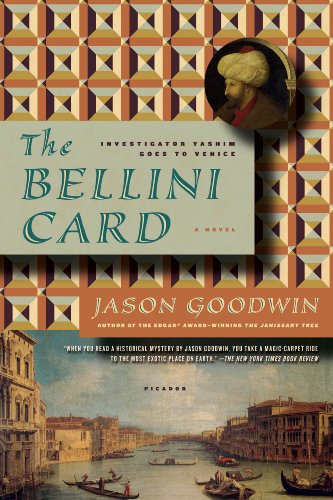
Jason Goodwin's The Bellini Card has a nose for the truth

My favorite line of the day is from The Bellini Card, Jason Goodwin's third novel featuring the most thoughtful, brooding polyglot late-Ottoman eunuch investigator in all of crime fiction:
"The sultan screwed up his face and opened his mouth as if to scream, then whisked a handkerchief from the desk and sneezed into it loudly and happily.

"Yashim blinked. In the Balkans, people said you sneezed whenever you told a lie."
For more on the Edgar Award-winning author, click here and scroll down.

© Peter Rozovsky 2010

Labels: , , , , ,

Tuesday, August 25, 2009

Flight dreck

Another bit from my current crime reading, Selçuk Altun's Songs My Mother Never Taught Me, dovetails nicely with a non-crime post I had planned to make. Here's Altun:

"The stewardess of the `business class' section was presenting the flight security precautions with the usual repulsive mimicry."

Here's me:
"A train journey begins with a thrilling lurch into motion. A plane journey begins with the slightly nauseating whiff of filtered, pressurized air.

"You squeeze past your rowmates' knees to get up. You squeeze past their knees to get back. (Just don't drop anything, because good luck squeezing down between rows to pick it up.) You contemplate the condensation between the windows. You choose from a wide range of entertainment options. You enjoy the easy-going conversational genuineness of the crew ..."
Coming soon: More from Selçuk Altun, plus my theory about why flight crews, so rigidly cheerful in the air, can be so obnoxious once they land.

© Peter Rozovsky 2009

Labels: , , , , , , ,

Monday, August 24, 2009

A novel from Turkey that won't leave me cold

Here's a bit from the second chapter of Selçuk Altun's Songs My Mother Never Taught Me:

"Today your humble servant Bedirhan Öztürk is thirty-seven years old! Instead of buying myself a birthday present I've come to a crucial decision. God willing, I'm going to break away from the business I've undertaken so patiently for the last twelve years.

"Please don't let the fact that I'm a hired killer alarm you. ...

"But retirement will come to pass, by the grace of God! Listening reverently to the evening ezan and eating my blessed pomegranate, I'll say my prayers and go to sleep, if you'll allow me. I'm sure that you've already begun to realize that your humble servant is no ordinary gun-toting operator."
I think I'll enjoy this novel's amiable tone. As a bonus, my alma mater gets a prominent mention in the third chapter.

© Peter Rozovsky 2009

Labels: , ,

Friday, July 10, 2009

A new blog about international crime fiction from folks who write the stuff

It's International Crime Authors Reality Check, a cooperative effort from Christopher G. Moore, Colin Cotterill, Matt Beynon Reese and Barbara Nadel, each of whom plans one post a week.

The opening lineup includes How the Devil Lost its Vagina from Cotterill, Quick, woman, go and get the Koran! from Rees, The Elements of Crime Fiction in Foreign Settings from Moore, and a modest greeting from Nadel.

The site also includes short biographies, information about the authors' books, and news links. I've written about three of the authors here on Detectives Beyond Borders, most recently about Cotterill's Curse of the Pogo Stick last week, and I'll look forward to adding Nadel to the list.

© Peter Rozovsky 2009

Labels: , , , , , , , , , ,

Thursday, June 11, 2009

4x4: The meme

My fellow award-winning blogger J. Kingston Pierce has tagged me with a meme tailor-made for Detectives Beyond Borders. The meme is built around questions involving the number four, and I especially liked the ones that involved travel and places where one has lived.

Since Jeff expanded the list of questions from eight to ten, I don't feel too badly about making my own adjustments. And you can do the same.


Four places I'd like to go or things I'd like to do:

1) Visit the Angkor temple complex in Cambodia

2) Visit the Ajanta caves in India

3) Hike the length of Hadrian's Wall

4) Complete a short walk I began a few years ago, along the West Kennet Avenue from Avebury to the Sanctuary


Four places I've lived:

1) Montreal

2) Rome

3) Philadelphia

4) The Boston area, which leads to my own category of ...


Four places I've lived in the Boston area:

1) Waltham

2) Brookline, whose no-overnight-parking regulations seemed intended to keep out the folks from ...

3) Brighton

4) Somerville


Four places I've been on vacation:

1) Split, Croatia. By the shimmering blue Adriatic Sea, in a hotel within the precincts of Diocletian's Palace. One of the places that has inspired me with a desire to live there.

2) 桂林 (Guilin, China.) Sweaty, hot, amid spotty air-conditioning and other trappings of a section of China making the uncertain transition to Western-style consumer capitalism. Also home of the near-hallucinogenic beauty of the sandstone natural spires, and the only place I have seen anyone playing a guitar while passenger on a bicycle.

3) Israel/Palestinian territories. Alas, it's not as easy as it once was to visit the Tomb of the Patriarchs to see blind old Muslim sage-like men praying at a site so fundamental to our sense of our own culture.

4) Istanbul, in particular Hagia Sophia, quite possibly the most influential building in the history of the world, and certainly one of the most beautiful. One can see the gallery mosaics up close, and there is something special about seeing and touching the rough, unfinished stone that lines the spiral stairways to the upper levels.


Four foods or drinks I have liked:

1) A nice, medium-rare steak

2) A good Brunello da Montalcino

3) Fresh raspberries

4) Deviled eggs


Four (with ties) books or movies I could read or watch again:

1)
Pride and Prejudice, Emma, Sense and Sensibility

2) Roughing It

3) Any of books 7 through 16 of Bill James' Harpur and Iles novels

4) Seven Samurai, Stray Dog and, appropriately for repeated viewing, Rashomon


Four works of art before which I have stood (or sat) either in deep relaxation, as close as I get to a meditative state, or with a profound sense of receptiveness:

1)
Piero della Francesca's Resurrection and Montefeltro Altarpiece (Scan by Mark Harden)

2) Velázquez's Las Meninas

3) Rembrandt's Bathsheba at Her Bath

4) Trajan's Column


Four literary, scientific, artistic or political figures from the past whom I'd like to watch at work or meet for dinner and drinks:

1) Giotto

2) Jane Austen

3) Mark Twain

3a) Charles Darwin

4) Jawaharlal Nehru. Anyone who can write a book of world history from memory and addressed as a series of letters to his daughter is a man to be reckoned with. Anyone who can write a book about his own country and call it The Discovery of India has a passionate intellect that's worth anyone's interest. And the man had a few practical accomplishments as well, I think.


Answers have begun to arrive from four people I think might take it upon themselves to answer these questions:

1) Sucharita Sarkar (yet another evocative post from one of my favorite writers in blogland.)

2) Seana Graham (good reading!)

3) Adrian McKinty (good reading about bridges and food!)

4) Maxine Clarke

and

5) Kerrie, who stepped in graciously for Maxine and talks about her journey from Paradise to Hell and back. Thanks!

© Peter Rozovsky 2009

Labels: , , , , , , , , , , , , , , , ,

Saturday, January 31, 2009

More Somer breeze

A few outtakes from this week's interview with Mehmet Murat Somer touched on setting, exotic and otherwise, a matter of occasional interest here at Detectives Beyond Borders.

"My books are not tourist guidebooks," Somer declared. Some crime novels, he said, express their sense of place through description, but "Istanbul is a personality in my books. It reflects ideas, feelings." To that end, he said he once turned down a request to give a visitor a tour of his novels' Istanbul and took the visitor for coffee instead. "What am I going to do, take them to transvestite nightclubs?"

At the same time, Somer appreciates the eye that a tourist or traveller can bring. "An observing eye," he said. "Even what we observe going for one day is valuable." This reminds me of Michael Genelin's remark at Bouchercon this year that a visitor may sometimes pick up details that a resident would miss because they are so commonplace.

With Somer's remark about Istanbul in mind, how can an author create a sense of place other than by taking readers sightseeing?

© Peter Rozovsky 2009

Labels: , , , ,

Thursday, January 22, 2009

History lessons

I enjoy fretting about possible tension in historical crime fiction between the history and the mystery. When should an author tell, and when should he teach? And, when relating the history of a setting unfamiliar to readers, should an author try to conceal his or her didactic intentions?

Jason Goodwin wades into the historical fray, fists full of zesty historical facts. And they work as story-telling, too. It helps that Goodwin's chosen setting may be the most colorful, central, cosmopolitan city that man has ever built: Istanbul/Constantinople. It helps that the city, a bridge between Europe and Asia, a jewel of art, a focus of commerce and intrigue for many centuries, a seat of the classical, then the Byzantine, then the Muslim world, was full of people from elsewhere — people who might well be eager for any scrap of information they needed to understand the complicated city in which they were trying to make their way.

Thus, Goodwin turns a greeting into a lesson on Byzantine iconography:

"`Yashim — the angel!' Grigor opened his arms wide across a desk piled with packets and papers done up in purple ribbon.

"The angel was Grigor's little joke, not one that Yashim particularly shared. As Grigor has once explained, Byzantine iconography represented angels as eunuchs. Angels stood on the threshold between men and God; eunuchs between men — and women. Both were intermediaries, dedicated to serve."
Or, on yet another facet of the city's colorful history:

"`Viking, Yashim. You've heard of the Vikings, surely? ... They scuffed Europe into what we call the Dark Ages. Most notable product, after widows: Russia.'

"Yashim was leaning forward, listening intently. Now he shook his head. `What do you mean, Russia? Or is it a Polish joke?'

"Palewski looked pained. `Not at all. The Vikings didn't just sail across oceans. They used the Baltic rivers, too. ... Up the Volga, down the Dnieper. The Black Sea. Constantinople. Easy. ...'

"`And that's the origin of Russia?'

"`Broadly speaking, yes. ...'"
And then, in an acknowledgement that must have made Goodwin smile as he wrote it, "`History lesson over. I don't know that it's been any good. Sun's gone. Let's have a drink.'"

© Peter Rozovsky 2009

Labels: , , , ,