Saturday, December 05, 2015

William McIlvanney is dead

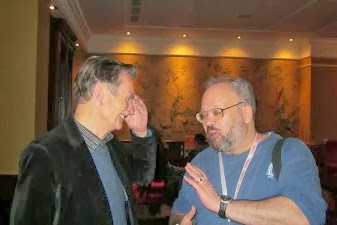
William McIlvanney and me at Crimefest Bristol
in 2013. Photo courtesy of Ali Karim.
I am shocked and saddened that the great Scottish author William McIlvanney has died.

McIlvanney's three novels about Glasgow Detective Inspector Jack Laidlaw — Laidlaw (1977), The Papers of Tony Veitch (1983), and Strange Loyalties (1991) — are the answer to anyone who needs proof that literary fiction can be tough, gritty, and unpretentious, or that crime writing can be beautiful, affecting, and a portrait of its time and place that deserves to last.

McIlvanney's sympathy with his low and not so lowlife characters was heart-rending and funny at the same time, and he made Glasgow his own in a way no other crime writer has done with a city, not Chandler with Los Angeles or Lawrence Block with New York or Jean-Claude Izzo with Marseille.

And oh, how he could make the oldest of hard-boiled crime fiction clichés seem new. The protagonist waking up drunk. The murder scene narrated from the killer's point of view. The police officer who sits around feeling bleak. The angry, nervous, fretting parent of a missing child. McIlvanney could make all seem like something you'd never read before.

He was a fluent and commanding speaker on stage at conventions, and a modest and jovial presence at the hotel bar, and I know of no other author regarded with such respect and affection by his fellow writers. Here's the Telegraph's obituary and appreciation. Here's a link to all Detectives Beyond Borders posts about McIlvanney. And here are a few of my favorite bits from the Laidlaw books:
"(H)e recognized the inimitable decor of Milligan's poky flat, a kind of waiting room baroque. 
"The walls were dun and featureless, the furniture was arranged with all the homeyness of a second-hand sale room and clothes were littered everywhere. It wasn't a room so much as a suitcase with doors."
 -- The Papers of Tony Veitch

 *
 "It was Glasgow on a Friday night, the city of stares. ... There were a few knots of people looking up at the series of windows where train departures were posted. They looked as if they were trying to threaten their own destinations into appearing."
-- The Papers of Tony Veitch

*
" ... his anger was displaced. It was in transit, like a lorry-load of iron, and he was looking for someone to dump it on. His jacket had been thrown on over an open-necked shirt. A Rangers football-scarf was spilling out from the lapels.

 "Looking at him, Laidlaw saw one of life's vigilantes, a retribution-monger. For everything that happened there was somebody else to blame, and he was the very man to deal with them. Laidlaw was sure his anger didn't stop at people. He could imagine him shredding ties that wouldn't knot properly, stamping burst tubes of toothpaste into the floor. His face looked like an argument you couldn't win."
 -- Laidlaw 

*
 "I've seen it go about its business all too often — all those trials in which you can watch the bemusement of the accused grow while the legal charade goes on around him. You can watch his eyes cloud, panic and finally silt up with surrender. He doesn't know what the hell they're talking about. He can no longer recognize what he's supposed to have done. Only they know what they're talking about. It's their game. He's just the ball."
 -- Strange Loyalties
*
"`Ma lassie's missin.' 
"`We don't know that, Mr. Lawson. ... She could've missed a bus. She wouldn't be able to inform you. She could be staying with a friend.'
"`Whit freen'? Ah'd like tae see her try it?' 
"`She is an adult person, Mr. Lawson.' 
"`Is she hell! She's eighteen. Ah'll tell her when she's an adult. That's the trouble nooadays. Auld men before their faythers. Ah stand for nothin' like that in ma hoose. Noo whit the hell are yese goin' to do aboot this?'" 
-- Laidlaw
© Peter Rozovsky 2015

Labels: , ,

Thursday, October 31, 2013

Liam McIlvanney; plus the way some presidents lie

As was the case last Friday, I'm too lazy to assemble and develop a coherent string of thought, so I'm going to play newspaper columnist again. If I were a real columnist, I'd try to make a virtue of my failure, and I'd call this post "While I was cleaning out the cobwebs of my mental attic" or "Stuff I wish I woulda thoughta." But, as that recently departed former journalism student Lou Reed sang in lines that could have been a copy editor serenading a columnist, "Some people, they like to go out dancing / And other people like us, we gotta work."  So, let's get to it.

1) Liam McIlvanney's All the Colours of the Town squarely confronts an issue I've long thought lurks beneath the surface of crime stories, especially those set during wartime: the queer, in-between situation of taking part in the action and, at the same time, observing it from the outside. McIlvanney's protagonist, Gerry Conway, is a Glasgow journalist sent to Belfast to dig up information on a Scottish politician's connections with sectarian paramilitaries in Northern Ireland:
"Maybe the News-Letter staffer was right. I was here to pick at scabs. I was greedy for all the old badness, the past’s bitter quota of hurt.

"I wasn’t alone. Across the West of Scotland, in the clubs and lodges, the stadiums and bars, people missed the Troubles. They mightn’t admit it, but they rued a little the ceasefires’ durability, the Armalite’s silence. We had followed the Troubles so closely for so long. There is something narcotic in watching a war unfold on your doorstep, knowing all the while it can’t harm you."
 Liam McIlvanney is William McIlvanney's son, and he shares something of that fine writer's penchant for long, loving descriptions of his protagonists' physical and human surroundings.

2) H.R. McMaster's Dereliction of Duty: Johnson, McNamara, the Joint Chiefs of Staff, and the Lies That Led to Vietnam got me thinking about changing fashions in presidential lies, evasions, and deceptions. McMaster's (and also Thomas E. Ricks') censure of Gen. Maxwell Taylor's close personal and social ties with the Kennedy family and of President Lyndon Johnson's preference for hand-picked advisers who would tell him what he wanted to hear reminded me of President Clinton and the Friends of Bill.  Johnson's insecurity reminded me of Richard Nixon and, reading how Johnson took advantage of instability in the Dominican Republic to divert attention from (and funding to) Vietnam in 1965 reminded me of the Iran/Contra scandal. I wonder if Reagan's advisers learned from Johnson's fate to make sure the president was well insulated from any dubious activities his administration might get up to.

© Peter Rozovsky 2013

Labels: , , , , , , , , , , , ,

Monday, October 28, 2013

Strange Loyalties: William McIlvanney in words and a picture

Your humble blog keeper (right) explains things
to William McIlvanney at Crimefest 2013
, Bristol.
Photo courtesy of Ali Karim
. Once again I'm rereading a novel by William McIlvanney, and once again I am struck immediately by how different he is from the legion of crime writers who acknowledge his influence.

This time the novel is Strange Loyalties (1991), third of McIlvanney's three Laidlaw novels and, like its predecessors, Laidlaw and The Papers of Tony Veitch, rereleased in trade paperback by Canongate.

A hard-drinking detective or police officer comes slowly to himself after a binge and boy, does his head hurt. You're read that scene a few hundred times, but probably not the way McIlvanney writes it. Here's the opening of Strange Loyalties:
"I woke up with a head like a rodeo. Isn't it painful having fun? Mind you, last night hadn't been about enjoyment, just whisky as anaesthetic. Now it was wearing off, the pain was worse. It always is."
First, McIlvanney comes with a funny, inventive, eye-catching way of saying, "I was drunk, and my head hurt." That's a good way to grab a reader's attention, a good thing to do in a novel's first sentence. Second, the humor is a welcome change from the pain and self-pity with which many another crime writer endows such first-person hangovers.

Third, McIllvanney immediately leavens the fun with somber self-realization that to me, at least, tugs at the heartstrings without getting maudlin.  If you've never read the Laidlaw novels, read that opening again. Don't you want to know the character who thinks those lines? Doesn't that mix make Laidlaw seem more real, more human?

So, who is like unto William McIlvanney? Allan Guthrie probably comes closest in his mix of humor and compassion, but even that top-flight crime writer doesn't do it with the concentration of his fellow Scotsman McIlvanney. Ken Bruen does something like it in Priest, though its characters lean more toward martyrdom and away from humor.

Ian Rankin calls it doubtful that he'd be a crime writer without McIlvanney's influence but, other than that McIlvanney's Laidlaw and Rankin's Rebus both work the streets of a tough Scottish city, I don't see striking similarities between the two. So I'll dump the question in your laps, dear readers: Which crime writers best combine humor and compassion? Which authors, if you want to put the question this way, will make you laugh and cry in the same book?

© Peter Rozovsky 2013

Labels: , , , , , , , ,

Saturday, July 13, 2013

William McIlvanney in a nutshell

My current reading is a hodgepodge of crime and noncrime. Here's a highlight from the crime part, The Papers of Tony Veitch, second of William McIlvanney's Laidlaw novels:
 "It was Glasgow on a Friday night, the city of stares. ... There were a few knots of people looking up at the series of windows where train departures were posted. They looked as if they were trying to threaten their own destinations into appearing." 
The line needs no analysis, but you'll get one anyway. The description's humor does nothing to soften its portrait of Glasgow. That's McIlvanney in a nutshell.
*
Cover blurbs often compare crime writers to Raymond Chandler, and the comparisons are generally superficial, fatuous or, I suspect, outright tongue-in-cheek. McIlvanney's emotional engagement with Glasgow, on the other hand, is one of the few facets of any crime novelist's writing that really is in the spirit of Chandler's with Los Angeles.

© Peter Rozovsky 2013

Labels: , , , ,

Monday, July 08, 2013

How William McIlvanney beats the stereotypes

The first thing that strikes me on my second reading of William McIlvanney's 1977 novel Laidlaw is how much better the book is than the many crime novels that have followed it in form but fallen short in spirit and execution.

Here's how an outline of Laidlaw might begin:
First chapter: Narrated from killer’s point of view as he flees murder scene.

Second chapter: Crusty police officer sits at his desk, feeling bleak.

Third chapter: Father of missing girl feels frustrated and powerless.
Forget, for a moment, that those tropes may not have been so tired back in 1977. The question on the floor is why McIlvanney's versions seem so fresh now that Canongate books has rereleased Laidlaw in 2013 (along with its follow-ups, The Papers of Tony Veitch and Strange Loyalties), other than that McIlvanney avoids the deadly trap of setting the inside-the-killer's-head chapter in italic type.

Start with compassion and humor. End with such telling detail that one feels one is reading novel observation rather that obligatory place-holders. Here's how the novel opens:
"Running was a strange thing. The sound was your feet slapping the pavement. The lights of passing cars batted your eyeballs. ..."
Find me a better description of alienation than that, of feeling inside one's body and removed from it at the same time. If you do, I bet it won't end on McIlvanney's humorous note:
"A voice with a cap on said. `Where's the fire, son?'"
Yes, quibblers, a voice with a cap on, a convincing subjective description of how the world might appear to a panicked young man fleeing through a crowded city's streets. Subjectivity here translates into empathy, which, in turn makes itself felt in McIlvanney's compassion for his characters, even the most unpleasant. That compassion, perhaps even more than his depictions of hard city (Glasgow), marks out his affinity with Goodis, Guthrie, and other great names in noir.

Then there's McIlvanney understated humor, of which the following bit about a clownish drunk is just one of my favorites (and it gives a nice picture of McIlvanney's Glasgow at the same time):
"He was circulating haphazardly. trying different tables. In Hollywood films it's gypsy fiddlers. In Glasgow pubs it isn't. With that instinct for catastrophe some drunk men have, he settled for a table where three men were sitting. Two of them, Bud Lawson and Airchie Stanley, looked like trouble. The third one looked like much worse trouble."
***
Here's an example of McIlvanney's compassion for his characters. Here's another that also exemplifies how McIlvanney gets beyond a crime-fiction trope by digging deeper into it. In this case, the trope is that of the introspective detective.

© Peter Rozovsky 2013

Labels: , , , ,

Saturday, July 06, 2013

"Sort of an anarchist with syndicalist tendencies," plus William McIlvanney

Elisha Cook Jr.
38 years before
"Hammett"
This post's title is a bit of dialogue from Wim Wenders' movie Hammett, based on Joe Gores' novel of the same name. That the line is uttered by Elisha Cook Jr., such a memorable presence in The Maltese Falcon, The Big Sleep, and Phantom Lady, still zesty at age 78 in 1982, makes a fine line even more delicious:
"Are you really a Wobblie?" 
 "Ah, no. That's just Hammett talking. What I am now is sort of an anarchist with syndicalist tendencies."
Cook appeared in Hammett forty years after he began making his name as a Hollywood fall guy. What are your favorite late-career cameo appearances?
*
Speaking of good lines, Canongate's rerelease of William McIlvanney's three Laidlaw novels (Laidlaw, The Papers of Tony Veitch, Strange Loyalties) may be the happiest event since this blog started, and one of the very few that deserve the name of event.

Laidlaw appeared in 1977, the other two in 1983 and 1991, and their author has since become recognized as a father figure to Scottish crime writers who have followed.  He has begun appearing at crime fiction festivals, including Crimefest 2013, celebrated by all and a genial presence for a literary demigod.

The Laidlaw books are the answer to anyone who needs proof that literary fiction can be tough, gritty, and unpretentious, or that crime writing can be beautiful, affecting, and a portrait of its time and place that deserves to last. (The place is Glasgow. That Glasgow is McIlvanney's adopted city is of interest. Does being a nonnative sharpen his perception?)

In addition to the books, McIlvanney has a website called Personal Dispatches, where bits of his writing appear from time to time, including a recent discussion with Sean Connery.

 © Peter Rozovsky 2013

Labels: , , , , , ,

Wednesday, May 22, 2013

"Ah refuse tae be victimised": William McIlvanney and Glasgow patter


I'm off to Crimefest in Bristol next week, so I thought I'd revisit a post or two about some of the featured guests at this year's edition of this fine crime fiction festival in South West England.  Foremost among those guests is William McIlvanney, the father of tartan noir and the author of Laidlaw, The Papers of Tony Veitch, and Strange Loyalties.
================
One often sees warnings against writing in dialect, but it works in passages like this, from William McIlvanney's 1977 novel Laidlaw:

"Ma lassie's missin'"

"We don't know that, Mr. Lawson. ... She could've missed a bus. She wouldn't be able to inform you. She could be staying with a friend."

"Whit freen'? Ah'd like tae see her try it?"

"She
is an adult person, Mr. Lawson."

"Is she hell! She's eighteen. Ah'll tell her when she's an adult. That's the trouble nooadays. Auld men before their faythers. Ah stand for nothin' like that in ma hoose. Noo whit the hell are yese goin' to do aboot this?"
Here's how the narrator describes Mr. Lawson:

" ... his anger was displaced. It was in transit, like a lorry-load of iron, and he was looking for someone to dump it on. His jacket had been thrown on over an open-necked shirt. A Rangers football-scarf was spilling out from the lapels.

"Looking at him, Laidlaw saw one of life's vigilantes, a retribution-monger. For everything that happened there was somebody else to blame, and he was the very man to deal with them. Laidlaw was sure his anger didn't stop at people. He could imagine him shredding ties that wouldn't knot properly, stamping burst tubes of toothpaste into the floor. His face looked like an argument you couldn't win."
The dialect works because it's part of the whole package, and no easy, condescending shortcut. Or maybe it's just that Lawson's speech sounds vividly in my head because of my recent listening to this. (Read about Glasgow patter here and here.)

And maybe, just maybe, it's because McIlvanney gives Lawson a line whose psychobabblish content sits comically against its Glaswegian accent: "Ah refuse tae be victimized."

And now your thoughts, please, on dialect, when it works, when it doesn't, why and whether authors should be especially careful with it. Examples welcome.

© Peter Rozovsky 2010

Labels: , , , , , , ,

Monday, April 26, 2010

"Thick as mince and a clatty bastit"

Readers of this blog know how much I love varieties of English other than my own, the slang especially.

Here's some of what I've found in Donna Moore's Old Dogs (I've boldfaced my favorite bits), and this is just in the first twenty-nine pages:

  • The line that gives this post its title.
  • "Naw, man, they're gonnae have this exhibition thing ther, with shitloads of expensive stuff. Would be a skoosh to nick something, I reckon."
  • "`Haw, fannybaws.' He poked Raymie in the side.

    "`Fuck's sake Dunc, I was sleeping. I was out on the randan last night and my head's still loupin'. This had better be fuckin' good or I'll batter you.'

    "`I'd like to see you try, ya mad rocket. You know that art gallery and museum place in the West End?'

    "`What art gallery Do I look like that Picasso bawbag, ya mad nugget?'"
The author's Big Beat From Badsville blog is good reading, too, ostensibly a guide to Scottish crime fiction but really a highly entertaining account of her adventures in Glasgow, with guest appearances from her parents and the unusually colorful lot that use the city's public transportation.

© Peter Rozovsky 2010

Labels: , , ,

Monday, March 22, 2010

The Papers of Tony Veitch, or showing, telling and compassion

"Show, don't tell" is one of those writing mantras that I think I believe in but have never examined thoroughly.

I guess the idea is that readers don't care what the author has to say, they want to see what the characters do. The Scottish novelist William McIlvanney intrudes on his own narrative far more than most crime writers do, often with thrilling results. Here's McIlvanney getting inside his protagonist's head in The Papers of Tony Veitch:

"He could recall giving up any belief in an overall meaning to living because any such meaning would have to be indivisible, unequivocally total, giving significance impartially to every drifting feather, every piece of paper blowing along a street.

"Eck was like one of those pieces of paper. You couldn't say the meaning of things was elsewhere and Eck was irrelevant. That was a betrayal. All we have is one another and if we're orphans all we can honorably do is adopt one another, defy the meaninglessness of our lives by mutual concern. It's the only nobility we have.

"Laidlaw tried to reinstate his energy by declaring war, over his whisky, on all brutalisers of others, all non-carers. Yet the very thought embarrassed. He would have been such a compromised champion, a failure opposing failure."
McIlvanney invokes compassion implicitly and, elsewhere, explicitly, compassion for victims, for perps, compassion for those who feel hopeless compassion. I've noticed a similar tendency in Allan Guthrie's novels and in Ken Bruen's Priest.

And now, two questions: 1) How do you feel about showing vs. telling? and 2) Is it any surprise that authors of hard stories about hard men should be attracted to compassion as a theme and a human attribute?

(Read about William McIlvanney here.)

© Peter Rozovsky 2010

Labels: , , , ,

Monday, May 25, 2009

Night of the living neds

(City Chambers, George Square, Glasgow)

"A Glasgow stabbing is more fun than an Edinburgh wedding," runs a popular saying, and my informant tells me Glaswegians say this with pride.

I got out of town before the celebration worked its way to full steam, but I expect occasional acts of yobbery happened in honor of Glasgow Rangers' wrapping up the Scottish Premier League soccer title on Sunday.

Championship games seem to follow me around. On Friday, I joined a boatful of Leinster fans on the Belfast-Stranraer ferry heading for Edinburgh to watch their team play for the Heinken Cup in rugby (They conducted themselves well, though an Edinburgh acquaintance complained that a Leinster fan accidentally bopped her in the head with a flag.) And last year, I wandered into Dublin in time to witness what may have been the greatest team performance in the history of hurling.

(Holyrood Park, Edinburgh)
That same head-bopped Edinburgher replied (good-naturedly, I think) to a Glaswegian's comment about her adopted city last week. "Don't, she wrote, "be led too far astray by those cunning Glasgwegian types." So yes, I learned something of the rivalry between Scotland's two largest cities. (For more insight than I can offer on the passions stirred by Scottish sports, see a long, thoughtful comment here.)

Cheers.

© Peter Rozovsky 2009

Labels: , , , , , ,