Thursday, July 27, 2017

Sunshine Noir, the CWA Dagger awards, and me

I feel a kinship with the shortlists (one word in British usage) for the Crime Writers Association Dagger awards, announced last week. Two of the six finalists for best short story "The Assassination," by Leye Adenle; and "Snakeskin," by Ovidia Yu   appeared in Sunshine Noir, a collection of short stories set in hot places. Here's what I wrote about Adenle's story in my introduction to the volume (I gave the introduction the title "Clime Fiction," and the indulgent editors, Annamaria Alfieri and Stan Trollip, in his role as part of the writing team of Michael Stanley, were kind enough to let it stand):

"Leye Adenle’s `The Assassination' is a taut tale of death and political corruption that harks back to honorable precedents in crime and espionage writing but is redolent of its setting, which I take to be the author’s country, Nigeria."

Here's what I wrote about Yu's:

"If you want gothic-tinged domestic mystery, you’ll find it in Sunshine Noir. (Family secrets flourish in steamy air. Try Ovidia Yu's `Snake Skin.')"

Three of the remaining shortlisted stories are from Motives for Murder, edited by Martin Edwards, including one by Edwards himself. I have no connection with Motives for Murder, but I will join Edwards on a panel at Bouchercon 2017 in Toronto. So when it comes to Daggers, I know almost everybody's shorts.

(Read about the nominees in all categories on the CWA website: https://thecwa.co.uk/the-daggers/)

© Peter Rozovsky 2017

Labels: , , , , , , ,

Tuesday, July 07, 2015

Manhattan Mayhem in The Philadelphia Inquirer

My review of Manhattan Mayhem, a star-studded collection of short crime fiction that celebrates Manhattan on the occasion of the Mystery Writers of America's 70th birthday, appears in Sunday's Philadelphia Inquirer.

The 17 contributors include Lee Child, Jeffery Deaver, Mary Higgins Clark, T. Jefferson Parker, and others, and each story takes place in or on a different Manhattan neighborhood, building, or river.

Highlights include Julie Hyzy's proving she can write chilling suspense as well as the cozy novels for which she is known, and a prime contender for greatest title ever: S.J. Rozan's  "Chin Yong-Yun Makes a Shiddach."

Read the entire review at philly.com.

© Peter Rozovsky 2015

Labels: , , , , , , ,

Thursday, June 18, 2015

Wow! I didn't know she could do that!

The second story in Manhattan Mayhem is a piece of dark psychological suspense with an ending I did not see coming.  It's one of my two favorite stories in the collection so far, and what makes it notable is that the writer is Julie Hyzy, author of two successful cozy mystery series. (She had the good taste to turn one of my suggestions into the title of one of her books.)

Nothing in Hyzy's previous work and nothing I knew about her prepared me for her Manhattan Mayhem story, "White Rabbit," so today's question is What writers have surprised you in this way? What novels or stories have made you think, "Wow! I didn't know he (or she) could do that!"?
*
Manhattan Mayhem includes 17 short stories, and it ccelebrates the 70th anniversary of theMystery Writers of America, the organization that, among other things, presents the annual Edgar Awards. My other favorite in the collection so far is T. Jefferson Parker's "Me and Mikey," and the best title has to be S.J. Rozan's "Chin Yong-Yun Makes a Shiddach." The contributors include Jeffery Deaver. Lee Child, Margaret Maron, Thomas J. Cook, and more,  a strong cast.

© Peter Rozovsky 2015

Labels: , , , ,

Tuesday, June 09, 2015

Location. Location? Location! with questions for readers

I'm reading a location-based collection of stories and, by coincidence, the first three stories I read illustrate three approaches to location in crime stories (other genres, too, I imagine).

One of the stories, and not a bad one, laid the tourism touch on a bit heavily, I thought, name-checking well-known locations with just the slightest whiff of the guidebook. A second, a fine story, was a bit more subtle in its invocation of setting but, as good as the story was, it would have worked just as well set in any number of other places. A third story, the best of the lot, to my mind, made superb use of its setting's unique features. The author could have written a similar story and set it elsewhere but, more than is the case with the other two, it would have been a different story.

 Now, your thoughts on setting, please. What novels or stories simply could not be set anywhere else? What novels or stories that emphasize their settings could, nonetheless, work if transplanted to a new location?  What, in other words, does setting mean to you? What constitutes good setting in fiction, crime fiction or otherwise? 
*
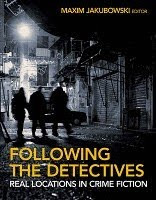
The book illustrated at the upper right of this post is Maxim Jakubowski's Following the Detectives: Real Locations in Crime Fiction, to which I contributed chapters on Andrea Camilleri's Sicily and Arnaldur Indriðason's Iceland. Arnaldur's novels are more intimately (and literally, in some cases) rooted in their settings than any others I know. What authors do you say are most inextricably bound up with their settings?

© Peter Rozovsky 2015

Labels: , , , ,

Thursday, May 28, 2015

Paul D. Brazill's 13 Shots ..., or Noir: I know it when I see it

I don't think much about what noir is or isn't, but every once in a while, as Potter Stewart did with obscenity in Jacobellis v. Ohio, I know it when I see it.

My latest epiphany has come with the opening stories of Paul D. Brazill's 13 Shots of Noir. The stories are all dark, of course, in the sense that their characters do terrible things,  but they are filled with humor, and one even has a happy ending of a kind.

So, what makes Brazill's stories noir? Just this: Better than most authors whose work gets tagged noir, Brazill makes every villain, as the saying goes, a hero in his own story. In addition to the attendant irony and humor, that is apt to fascinate and horrify a reader at the same time. And that, it says here, is one of noir's defining characteristics.

© Peter Rozovsky 2015

Labels: , , ,

Wednesday, November 20, 2013

"He was a bald-headed man of no particular age ..." or What's your favorite line?

This post's title comes from Raymond Chandler's story "Nevada Gas," which you should never read before getting in the back seat of a car unless you are absolutely sure the windows and the door handles work. The complete passage follows:
"De Ruse half-closed his eyes and watched the croupier's fingers as they slid back across the table and rested on the edge. They were round, plump, tapering fingers, graceful fingers. De Ruse raised his head and looked at the croupier's face. He was a bald-headed man of no particular age, with quiet blue eyes. He had no hair on his head at all, not a single hair."
I've never seen that passage on the lists of famous Chandler quotations, and I don't know why. Maybe the compilers of such lists are more familiar with Chandler's novels than with his short stories. The passage does at least as much to set a mood as the opening to "Red Wind," but how does it do what it does?

How about that juxtaposition of plump and graceful, two words not generally associated? How about no particular age,  without qualification or modification, no "appeared to be," no "He could have been thirty, or he could have been sixty"?  Or the intensifying not a single hair after Chandler has already told us the croupier is bald? Surprising? Yep. Dreamlike? Otherworldly? Maybe. As good as blondes and bishops and stained-glass windows? I'd say yes.

What's your favorite Chandler line? And why? Or choose a memorable line by another author, and tell my why you like it.
*
(Blogger's spellcheck program is politically correct with respect to what its designers would probably call gender, but is really sex.  It flagged as a misspelling blondes two paragraphs above. I wonder if the simps who wrote the program would come up with a more gender-approprate name for one of Bob Dylan's most ambitious and celebrated albums.)

© Peter Rozovsky 2013

Labels: ,

Wednesday, May 15, 2013

Mad Italian shorts

Thanks, readers. Commenting on Monday's post about short stories, one of you suggested Pirandello's "The Fly." That led me to a collection of Pirandello's shorts called Tales of Madness, a selection from his aborted project to write a short story a day for a year. (Another collection from the project is called Tales of Suicide, but don't worry. Pirandello was not as downbeat as all that.)

To my surprise, the collection's first story is a crime story, pure and not so simple. Not a detective story, though it contains a murder and is almost all mystery.

Here's how the story, "Who Did It?", begins:

"Then you tell me who did it, if what I say just makes all of you laugh. But at least free Andrea Sanserra, who is innocent. He didn't keep our appointment, I repeat for the hundredth time. And now let's talk about me."
Its end ought both to satisfy readers who crave twist endings to their short stories, and to make those same readers ponder the subject raised in the collection's title. If only more crime stories could make their readers think as much about what they've just read as this one did.
*
A commenter informs me that May is Short Story Month. Thanks, Paul.

© Peter Rozovsky 2013

Labels: ,

Monday, May 13, 2013

DBB slips into some shorts

Spring is a good time for shorts, and that's what I've been reading a lot of these days, a f*ckload of shorts, in one case. The list has included:
  1. Mr. Calder and Mr. Behrens by Michael Gilbert
  2. Erased and Other Stories by author, cameraman, and Detectives Beyond Borders friend Thomas Kaufman
  3. A F*ckload of Shorts by cozy writer Jedidiah Ayres
  4. Short Sentence by miscellaneous and, saving the best for last,
  5. "An Occurrence at Owl Creek Bridge," by Ambrose Bierce
I suspect I'll have something to say about several of these items, whether about Gilbert's deadpan hard-boiled humor, Ayres' multiple points of view and general degeneracy, or artful, surprising but non-gimmicky endings by Kaufman and in Anne Zouroudi's contribution to Short Sentence.

Click on the the Bierce title above and read the story free online. When you get your breath back, see if you can guess how I think Bierce addresses the great philosophical problem of almost all crime fiction.

In the meantime, what are your favorite stories, crime or otherwise, and why do you like them?
***
A kind DBB reader sends a link to this Oscar-winning 1962 film adaptation of "An Occurrence at Owl Creek Bridge."
***
A commenter informs me that May is Short Story Month. Thanks, Paul.

© Peter Rozovsky 2013

Labels: , , , , ,

Saturday, January 19, 2013

Detectives Beyond Borders tries some "Blood and Tacos"

Let's keep this pulp thing going a while longer, only with a twenty-first-century nod to a 1970s successors to pulp magazines.

I've just read Gary Phillips' "The Silencer," the first story in Blood & Tacos #1, and here's why I think I'll like this quarterly digest of short crime fiction,  whose fourth issue should be out soon:

  • Phillips' title character, a Vietnam veteran, used to run an auto-repair and customizing shop called Danang Drag Motor Specialists.
  • The "former petty street thug Ronnie Brownlee, who now went by Rahim Katanga."
  • Katanga's group, with its "Ministers of Praxis, MPs for short."
  • "Y'all say four kids went missing after they attended your propaganda class."

    "After school program, policeman," a tall MP emphasized. "We help them with their math and reading skills."
  • Any story that makes both a self-styled revolutionary group and The Wild, Wild West part of its literary arsenal has got lots going for it.
That sort of thing makes me wish I'd been around in the 1970s.

Wait a minute, I was around in the 1970s, and it's a hell of a lot of fun to see the era evoked even as a story pokes fun at its excesses and its self-seriousness. I like these guys' attitude.

© Peter Rozovsky 2013

Labels: , ,

Sunday, August 12, 2012

Yams! Yams! Yams!

Or, to state the case more fully:
"Rubbing his sleepy eyes, he looked a second time, and with a sharp gasp he realized what they were. Yams! Yams! Yams!"

The passage is from Ryūnosuke Akutagawa's story "Yam Gruel," which has nothing to do with crime, but how could I resist a line like "Yams! Yams! Yams!"?

Akutagawa (1892-1927) did write stories with elements of crime to them, notably the two on which Akira Kurosawa based his celebrated movie Rashomon. And "Kesa and Morito," based, like a number of Akutagawa's stories, on old Japanese tales, may remind crime fans of Double Indemnity.

© Peter Rozovsky 2012

Labels: , ,

Friday, August 10, 2012

Shane MacGowan meets Ryūnosuke Akutagawa

One of the bounciest, most cheerful songs I've heard recently also makes the Detectives Beyond Borders list of great noir and crime songs (click the link, then scroll down for some good reading and listening.)

The song is "Rain Street," from the Pogues' 1990 album Hell's Ditch, and it includes lines such as:
"Down the alley the ice wagon flew
Picked up a stiff that was turning blue
The local kids were sniffin' glue
Not much else for a kid to do
Down rain street."
Lyrically, the song is a bit like Lou Reed and, in its stream of images, something like Bob Dylan's long, near-surrealistic songs from the mid-1960s. But Shane MacGowan had a livelier sense of fun than both those guys, and the Pogues were better and tighter musically, so the song is just plain fun to listen to even if you ignore the words.

But those words ... they're a little like David Goodis or maybe, I don't know, Nelson Algren. Click on the song's title above to hear Shane and the boys perform it.
***
Rashomon is one of the greatest and most celebrated of all movies, and probably the best-known Japanese movie in the Western world. (How many movies have lent their titles to a psychological effect?)

But thirty-six years before Akira Kurosawa's film, "Rashomon" was a story by Ryūnosuke Akutagawa, one of two by the author that formed the basis of the movie. (The story "Rashomon" is the source of the ramshackle gate and the unforgettable rain in the movie; the "Rashomon effect" is depicted in a story called "In a Grove.")

Late on a rainless night in a deserted office is no time or place to start a consideration of twentieth-century Japanese literature, so I'll begin and end by saying that "In a Grove" is one of the wittiest and most carefully and deliberately constructed stories this writer has had the pleasure to read. As of now, I am, albeit tentatively, a Ryūnosuke Akutagawa and you should be, too. Read him to have your eyes opened to new, little-explored possibilities for crime stories.

© Peter Rozovsky 2012

Labels: , , , , , , , , ,

Friday, August 03, 2012

Elmore Leonard's "Raylan: A (non-) Novel"

Elmore Leonard's novel Raylan: A Novel is no novel, at least through its first two thirds, and I’ll eat my hat if it turns out to be one in the end.

Rather, it’s a collection of loosely linked stories, and a good one.  At least through the first two stories, it's as good as Pronto, the first Raylan Givens novel, and better than Riding the Rap. Characters in the second story will occasionally mention events in the first, but that’s as strong as the connection gets. I felt a bit cheated when I reached the first story’s satisfying end, only to find a new story beginning.

I wonder whether Leonard and his publishers really do regard the book as a loosely organized novel, or whether going out of their way to insist in the title that the book is a novel is strictly market-driven, a recognition that novels are an easier sell than short-story collections.

Any thoughts from Leonard fans and others?

© Peter Rozovsky 2012

Labels: , ,

Tuesday, July 17, 2012

Steven Torres' serious, funny short stories

I once had a colleague who had been born in Puerto Rico and who would hold forth at the drop of a hat on race and ethnicity in America. In fact, he wouldn't wait for the hat to drop; he'd speechify whether his listeners wanted to hear him or not.

His saving graces were considerable intelligence and a bracing questioning of our industry's orthodoxy at a time when diversity was a corporate buzzword. He dismissed the Miami Herald's Spanish-language edition, for example, insisting that Latinos in the United States wanted to read and speak English.

I thought of this when reading one of Steven Torres' stories about Ray Cruz, the most dangerous man in New York City:
"The man holding Carver thought for a second, then started shouting in Italian again.
"`Speak English, maricon!' Ray roared. At the same time he pulled the trigger. The bullet hit the gunman’s right shoulder. He let go of Carver and went from crouching to sitting, and Ray Cruz took a step closer, put another bullet in the man’s chest, six inches below his chin."
That's humor about which could write a paper or at least rub one's chin thoughtfully after one got done laughing.

Another thing I like is Torres' juxtaposition of stories about Ray Cruz with others about a counterpart named Viktor Petrenko. Without providing too much of a spoiler, I'll say I read each as the flip side of the other, or else as contrasting perspectives on the moral destiny of men who do bad things.

(No, Torres says, he did not know when he wrote the Petrenko stories that there was a celebrated figure skater of the same name. There are no double Salchows or triple Axels in these stories, and the protagonist's landings are anything but smooth.)
*
Steven Torres is author of the Precinct Puerto Rico novels, The Concrete Maze, and the short-story collections Killing Ways, Killing Ways 2, The Box and Other Odd Stories.

© Peter Rozovsky 2012

Labels: , , ,

Wednesday, March 28, 2012

Dashiell Hammett free online!!!

Dashiell Hammett's early story "Arson Plus"  is available free online as the Library of America's story of the week. The story was one of Hammett's first, but it's almost miraculously full of the humor and laconic hard-boiled style of his later work.

Hammett was our best crime writer,  the Library of America may be our best publisher, and and the price is right. What's not to like?

© Peter Rozovsky 2012

Labels: ,

Wednesday, January 11, 2012

Allan Guthrie's black shorts

Allan Guthrie, that sharp noir author, scholar, editor, agent, and impresario, is back with a collection of cheap shorts.

Hilda's Big Day Out offers four gut- and heart-wrenching slabs of noir, including the title story, which is atypical in at least two ways: It has an arguably happy ending, and its narrator is a dog.

Of the remaining tales, "Bye Bye Baby," which gave rise to Guthrie's novella of the same name, may wring tears of pity from even the hardest-hearted reader. Like David Goodis' novel Cassidy's Girl, its noirness inheres not in a tragic ending, but rather in an inconclusive sort of non-ending. Not every tragedy has the easy out of catharsis or death. Sometimes the nightmare just goes on.

© Peter Rozovsky 2012

Labels: , , ,

Thursday, November 03, 2011

Crime Factory: The First Shift rules!

Crime Factory: The First Shift (New Pulp Press) is fat with fiction, thirty-some noir stories from:

Dennis Tafoya, Andrew Nette, Jedidiah Ayres, Roger Smith, Josh Converse, Charlie Stella, Greg Bardsley, Hilary Davidson, Kieran Shea, Nate Flexer, Cameron Ashley, Patti Abbot, Chad Eagleton, Ken Bruen, Jimmy Callaway, Dave Zeltserman, Steve Weddle, Craig McDonald, Keith Rawson, Leigh Redhead, Anonymous-9, Jonathan Woods, Liam Jose, Dave White, Chris F. Holm, Frank Bill, Adrian McKinty, and Scott Wolven.

I've read Tafoya's, Smith's, and Stella's contributions so far. Tafoya and Smith are established Detectives Beyond Borders favorites, and Stella became a new one with his story "The Decider," an act of workplace wish fulfillment that management might want to keep out of workers' hands.

Smith's "Half-Jack" is marked by this memorable phrase that isn't even part of the main action: "...the carefully coded conversation of the sex-addicted." And Tafoya's story, "Stinger," opens the collection thus: "They met in Arraignment, and she knew he was the one."

And I still have twenty-five stories left to read. This is going to be fun.
© Peter Rozovsky 2011

Labels: , , ,

Friday, August 26, 2011

Bad manners and Colin Cotterill: Whom would you kill?

Colin Cotterill has, like me, fantasized about killing off people with bad manners. In my case, the victims include the slouching youth who blasts music in the subway and the self-important lawyer bellowing into his cell phone on the Paoli local to the Main Line. Here's a post I made in 2009 about Cotterill's Aging Disgracefully, along with a question to readers.
***
"Hilda knew the lass would be making people's lives a misery when she was sixty. She'd decided then and there to make an example of her."
The perp/protagonist of "Gran Larceny" is a senior citizen, which is the point of Colin Cotterill's Ageing Disgracefully, a collection of short stories about "murderers, bank robbers, practical jokers, serial killers, perverts and just plain liars, all of whom are old enough to know better."

She also shares a trait with the killer in Ken Bruen's Calibre: She targets people with bad manners.

(It is just coincidence that I am trapped in the Pen & Pencil Club with a roomful of a) flacks and political operatives who [though it's redundant to say so] are b) unnecessarily loud and are also listening to c) reggae.)

Who would you bump off, rob or set up because of their rudeness, thoughtlessness, lack of consideration and other offensive carrying on? How would you do it?
***
Colin Cotterill will be part of my “CRANKY STREETS: WHAT'S SO FUNNY ABOUT MURDER?” panel on Saturday, Sept. 17, 11:30 a.m.-12:30, at Bouchercon 2011.

© Peter Rozovsky 2011

Labels: , , ,

Friday, October 01, 2010

A welcome Rut

I had no idea it was coming, but yesterday I received the welcome news that Scott Phillips (crouching at lower left in the photo at right) is about to release a new novel.

Rut, published by Concord Free Press,

"takes readers to the Rocky Mountains circa 2050, where the once thriving burg of Gower is about to become a 21st-century ghost town. Thanks to extreme weather and plenty of toxic waste, the skiers and celebrities are gone, along with the money and the veneer of civilization. What’s left? Old-time religion and brand-new pharmaceuticals, bad food and warm beer, mutated animals and small-town gossip. Can the town survive? We’ll see."
Now, that sounds like one believable speculative novel.

Phillips has written three previous novels: The Ice Harvest, The Walkway, and Cottonwood. The first of these was made into a fine movie starring John Cusack and Billy Bob Thornton. He also writes some of the most deadpan hilarious short crime fiction anywhere.

I'll be looking for Rut. And you should, too.

© Peter Rozovsky 2010

Labels: ,

Sunday, August 29, 2010

Bye Bye Baby: Fast, hard, cheap and good


"In the car, Erica said, `I don't know whether to laugh or cry.'"

Allan Guthrie's Bye Bye Baby is fast, hard, twisted and, thanks to a publishing quirk, cheap.

The novella's publication was pushed back to 2013 and, in the interim, Guthrie secured electronic publication rights. That's why you can read this affecting, ingenious kidnapping tale with a twist for $2.99.

Guthrie wrote Bye Bye Baby for Barrington Stoke's series of crime stories for adult reluctant readers. What does this mean for enthusiastic readers? A story that moves quickly, in short chapters of crisp prose, with plenty of plot turns to hold the attention, and characters you can love and others you can hate. And what's wrong with that?

Like Guthrie's full-length novels, Bye Bye Baby is sly, noir as all hell (more noir than some, actually), and it just might bring a tear of pity to your eyes. It's a police procedural filled with incident and back story, and man, what an ending.
***
Click here for a discussion of the challenges and, just maybe, the possibilities involved in publishing novellas and other short crime fiction.

G© Peter Rozovsky 2010

Labels: , , ,

Friday, August 27, 2010

Just a bit more Hammett, including the Continental Opera

I left the house without the non-American book I was going to write about, so I'll continue my Hammett holiday a bit longer.

1) Even the earliest Continental Op stories have that twist ending that casts into question all that has gone before, or comes as a comic anti-climax, or seems almost to be the beginning of a new story before the old one has ended.

2) The first great Op story was probably "Zigzags of Treachery" — and here I welcome comment from readers more up on their Hammett than I. I don't know how critical consensus ranks the Op stories. "The Golden Horseshoe" is the best of this batch I've read in recent days.

3) Hammett's experience as a private detective is often cited as contributing to the authenticity of his writing. It does this in the Op's convincing asides about detective work (good shadowing, the Op tells us, perhaps ironically, is not as hard as one would think), but also in observations like this:
"Little things, those, but a private detective on the witness stand—unless he is absolutely sure of every detail—has an unpleasant and ineffectual time of it."
4) Hammett's novel Red Harvest was made into an opera, which elicited the observation from the Thrilling Detective Web Site's Kevin Burton Smith that "I guess it won't be over until the Fat Man sings."

Go here for a compact but thorough discussion of Hammett's short fiction, including a typology of his plots.

© Peter Rozovsky 2010

Labels: , ,