Friday, April 22, 2011

Garry Disher's Wyatt comes to America

Parker is Richard Stark's professional thief, Wyatt is Garry Disher's.

Similarities between the two protagonists are obvious, including everything from their names to their personalities to the targets of their heists to the titles of the books. And, though Disher has paid amusing tribute to Stark, the influence may extend from Disher as well as to him.

My posts on the subject in this blog's early days drew passionate comments from some Australian readers angry at what one called a "cultural cringe" — excessive imitation by the Australian Disher of an American source. Disher himself weighed in on my Parker/Wyatt questions, though his comments seem to have disappeared from the State Library of Victoria's Web site. (No conspiracy need be inferred. He posted the comments four years ago, and they may have been removed to clear space.)

If I recall correctly, Disher said he wanted Wyatt to be a more fully rounded character than Parker. Indeed, the fifth Wyatt novel, Port Vila Blues, has Wyatt displaying remorse, which Parker never did.

American readers will soon get their chance to meet Wyatt; Soho Press is publishing the seventh and latest novel in the series, called simply Wyatt. A first glance at the book finds Wyatt sizing up a potential human obstacle to a heist, much as Stark often had Parker do, but with a good deal more psychological analysis than Parker was given to. One way is not necessarily better than the other, but it's good to find differences between two protagonists in many ways so similar.

Wyatt follows Disher's previous Wyatt book, The Fallout, by thirteen years. The series' resumption after a long layoff may remind readers of another crime series.
***
© Peter Rozovsky 2011

Labels: , , , , ,

Thursday, December 13, 2007

The lowdown on Wyatt and Parker

After often pondering Garry Disher's Wyatt and his entertaining and intriguing ties to Richard Stark's Parker, I went to the source, and the source answered. Here's Disher's reply to my questions, along with some observations about his other series characters, Hal Challis and Sergeant Ellen Destry. (Another hat tip to that human RSS reader, Damien of Crime Down Under.)

© Peter Rozovsky 2007

Technorati tags:


Labels: , , , , ,

Friday, December 07, 2007

Garry Disher plus one last Paris picture

And no, the picture is not of my hotel room.

Crime Down Under posts links to two articles by the award-winning, attention-getting, worth-reading Garry Disher. In one, Disher talks about becoming a writer, including some interesting remarks about the trials and tribulations of being so versatile an author. In the other, he offers a detailed analysis of how he writes, and he discusses some of the products of that writing: Hal Challis, Ellen Destry, and the cold, mysterious Wyatt. The latter article includes the excellent news that Disher is at work in on a seventh Wyatt novel. But Disher does not discuss the entertaining and intriguing ties between Wyatt and Richard Stark's Parker.

A bonus for readers in the Northern Hemisphere is that Disher's articles appear under the heading "Great Victorian Summer Read Blog." The nerve of the guy, lording it over we damp, shivering northerners.

© Peter Rozovsky 2007

Technorati tags:


Labels: , , , , , , ,

Tuesday, March 20, 2007

Second-guessing my second thoughts

This Parker-Wyatt thing keeps getting weirder and weirder. I'd based my comments on the similarities between the two on my reading of all but one of the twenty-three Parker novels but just the first two Wyatt books. Seventeen pages into Port Vila Blues, Wyatt number four, though, I thought, "Aha! Now Disher has made the decisive break from his imitation/tribute to Parker."

Wyatt shows remorse for a partner shot and damaged during a holdup, vowing to support him for life. He visits the man and his sister in their rundown house to give them money. The man, who has uncertain control of his bodily functions since the injury, soils himself as he and Parker try to fence a stolen gold and diamond brooch. The opening pages, in short, are full of pathos miles removed from the thoroughly ruthless Parker.

Then, idly flipping through the novel, I came upon a description of a heist virtually identical to one in a Parker novel, Deadly Edge, if my memory serves me well. If I remember to do so, I'll post both passages here later.

© Peter Rozovsky 2007

Technorati tags:


Labels: , , , ,

Monday, March 19, 2007

Wyatt and Parker

I've posted from time to time on the similarities between Garry Disher's Wyatt and Richard Stark's Parker, similarities that are too close and too numerous to be mere chance.

But has either Stark (a pen name of Donald E. Westlake) or Disher ever discussed the issue?

© Peter Rozovsky 2007

Technorati tags:


Labels: , , , ,

Wednesday, February 28, 2007

Wyatt and Parker, Part II

My comments about Garry Disher and Richard Stark (Donald E. Westlake) a few months ago drew some pointed responses from readers puzzled or angry about Disher's use of Stark's Parker character as a model for his own Wyatt.

I've just finished Disher's second Wyatt novel, Paydirt, and, as the novel ends, Wyatt, troubled by a hitman from the mob, called here "The Outfit," vows to take his quarrel to the Outfit personally. Those angry November readers may be unhappy to learn that Stark had written a Parker novel called The Outfit, in which, well, you can guess.

If I were Australian, I might be more sensitive to allegations that Disher was engaging in "cultural cringing" by using an American model. (Of course, I'm not American, either, as readers of this blog might assume.) Instead, I urge everyone to read some Wyatt novels, then a few of the earlier Parkers. Then they should read Disher's clever and funny short story "My Brother Jack," available in The Oxford Book of Detective Stories. In addition to providing some of the best crime writing from any country, this should convince readers that Wyatt is no mere copy of Parker. And "My Brother Jack" should make any reader believe that Disher may have been at once paying homage to a great crime writer and setting himself the challenge of sticking fairly closely to a model while at the same time creating a character of noticeably different temperament.

I have never seen Disher discuss the Wyatt-Parker question. Do any readers know of such a discussion? Better still, if Garry Disher ever reads this, I'd love to hear what he has to say.

© Peter Rozovsky 2007

Technorati tags:

Labels: , , ,

Wednesday, February 07, 2007

Does life imitate art, or what?

Readers of crime fiction have noted similarities between two no-nonsense, thouroughly professional thieves, Richard Stark's Parker and Garry Disher's Wyatt. Disher himself provides tantalizing clues in his story "My Brother Jack." The Crime Down Under blog provides another even more exciting possible source for Wyatt (or was Wyatt the source?)

© Peter Rozovsky 2007

Technorati tags:

Labels: , ,

Wednesday, November 15, 2006

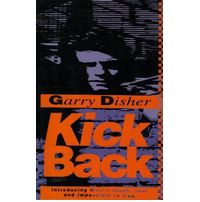
A thrilling house of games: "Kickback" by Garry Disher

On the off chance that I ever again receive a comment on this blog, I pick up my assessment of Kickback where my initial discussion left off.

The obvious and numerous nods to Richard Stark's Parker novels in the end serve to highlight the differences of temperament between Disher and his protagonist, Wyatt, and Stark/Parker. Like the best Parker books, Kickback is a well-paced and compelling caper story. We see the selection of a target, the debate over method, the acquisition of guns. The crime's planners worry over a safe place to hide out afterward and about their need for seed money to pay for the robbery. The caper is planned, and both it and a preliminary crime step on dangerous toes, with violent complications.

But Disher is more interested in emotion and less in surgical detail than Stark. Wyatt, though impatient with stupidity in others, is more social and susceptible than Parker. For one thing, he lets himself become involved with a woman during the caper's planning, which Parker avowedly would never do. And when he does become involved, the feelings are more than just sexual. There are tenderness and vulnerability in Wyatt's feelings for this novel's femme fatale. There are also touches of humor here, both on the author's part and the protagonist's, where there would be none in a Parker book. A typical Parker novel would never contain an exchange like this:

Hobba jabbed with the gun. `I said shut up.'

`Ivan's got contacts. Anything happens to me, you've had it.'

`Sugar,' Hobba said wearily, `your brother thinks you're a fuckwit.'


The family complications implied in that exchange are another `human' facet bolstering the case that Wyatt is no mere Parker clone. And the killing of an ultimately hapless villain in Kickback has pathos utterly foreign to Parker's world.

I hope I have not offended Australian readers by discussing Wyatt almost exclusively in terms of Parker. We (North) Americans are often accused of cultural arrogance, and sometimes we even deserve the accusations. But I know from Disher's short story "My Brother Jack" that he loves to play literary games. I'd say that at least in this first of his Wyatt novels, he renders tribute to Stark and Parker, playing the high and amusing game of imitating Stark in details while remaining different in the essentials, and trying to write a compelling story at the same time. He succeeds.

Besides, the borrowing may run both ways. In addition to the similarity in titles between the later Parker novels and those of the Wyatt books of a few years earlier, Stark appears to have borrowed a detail or two from Disher. An improvised door alarm from Stark's Ask the Parrot (2006), for example, is virtually identical to one from Kickback (1991).

© Peter Rozovsky 2006

Technorati tags:

Labels: , , , , ,

Monday, November 13, 2006

Garry Disher's "Kickback"

I've started Kickback, the first of Disher's six novels published between 1991 and 1997 about a tough professional thief named Wyatt. Wyatt works three or four jobs a year and relaxes in warm locales the rest of the time, like Richard Stark's Parker. He is identified only by a last name, like Parker, and his capers can go wrong when an amateur is part of the job, like Parker's.

Many reviewers have noted the similarities. Wyatt is similar to Parker, "obviously inspired by Parker," even "a Parker clone," according to one Wyatt admirer on this blog. What I've never seen Wyatt called is an affectionate tribute to Parker, and that's what this book is in its opening chapters. The set-up is nearly identical to those in some of the Stark books, for example, but the characters act in ways just different enough to give the story a slightly different feeling. Disher also pays a bit more attention to details of setting than Stark, and there is just enough unfamiliar language to spice things up for this North American reader (" ... they were too up themselves to be sus about what he did for a crust.")


Stark (nom de plume of Donald Westlake) may have returned the compliment. The first four Wyatt novels are Kickback, Paydirt, Deathdeal and Crosskill. When Stark brought Parker back in 1998 after a twenty-five year hiatus, he called the first five new Parker novels Comeback, Backflash, Flashfire, Firebreak and Breakout. Are the similar titles coincidence? I think not.

More later.

© Peter Rozovsky 2006

Technorati tags:

Labels: , , , ,

Friday, September 29, 2006

Garry Disher and "Meta"-Mysteries

I recently posted a comment about two mystery stories set in the world of mystery writers. The stories' self-referentiality made me squirm, their weird coziness and confidence that everyone would get the in-jokes. But Garry Disher's "My Brother Jack" in The Oxford Book of Detective Stories has forced me to sharpen my thinking on this vital matter. That story is entirely self-referential, a tale of a crime writer and his character teaming up to catch a villain who harasses them for not getting details right in their stories. The difference is that its self-referentiality is about the process of creating a story -- and it's as funny as all hell. Disher muses on, among other things:

-- Raymond Chandler
-- V.I. Warshawski
-- Sue Grafton's Kinsey Milhone
-- Lawrence Block's Matt Scudder
-- the difficulties of naming characters
-- His own work
-- Richard Stark's Parker
-- Inspectors Morse and Wexford
-- the art of creating a convincing private eye
-- Stanley Kubrick's The Killing
-- John D. MacDonald
-- Ross MacDonald
-- the flip tone of American crime writing
-- the gorgeous, formulaic language of crime stories

It's clever, it's an academic exercise (no shock from someone who's been a university writer-in-residence), and it's like a Woody Allen spoof except that it works perfectly as full-fledged fiction. A brief sample:

"It was about 10:30 and I was in bed, reading. There was no wind but those chimes rang out with the kind of abrupt discordancy that made me think prowler ... The love/sex interest in this story flung down her Sisters in Crime newsletter, revealing her small but high, low-slung but pointed, melony but round, sloping but curved, tanned but creamy breasts and said, `What the fuck was that?'"

P.S. This collection also has stories by Pentti Kirstila and Ian Rankin that I've praised elsewhere, along with a lot of good stories from the early days of Western crime fiction almost to today. It's worth looking for.

Technorati tags:


© Peter Rozovsky 2006

Labels: , , , , , ,

Wednesday, September 27, 2006

An Entry About Australia That Won't Call it "Down Under"

A correspondent suggests that Australia, "perhaps because of its prison-colony origins, has produced at least two amoral heroes": Garry Disher's Wyatt and Robin Wallace's Essington Lewis.

What about it, readers? Does a country's rough and ready past lead writers to create rough and ready protagonists? Hmm, a top Australian crime-fiction award is named after a bush ranger and outlaw ...

© Peter Rozovsky 2006

Labels: , ,