Monday, July 23, 2012

Happy birthday, Raymond Chandler

Raymond Chandler turns 124 127 years old today, so I thought I'd bring back some old posts about his influence on crime writers beyond his own American (and English) borders.
==========
Four years ago the Los Angeles Times asked writers what they would give Chandler as a birthday gift, but I'd like to discuss taking rather than giving, namely what other writers have taken from Philip Marlowe's great creator.
Two years ago, in a post called "Chandler in South Africa," I noted Roger Smith's graceful extended tribute to Chandler in his novel Mixed Blood.

Last year I discovered Claudio Nizzi, Massimo Bonfatti, and their loving, amused, and amusing tribute to Chandler (and just about every other crime, movie, and pop-culture trend) in their Leo Pulp comics.

Matt Rees, Welsh-born and Jerusalem-based author of mysteries set in the Palestinian territories, told Detectives Beyond Borders that: "My primary interests in specifically detective writers are Chandler and Hammett." Moreover, he said the social chaos of the territories reminded him of the worlds those two authors portrayed so well: "In the lawlessness and the corruption of the police force – which is often involved with the gangs – I see many parallels with the San Francisco and Los Angeles of Hammett and Chandler."

In Ireland, Declan Hughes invoked Chandler in discussing his own country's Celtic Tiger economic explosion and concurrent boom in crime and crime fiction: "The hardboiled novel always depended on boomtowns where money was to be made and corners to be cut: twenties San Francisco for Hammett, forties LA for Chandler.”

Also in Ireland, your humble blogkeeper noted the debt to Chandleresque plotting and wisecracking in Declan Burke's first novel, Eightball Boogie. Colin Watson's delightfully opinionated social history of English crime writing, Snobbery With Violence, cites Chandler, who "never produced a dull line," for his observations about crime writing and English writers.

An afterword to Juan de Recacoechea's Bolivian crime novel American Visa noted the author's references to Chandler, Hammett, Chester Himes, and movies based on their work. I've also detected more than superficial signs of Chandler's influence in novels by Australia's Peter Corris and noted the traces of Chandler some have found in the work of Algeria's Yasmina Khadra. Finally, Chandler is one of many crime writers upon whom Australia's Garry Disher muses in his wildly self-referential and wildly funny story "My Brother Jack."
***
And now it's your turn. What other crime writers from outside the United States have felt Chandler's influence? How has the influence shown itself?
***
Late-breaking Chandler tribute: I've just read the following in William Campbell Gault's Murder in the Raw (also published as Ring Around Rosa):
"Well, what had I brought to this trade? Three years in the O.S.S. and my memories of a cop father. Along with a nodding acquaintanceship with maybe fifty lads in the Department. That didn’t make me any Philip Marlowe."
 © Peter Rozovsky 2008, 2012

Labels: , , , , , , , ,

Friday, April 22, 2011

Garry Disher's Wyatt comes to America

Parker is Richard Stark's professional thief, Wyatt is Garry Disher's.

Similarities between the two protagonists are obvious, including everything from their names to their personalities to the targets of their heists to the titles of the books. And, though Disher has paid amusing tribute to Stark, the influence may extend from Disher as well as to him.

My posts on the subject in this blog's early days drew passionate comments from some Australian readers angry at what one called a "cultural cringe" — excessive imitation by the Australian Disher of an American source. Disher himself weighed in on my Parker/Wyatt questions, though his comments seem to have disappeared from the State Library of Victoria's Web site. (No conspiracy need be inferred. He posted the comments four years ago, and they may have been removed to clear space.)

If I recall correctly, Disher said he wanted Wyatt to be a more fully rounded character than Parker. Indeed, the fifth Wyatt novel, Port Vila Blues, has Wyatt displaying remorse, which Parker never did.

American readers will soon get their chance to meet Wyatt; Soho Press is publishing the seventh and latest novel in the series, called simply Wyatt. A first glance at the book finds Wyatt sizing up a potential human obstacle to a heist, much as Stark often had Parker do, but with a good deal more psychological analysis than Parker was given to. One way is not necessarily better than the other, but it's good to find differences between two protagonists in many ways so similar.

Wyatt follows Disher's previous Wyatt book, The Fallout, by thirteen years. The series' resumption after a long layoff may remind readers of another crime series.
***
© Peter Rozovsky 2011

Labels: , , , , ,

Thursday, May 28, 2009

Strictly business in New York

This evening's Soho Crime event at Partners & Crime in New York was more meet and mingle than rap and read, and time passed too quickly for me to do all the meeting and mingling with the authors that I'd have liked to do. Still, editors, publicists, booksellers and a collector and fan with apparently wide Irish crime-fiction contacts made for an enjoyable and possibly productive evening.

Eliot Pattison, one of the six featured meeters and minglers, writes series about Tibet and colonial America, but he's a big fan of Irish and other Celtic music, it transpires. We didn't get the chance to chat about his Tibet books, of which I've read two and bought a third at the event. But he did tell me about some good places to hear Celtic music. (The other authors were Cara Black, Garry Disher, Mick Herron, Henry Chang and James R. Benn. I'd particularly have liked more time to talk technique with Disher.) I also saw a copy of Adrian McKinty's Fifty Grand on display, and a Soho editor told me about a new title they're really excited about: Stuart Neville's Ghosts of Belfast. There's something to this Irish crime fiction thing.

Alas, my train ride home called to mind another Irish crime novel. Three passengers on the Amtrak Quiet Car, where cell-phone use is barred, were using their cell phones. The serial killer in Ken Bruen's Calibre would have known what to do about that.

© Peter Rozovsky 2009

Labels: , , , , , , ,

Saturday, May 23, 2009

Cross-border crime-fiction events in Philadelphia and New York

Cara Black and Garry Disher headline the next Robin’s Book Store’s Crime Fiction Book Club brunch this Sunday, May 24, 1 p.m. at Bridget Foy’s, 200 South Street, Philadelphia, 215-922-1813.

On Wednesday, May 27, at 7 p.m., Black and Disher will join Mick Herron , Elliot Pattison, Henry Chang and James R. Benn for a Soho Crime chat and signing at Partners & Crime, 44 Greenwich Avenue, in New York. Call 212-243-0440.

© Peter Rozovsky 2009

Labels: , , , , , ,

Friday, January 02, 2009

A bit more about Donald Westlake

Can I say just one more thing about the man? Or three or four?

Here's a post I made a year ago about Westlake's occasional tendency to jump the boundaries between series. Here's one delicious way he solved the problem of sustaining interest in a long-running series. Here's a bit about the fine Australian author Garry Disher and his fascination with Parker.

And here's just a touch of Dortmunder sneaking into a Parker book, Dirty Money:

"`You kill a lawman,' [Parker] said, `you're in another zone. McWhitney and I are gonna have to work this out.'

"`But not on the phone.'

"Parker yawned. `Nothing on the phone ever,' he said. `Except pizza.'"
© Peter Rozovsky 2009

Labels: , , , , ,

Wednesday, March 19, 2008

Chain of Evidence: Garry Disher's parallel cases and supporting characters

Those are two of the features that make Chain of Evidence work. The fourth in Garry Disher's Hal Challis/Ellen Destry series uses the time-honored device of parallel cases, and it keeps them parallel; they never meet. And several of the supporting characters are especially strong because they do just a bit more than supporting characters of similar type generally do.

The latter adds greatly to the novel's texture. A callous, career-minded chief is just a bit more callous and career-minded than most. A jealous, small-time corrupt, socially inept officer is just a little bit more than usual of each, enough that one wonders when he might go over the edge.

The parallel cases are a child abduction handled by Sgt. Ellen Destry on the Mornington Peninsula in Victoria, Australia, and an old missing-persons case in which Destry's boss, Inspector Hal Challis, becomes involved while visiting his ailing father in South Australia. No, the cases do not come together to reveal hidden connections that no one would have dared imagine. Yes, they (and the novel) hold together, because of Challis' and Destry's mutual longing, personal on Challis' part, personal and professional on Destry's. It's an impressive way of binding two unrelated cases into one coherent novel. The South Australia case has the additional virtue of emerging seamlessly from a matter that relates to Challis's family. Challis' personal life is no mere device to add atmosphere or realism, in other words.

Other strong points relate to character as well, or rather to assumptions that Disher has investigators make about characters. I'll leave off, to avoid plot spoilers.

But I will ask you a question about characters. What other authors keep minor or supporting characters fresh by having them do things just a bit differently from other of their type?

© Peter Rozovsky 2008

Technorati tags:

Labels: ,

Tuesday, March 18, 2008

Up this beanstalk a boy must climb who is not himself a bean: Crime fiction and children's fiction

Readers of Detectives Beyond Borders may know the tale of how this innocent crime-fiction reader unexpectedly found himself reading and becoming a big fan of Eoin Colfer's Artemis Fowl books and his Half Moon Investigations.

I was reminded this week of that marvelous discovery as I read the author's note with which Garry Disher prefaces his collection of short stories called Straight, Bent and Barbara Vine. Sara Paretsky's V.I. Warshawski, Disher writes:

"depends upon a community of women friends and is given to examining her conduct in personal and private matters. But ultimately she must act alone. It's a rule of thumb of crime and children's fiction that the solution must lie with the hero, not the cavalry."
That makes sense, doesn't it? One might ultimately forge additional links with the heroic tradition in general, but for now, think about that frisson of excitement you feel when Jack kills the giant, Odysseus makes it home, or your favorite fictional cop or P.I. gets to the end of a novel alive.

Can you see any other connections between crime fiction and children's fiction?

© Peter Rozovsky 2008

Technorati tags:

Labels: ,

Friday, January 25, 2008

Summer reading in Australia

Those of us shivering here in lands where cold winters are the norm (but newspapers nonetheless think cold weather and snow newsworthy) can sigh wistfully at a blog devoted to summer reading. But you just wait. We'll get back at them in six months.

The State Library of Victoria had the delightful idea not just of asking readers what their summer choices are, but of inviting authors to post essays and lead discussions.

Guests so far have included two writers discussed here: Adrian Hyland and Garry Disher. Disher offers detailed discussions of crime fiction, of how he works, and of his own characters. Hyland offers yet more delightful stories behind his novel Diamond Dove and his life amid Australia's indigenous people.

I'd like to see libraries elsewhere follow suit. This is a terrific way to connect authors and readers. (Hat tip to Crime Down Under.)

© Peter Rozovsky 2008

Technorati tags:


Labels: , ,

Sunday, January 13, 2008

Authors' personalities: What kind of people do you think your favorite writers are?

After the high seriousness of recent Detectives Beyond Borders posts, today I offer an agreeable parlor game. Your job is to imagine what sorts of people your favorite authors are and to tell me why you guessed the way you did.

Was it something from their books? Something they did? Something they said in interview? To start you off, I'll tell you two of mine: I imagine Donald Westlake and Garry Disher to be intelligent and analytical, the former because of his plot experiments and his thoughtful comments about the state of popular culture, the latter because of the highly amusing deconstruction of detective stories in his own story"My Brother Jack."

© Peter Rozovsky 2008

Technorati tags:

Labels: ,

Monday, December 17, 2007

Necessity is the mother of this question to readers

I had intended to post about the remake of a movie I discussed here some time back, but that will have to wait, thanks to a defective DVD from the video store. This was just the second defective disc I'd rented, and I believe the first one was of the same movie. Oh, well. You remember what George Santayana said, don't you?

Instead, I'll share some observations about Kittyhawk Down by Garry Disher, whose books about the professional thief Wyatt I've discussed recently. Disher's approach in this novel, the first of his Hal Challis books that I've read, dovetails nicely with some readers' comments on my recent posting about crime series and freshness. The discussion turned to writers who change the central point-of-view character from book to book, and names including Michael Robotham, Karin Fossum, Olen Steinhauer and Ed McBain came up.

Disher does something vaguely McBainian in Kittyhawk Down's early chapters, opening each with a different point of view in a pattern that seems almost symphonic, if one diagrams it: Hal Challis gets the first chapter; followed by his sidekick, Ellen Destry; then Pam Murphy, another officer; then Challis again; Destry again; a local eccentric; and a return of Challis, a kind of ABCABDA structure.

Disher discusses his ensemble approach and other issues here and here on the State Library of Victoria's summer reading blog. In the latter piece, he writes that he became more interested in Destry as the series progressed. What began as the Challis series, and was billed as such, is now the Challis/Destry series.

Thus, today's question. The Challis series became the Challis/Destry series. Similarly, Bill James billed early books in his great series as Detective Chief Inspector Colin Harpur novels until the manic Desmond Iles came on the scene, and the books became the Harpur & Iles series. Who else has done this? Who has started writing a series with one protagonist, then brought in a co-star or changed protagonists as the series progressed?

© Peter Rozovsky 2007Technorati tags:


Labels: , , , , ,

Thursday, December 13, 2007

The lowdown on Wyatt and Parker

After often pondering Garry Disher's Wyatt and his entertaining and intriguing ties to Richard Stark's Parker, I went to the source, and the source answered. Here's Disher's reply to my questions, along with some observations about his other series characters, Hal Challis and Sergeant Ellen Destry. (Another hat tip to that human RSS reader, Damien of Crime Down Under.)

© Peter Rozovsky 2007

Technorati tags:


Labels: , , , , ,

Friday, December 07, 2007

Garry Disher plus one last Paris picture

And no, the picture is not of my hotel room.

Crime Down Under posts links to two articles by the award-winning, attention-getting, worth-reading Garry Disher. In one, Disher talks about becoming a writer, including some interesting remarks about the trials and tribulations of being so versatile an author. In the other, he offers a detailed analysis of how he writes, and he discusses some of the products of that writing: Hal Challis, Ellen Destry, and the cold, mysterious Wyatt. The latter article includes the excellent news that Disher is at work in on a seventh Wyatt novel. But Disher does not discuss the entertaining and intriguing ties between Wyatt and Richard Stark's Parker.

A bonus for readers in the Northern Hemisphere is that Disher's articles appear under the heading "Great Victorian Summer Read Blog." The nerve of the guy, lording it over we damp, shivering northerners.

© Peter Rozovsky 2007

Technorati tags:


Labels: , , , , , , ,

Saturday, July 28, 2007

I can't make it to Australia this weekend ...

... but if I could, I'd be at the 2007 Byron Bay Writers Festival. There's lots to interest crime-fiction fans on the program. Readers of this blog might be especially intrigued by the following:

Garry Disher will be taking part in a panel titled Home and away: what succeeds in a global market along with Nury Vittachi, Laksmi Pamuntjak and chaired by Deepika Shetty. This session will go from 10:30 - 11:30 am and is held in the Macquarie Marquee.

And here's another that might be even more interesting:

Over at the Maquarie Marquee Garry Disher and Alexis Wright (Carpentaria) will be telling us all about Everything in its place: how landscape, natural and built, informs writing.

A big hat tip to Damien at Crime Down Under, who I hope will report on the proceedings.

© Peter Rozovsky 2007

Labels: ,

Tuesday, March 20, 2007

Second-guessing my second thoughts

This Parker-Wyatt thing keeps getting weirder and weirder. I'd based my comments on the similarities between the two on my reading of all but one of the twenty-three Parker novels but just the first two Wyatt books. Seventeen pages into Port Vila Blues, Wyatt number four, though, I thought, "Aha! Now Disher has made the decisive break from his imitation/tribute to Parker."

Wyatt shows remorse for a partner shot and damaged during a holdup, vowing to support him for life. He visits the man and his sister in their rundown house to give them money. The man, who has uncertain control of his bodily functions since the injury, soils himself as he and Parker try to fence a stolen gold and diamond brooch. The opening pages, in short, are full of pathos miles removed from the thoroughly ruthless Parker.

Then, idly flipping through the novel, I came upon a description of a heist virtually identical to one in a Parker novel, Deadly Edge, if my memory serves me well. If I remember to do so, I'll post both passages here later.

© Peter Rozovsky 2007

Technorati tags:


Labels: , , , ,

Monday, March 19, 2007

Wyatt and Parker

I've posted from time to time on the similarities between Garry Disher's Wyatt and Richard Stark's Parker, similarities that are too close and too numerous to be mere chance.

But has either Stark (a pen name of Donald E. Westlake) or Disher ever discussed the issue?

© Peter Rozovsky 2007

Technorati tags:


Labels: , , , ,

Wednesday, February 28, 2007

Wyatt and Parker, Part II

My comments about Garry Disher and Richard Stark (Donald E. Westlake) a few months ago drew some pointed responses from readers puzzled or angry about Disher's use of Stark's Parker character as a model for his own Wyatt.

I've just finished Disher's second Wyatt novel, Paydirt, and, as the novel ends, Wyatt, troubled by a hitman from the mob, called here "The Outfit," vows to take his quarrel to the Outfit personally. Those angry November readers may be unhappy to learn that Stark had written a Parker novel called The Outfit, in which, well, you can guess.

If I were Australian, I might be more sensitive to allegations that Disher was engaging in "cultural cringing" by using an American model. (Of course, I'm not American, either, as readers of this blog might assume.) Instead, I urge everyone to read some Wyatt novels, then a few of the earlier Parkers. Then they should read Disher's clever and funny short story "My Brother Jack," available in The Oxford Book of Detective Stories. In addition to providing some of the best crime writing from any country, this should convince readers that Wyatt is no mere copy of Parker. And "My Brother Jack" should make any reader believe that Disher may have been at once paying homage to a great crime writer and setting himself the challenge of sticking fairly closely to a model while at the same time creating a character of noticeably different temperament.

I have never seen Disher discuss the Wyatt-Parker question. Do any readers know of such a discussion? Better still, if Garry Disher ever reads this, I'd love to hear what he has to say.

© Peter Rozovsky 2007

Technorati tags:

Labels: , , ,

Wednesday, February 07, 2007

Does life imitate art, or what?

Readers of crime fiction have noted similarities between two no-nonsense, thouroughly professional thieves, Richard Stark's Parker and Garry Disher's Wyatt. Disher himself provides tantalizing clues in his story "My Brother Jack." The Crime Down Under blog provides another even more exciting possible source for Wyatt (or was Wyatt the source?)

© Peter Rozovsky 2007

Technorati tags:

Labels: , ,

Monday, January 01, 2007

New crime fiction from Australia

The Age newspaper of Melbourne offers this long list of books of all kinds scheduled for publication in 2007. It includes Shane Maloney's next Murray Whelan novel (Sucked In) and books from Garry Disher (Chain of Evidence) and Peter Temple.

Labels: , , , ,

Wednesday, November 15, 2006

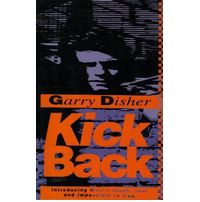
A thrilling house of games: "Kickback" by Garry Disher

On the off chance that I ever again receive a comment on this blog, I pick up my assessment of Kickback where my initial discussion left off.

The obvious and numerous nods to Richard Stark's Parker novels in the end serve to highlight the differences of temperament between Disher and his protagonist, Wyatt, and Stark/Parker. Like the best Parker books, Kickback is a well-paced and compelling caper story. We see the selection of a target, the debate over method, the acquisition of guns. The crime's planners worry over a safe place to hide out afterward and about their need for seed money to pay for the robbery. The caper is planned, and both it and a preliminary crime step on dangerous toes, with violent complications.

But Disher is more interested in emotion and less in surgical detail than Stark. Wyatt, though impatient with stupidity in others, is more social and susceptible than Parker. For one thing, he lets himself become involved with a woman during the caper's planning, which Parker avowedly would never do. And when he does become involved, the feelings are more than just sexual. There are tenderness and vulnerability in Wyatt's feelings for this novel's femme fatale. There are also touches of humor here, both on the author's part and the protagonist's, where there would be none in a Parker book. A typical Parker novel would never contain an exchange like this:

Hobba jabbed with the gun. `I said shut up.'

`Ivan's got contacts. Anything happens to me, you've had it.'

`Sugar,' Hobba said wearily, `your brother thinks you're a fuckwit.'


The family complications implied in that exchange are another `human' facet bolstering the case that Wyatt is no mere Parker clone. And the killing of an ultimately hapless villain in Kickback has pathos utterly foreign to Parker's world.

I hope I have not offended Australian readers by discussing Wyatt almost exclusively in terms of Parker. We (North) Americans are often accused of cultural arrogance, and sometimes we even deserve the accusations. But I know from Disher's short story "My Brother Jack" that he loves to play literary games. I'd say that at least in this first of his Wyatt novels, he renders tribute to Stark and Parker, playing the high and amusing game of imitating Stark in details while remaining different in the essentials, and trying to write a compelling story at the same time. He succeeds.

Besides, the borrowing may run both ways. In addition to the similarity in titles between the later Parker novels and those of the Wyatt books of a few years earlier, Stark appears to have borrowed a detail or two from Disher. An improvised door alarm from Stark's Ask the Parrot (2006), for example, is virtually identical to one from Kickback (1991).

© Peter Rozovsky 2006

Technorati tags:

Labels: , , , , ,

Monday, November 13, 2006

Garry Disher's "Kickback"

I've started Kickback, the first of Disher's six novels published between 1991 and 1997 about a tough professional thief named Wyatt. Wyatt works three or four jobs a year and relaxes in warm locales the rest of the time, like Richard Stark's Parker. He is identified only by a last name, like Parker, and his capers can go wrong when an amateur is part of the job, like Parker's.

Many reviewers have noted the similarities. Wyatt is similar to Parker, "obviously inspired by Parker," even "a Parker clone," according to one Wyatt admirer on this blog. What I've never seen Wyatt called is an affectionate tribute to Parker, and that's what this book is in its opening chapters. The set-up is nearly identical to those in some of the Stark books, for example, but the characters act in ways just different enough to give the story a slightly different feeling. Disher also pays a bit more attention to details of setting than Stark, and there is just enough unfamiliar language to spice things up for this North American reader (" ... they were too up themselves to be sus about what he did for a crust.")


Stark (nom de plume of Donald Westlake) may have returned the compliment. The first four Wyatt novels are Kickback, Paydirt, Deathdeal and Crosskill. When Stark brought Parker back in 1998 after a twenty-five year hiatus, he called the first five new Parker novels Comeback, Backflash, Flashfire, Firebreak and Breakout. Are the similar titles coincidence? I think not.

More later.

© Peter Rozovsky 2006

Technorati tags:

Labels: , , , ,