Friday, June 16, 2017

James R. Benn, Billy Boyle, and the corporate side of World War II

Jim Benn was a member of a panel I moderated at Bouchercon 2013 in Albany on the subject of "World War II and Sons," and he deserved to be there. His Billy Boyle novels look at World War II through the eyes of a brash but unworldly young man who finds himself on Dwight David Eisenhower's staff during the war. This affords him the chance to travel throughout the war's European and North African theaters and, as Benn says below, to "investigate the lesser-known aspects of the war." The 12th Billy Boyle novel, The Devouring, will be published in September. Benn talks here about the book and what he learned while researching it.
==================

I never imagined the twelfth book in the Billy Boyle series would be set in Switzerland. After all, as Harry Lime told us in the noir classic The Third Man, the only thing the Swiss are famous for is cuckoo clocks. My novels are set during the Second World War, and feature military detective Captain Billy Boyle, who investigates low crimes in high places for General Eisenhower. So how did Billy get to Switzerland in The Devouring (set for release in September 2017)?

This journey began when I was researching the French underground for the 2016 release, Blue Madonna. I stumbled across a brief mention of a group of young Jewish resisters in occupied France who worked to smuggle Jewish children into Switzerland. I’d never heard of that, and it piqued my interest, since I try to investigate the lesser-known aspects of the war. More research led me to Nancy Lefenfeld’s excellent 2013 book The Fate of Others; Rescuing Jewish Children on the French-Swiss border.


What I learned was chilling. 

The Swiss were almost as much the enemy as the Germans. The smuggling operation had to evade German patrols, mines, and barbed wire, and that was only half the trip. The Swiss were not fans of refugees, especially Jewish refugees. At the beginning of the war, Jews on the run from Nazi Germany were defined as non-political refugees and denied entry to Switzerland. In fact, the infamous red J stamped on the passports of German Jews was put there at the request of the Swiss government, to make it easier to sort out Jewish refugees at the border and send them back.C
Entire families who had made the hazardous journey across occupied France and made it across the doubly-guarded border were usually sent back when apprehended in Switzerland. They were even charged car fare to the border, where they were turned over to the Nazis and certain death.

Finally, the Swiss relented somewhat, and decreed that children under sixteen years of age, traveling alone, would not be sent back if they made it across the border alive. Hence the smuggling operation, led by Mila Racine, Simon Lévitte, and others involved in Jewish scouting organizations and Zionist youth movements. They escorted hundreds of children to safety. These valiant efforts were ended by 1943, due to stepped up German patrols and the capture of Mila Racine as she led a group of children.

So, this is not the story I tell in The Devouring. In the world of Billy Boyle it’s June 1944, shortly after D-Day. He’s sent to Switzerland to work with OSS Chief Allan Foster Dulles on Operation Safehaven, a plan to keep German assets in Swiss banks from being used for any post-war Nazi resurgence and to channel such funds into reconstruction efforts.

By German assets, I mean looted gold. Gold looted from conquered nations, gold torn from the teeth of concentration camp victims, gold from crates and crates of wedding rings, gold extorted from the powerless across Europe. Swiss banks colluded with the Third Reich to launder looted gold and enabled Germany to purchase war materials on the international market.


Louis Richard Sosthenes
Behn.
By Source, Fair use,
https://en.wikipedia.org/w/
index.php?curid=51615741x
Nowhere is the intersection of big business and Nazi Germany more bizarre than that of International Telephone and Telegraph and Focke-Wulf. Created in 1920 by Sosthenes Behn, ITT quickly grew into a giant corporation. Behn acquired a number of German firms in the 1930s, and in 1933 he met with Adolf Hitler. Behn understood how the politics of the Nazi regime worked, and he arranged for cash payments to be made throughout the war, via his German and Swiss contacts, to Heinrich Himmler, head of the SS. His purpose was to ensure that the Third Reich not take over his German holdings. While a US citizen, Behn was not going to let something like a world war interfere with profits.

One of the German firms ITT had a substantial interest in was Focke-Wulf. ITT owned 29% of the German aircraft manufacturer, which produced fighter planes for the Luftwaffe, including the Focke-Wulf 190, a fighter particularly effective against allied bombers. Behn saw substantial profits from Focke-Wulf, and elected to plow them back into the company, making Focke-Wulf even more effective in its production of fighter planes.

Behn may have been betting on a German victory, although his real motivation is unproven. What is known is that he pursued profit above all. In the 1960s, ITT presented a case for compensation from the US government for the damage caused to Focke-Wulf plants (by those allied bombers that survived attacks by the Fw-190 fighter). ITT was awarded $27 million dollars in compensation. Ford and General Motors also won large amounts.

This is the upside-down world of corporate loyalty and greed that Billy Boyle finds himself in as he navigates the mean streets in the old town of Bern, Switzerland, home to Swiss bankers, Gestapo agents, spies of all nations, and Moe Berg, the smartest man in baseball. But that’s a story for another day. 

© Peter Rozovsky 2017

Labels: , ,

Friday, September 05, 2014

Stuart Neville's Ratlines: Out of a different past

Several of Northern Ireland's brilliant cohort of crime writers write not just about their land's sectarian Troubles, but also about the conflict's afterlife (or persistence, if one prefers). Brian McGilloway, Garbhan Downey, and Anthony Quinn are just three who demonstrate that the Troubles continue to reverberate after the Good Friday Agreement.

Stuart Neville became an instant leader of the group with The Ghosts of Belfast, whose very title proves the continuing sensitivity of the subject. (The 2009 novel was released in the U.K. under the powerful but less politically charged title The Twelve.)

Neville crossed over the border and further into the past for his 2013 novel Ratlines.  The time is 1963, the occasion the murder of a Nazi given shelter in Ireland after World War II, and the novel's title a reference to the networks by which Nazis were helped to safety and, in some cases, to prosperity after the war.

Neville does a nice job imagining and investigating the sorts of corruption attendant on such arrangements, and not just the moral corruption that offers succor to evil men, either.  This novel's world has plenty of room for theft, dishonesty, and violence among the criminals themselves, and among the people who pursue them as well.  The book also contains flashes of just the sort of agony that haunted Fegan, the ex-IRA killer of The Ghosts of Belfast.   And, though I have never talked politics with Neville, I suspect after reading Ratlines that he is no fan of nationalism of whatever kind.

==============
Stuart Neville will be part of my Belfast Noir: Stories of Mayhem and Murder from Northern Ireland panel at Bouchercon 2014 in Long Beach, California. The fun starts at 11:30 a.m, Friday, Nov. 14, in the Regency B room. See you there.

© Peter Rozovsky 2014

Labels: , , , ,

Wednesday, August 27, 2014

Tony Judt, film noir, and American movies in Europe

(A Czech edition of Tony Judt's
"Postwar." As suggestive as it is
that the book should have been
translated into Czech, I included
this cover only because the English
edition I was going to use carries
a cover blurb that calls the book
"awesome." Such a word has
no place here.)
Tony Judt's Postwar: A History of Europe Since 1945 offers observations that might interest fans of crime movies and novels. Here are a few from the final chapter of Judt's section on the immediate postwar years, when American cultural influence was at a peak in Europe:
"Only intellectuals were likely to be sufficiently moved by Sergei Eisenstein's depiction of Odessa in the Battleship Potemkin to translate their aesthetic appreciation into political affinity, but everyone--intellectuals included--could appreciate Humphrey Bogart."
I'm not sure how historically valid it is to compare a silent film from 1925 (Potemkin) with a talkie-era star who made his first well-known film only in 1934 (The Petrified Forest) and whose real stardom came in the 1940s. Still, the suggestion that intellectuals could appreciate Bogart provokes thought, if only because its perspective is unusual in discussions of American popular culture.

The very next page offers this, on the American.film industry's business practices after World War II:
"(W)hen European governments after 1949 took to taxing cinema receipts in order to subsidize domestic film producers, American producers began investing directly in, foreign productions, their choice of European Venue for the making of a film or group of films often depending on the level of `domestic' subsidy then available."
Among other things, Judt suggests, American domination of European movie markets meant that U.S. movies of the time can be better guides to European viewers' experience than domestic movies are. In addition, he writes, it was Europeans who were likelier to make escapist movies in this period while American directors and producers were turning out the melodramas the French would later call film noir.  I suspect most of us would say American movies took over the world merely because they were more glamorous or better made  (Judt recognizes the latter possibility). But the idea that American movie makers were better judges of European taste that were European movie makers is a good deal more exciting and opens the door to all sorts of interesting questions.

Your thoughts, please.

© Peter Rozovsky 2014

Labels: , , , , , ,

Sunday, August 24, 2014

Hard-hitting post-war zest from Tony Judt

I left my copy of The Historian's Craft home today; what a blochhead! Instead, I'll offer one of many provocative passages from Postwar, Tony Judt's history of Europe since 1945 (and I still have almost 700 pages left to read, so expect more):
"Writers and journalists, having left a written record of their wartime allegiance, came off worst. Highly publicized trials of prominent intellectuals--like that of Robert Brasillach in Paris in January 1945--provoked protests from bona fide resisters like Albert Camus, who thought it both unjust and imprudent to condemn and execute men for their opinions, however ghastly these might be.

"In contrast, businessmen and high officials who had profited from the occupation suffered little, at least in western Europe. In Italy the Allies insisted that men like Vittorio Valletta of FIAT be left in place, despite his notorious engagement with the Fascist authorities. Other Italian business executives survived by demonstrating their erstwhile opposition to Mussolini's Social Republic at Salo--and indeed they
had often opposed it, precisely for being too 'social.'"
I like this passage for several reasons, not least the zest with which Judt wrote it. As for its politics, I wonder what crime writers including Didier Daeninckx and Andrea Camilleri would think of it. Would they, like Camus, protest the execution of a man whose politics they surely abhor?

© Peter Rozovsky 2014

Labels: , , ,

Monday, July 21, 2014

Noir but not crime: What books make your list?

Louis-Ferdinand Céline's Journey to the End of the Night is no crime novel, but someone once included on a list of great noir novels.  Curzio Malaparte's The Skin and Kaputt may deserve similar honors.

The shocking, lyrical, satirical, violent, funny novel/memoir/at times near-hallucinatory accounts of World War II (the first set largely in Naples, the second mostly in Eastern Europe) are a trip through a reality as dark as anything Jim Thompson came up with at his most fevered.

How about you? What books or stories that you've read are noir but not crime?

© Peter Rozovsky 2014

Labels: , ,

Sunday, January 05, 2014

Curzio Malaparte's The Skin: Life during noir time

Commentators lapse into cliché or trivial vulgarity when discussing Curzio Malaparte's 1949 novel The Skin, and it's hard to blame them. Almost anything one can say about the book comes off as incomplete, as a stance, or an attitude.

 Milan Kundera comes closest to the mark among the comments attached to the new NYRB translation of the book with an assessment that reads, in part, "suddenly, good and evil have veiled their faces; the new world is still barely known." But even that brief excerpt, quoted on the back cover, does not take in the novel's dark humor.

The novel has a character named Curzio Malaparte accompanying American forces in and around Naples after Italy signed the Armistice of Cassibile and went over to the Allied side in World War II. This is no crime novel, but its scenes of desperation, self-laceration, pity, and squalor will make any crime reader think about what noir really means.

I'll post an excerpt or two in the coming days, and I hope it will be clear why I choose the excerpts I do:
"General Cork was a real gentleman—a real American gentleman, I mean. He had the naïveté, the artlessness and the moral transparency that make American gentlemen so lovable and so human. He was not a cultivated man, he did not possess that humanistic culture which gives such a noble and poetic tone to the manners of European gentlemen, but he was a `man,' he had that human quality which European men lack: he knew how to blush. ... Like all good Americans, he was convinced that America was the leading nation in the world, and that the Americans were the most civilized and the most honorable people on earth; and naturally he despised Europe....
"Then he had asked me which gods the Americans would have to respect in Europe if they were to be saved.
"`Our hunger, our misery, and our humiliation,' I had replied."
 I have suggested that The Skin might interest my Bouchercon WWII panel friends James Benn and Martin Limón. J. Robert Janes might be interested as well.

© Peter Rozovsky 2014

Labels: , , , , ,

Friday, January 03, 2014

How do authors keep history fresh? How about bloggers and old posts?


Damn me, but has it really been three years since this post first appeared? Must be; Blogger doesn't lie. Anyhow, I've been thinking so much about fiction and history recently that I thought I'd bring back this post on that stimulating subject.
 ====
 Authors of historical fiction have a problem: Readers know how the story ends, at least the historical part, but the writer still has to keep them reading.

How do they do this?

Here's what John Lawton does in A Little White Death, third of his novels about Frederick Troy. A physician has come to the United States to treat John F. Kennedy for Addison's disease and has met up with a fellow Brit just before returning to England. Here's how the doctor who has just treated Kennedy ends the meeting with his friend:
"`Fine. I understand. Now why don't you hop in a cab. We can have one last drinkie before I dash to Idlewild.'"
That's a powerful little chapter-ender. The speaker of that line carries the weight of the history that the reader already knows about. And he does this without ever ruining the illusion that he exists in a world innocent of that history, which had not yet occurred at the time Lawton portrays. At the very least, that's a neat bit of fun on Lawton's part.

He does something similar in Black Out, the first novel in the series. I won't give that example because it's a bit spoilerish, coming as it does near the end of the book. I will reveal, for those who have not read the novel, that it reinforces the series' status as a social history of mid-twentieth-century England, critical, personal and unsparing.

In other words, you should read the book. Until you do, ponder this question: How do historical novelists get around the annoying fact that the reader knows how the history turns out?

© Peter Rozovsky 2010

Labels: , , , , , ,

Tuesday, December 31, 2013

Curzio Malaparte and James Ellroy: History, truth, and everything

A comment on Sunday's post about James Ellroy's "Underworld U.S.A." novels is pertinent to both the novels your humble blogkeeper is reading.

Dana King, that fine author, nice guy, and skilled horn blower, said Ellroy has:
"a keener understanding of American history, and of the true ethos that has driven American society and history, than do many others."
Not "grasp of the facts," but "keener understanding" of American history and the ethos behind it.  Were Ellroy's tycoons, FBI chiefs, and gangsters as deranged in real life as they are in his books? Do his killer protagonists have real-counterparts? Does this matter, as long as the fiction makes sense, or feels right? What truth must a historian serve? A writer of fiction? Is historical fiction the same as fiction that takes history as its theme?  Or is Ellroy just doing what all fiction arguably should do but so little does: portray real life, comment on real life, and entertain readers all at the same time?

Besides Ellroy's American Tabloid, the other novel that sparked these questions is Curzio Malaparte's The Skin. That shocking, dark, graphic, and very blackly funny 1949 novel, banned by the church, banned by the Neapolitans, tells the story of the American military and the misery of Naples toward the end of World War II. "The book caused a scandal," one commentator said, "because it was mistaken for a realistic work."

Here's a bit of The Skin:
"`We are the volunteers of Freedom, the soldiers of a new Italy, It is our duty to fight the Germans, to drive them out of our homeland ... It is our duty once more to hoist the flag that has fallen in the mire, to set an example to all in the midst of so much shame, to show ourselves worthy of the task that our country entrusts to us.' ... When I had finished speaking Colonel Palese said to the soldiers: `Now one of you will repeat what your commanding officer has said. I want to be sure you understand. You!' he said, pointing to a soldier. `Repeat what your commanding officer said.'
"The soldier looked at me; he was pale, he had the thin, bloodless lips of a dead man. Slowly, in a dreadful gurgling voice, he said: `It is our duty to show ourselves worthy of the shame of Italy."

"Colonel Palese came up close to me. `They understand,' he said in a low voice, and moved silently away."
I might not make American Tabloid the textbook for a course on twentieth-century American history or The Skin for a course on Italy during and after World War II. But both would make fine collateral reading.

© Peter Rozovsky 2013

Labels: , , , , , , , ,

Sunday, November 10, 2013

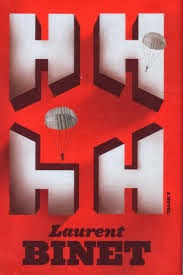
HHhH's best joke

Chapter 146 of Laurent Binet's HHhH (don't worry; the chapters are short. The novel weighs in at 327 pages) begins with quotations from Seven Men at Daybreak, Alan Burgess' 1960 novel about the plot to kill Reinhard Heydrich, in which Jan Kubiš and Jozef Gabčík were parachuted into Czechoslovakia to carry out the mission.  Binet does not entirely approve of Burgess.

There follows a long paragraph in which Binet works himself up into a righteous huff, proclaiming, detail by detail, how much his research has taught him about the fateful flight, working his way up to this:
"I know pretty much everything that can be known about this flight and I refuse to write a sentence like `Automatically they checked their parachute harnesses.' Even if, without a doubt, they did exactly that."
© Peter Rozovsky 2013

Labels: , , , , , , , ,

Friday, November 08, 2013

Why you should read HHhH

In today's busy world, in these straitened times, it's more important than ever to maximize the return on your reading dollar, to choose books that can do more than one thing for you. And that's why you should read HHhH.

Laurent Binet's 2010 novel is a thriller; a history lesson; a lesson on the importance of history (which is not the same thing); and a meditation on how we read, write, and experience fiction and history; and it has, as almost any serious book will, good jokes.

HHhH stands for Himmlers Hirn heisst Heydrich, German for Himmler's brain is called Heydrich, and the novel has as one of its centers a Czech and a Slovak soldiers' real-life assassination of Reinhard Heydrich, the Nazi official who will become known, as we are told in the opening chapters, as the Butcher of Prague. Another center is the narrator's research on the book he is writing about the assassination plot. Shot through are compelling bits of Central European history that, believe, you want to know.

The book's cover copy gives just part of the story, recounting briefly the assassins' plot, but lapsing into sketchy adjectives for the rest: thrilling. Intellectually engrossing, and, more telling, "a profound meditation on the debt we owe to history."

But you know what? I don't blame the copywriters. HHhH is a difficult novel to describe without making it sound like a piece of self-contemplating postmodern whimsy or a plodding piece of must-read. But it is anything but. Far from looking inward, it look out into the world and its history far more than most fiction does. Its "voice" is low-key, engaging, and, where called for, self-deprecating. And, while the novel treats its subject with due seriousness (Heydrich may have been the worst human being who ever lived), it gains in seriousness by eschewing solemnity.  And now I'm going to shut up and resume my reading.

The book is beautifully translated from the French by Sam Taylor, one of whose most felicitous phrases occurs, in a bit of irony, no doubt unintended, on Page 88.
*
(Hear the Europa Philharmonic Orchestra perform Memorial to Lidice, written by the Czech composer Bohuslav Martinů in 1943 to commemorate the village wiped out by the Germans in revenge for Heydrich's killing.)

© Peter Rozovsky 2013

Labels: , , , , , , , , , , , , ,

Friday, October 18, 2013

How historical fiction chronicles linguistic change, or What the hell is an air-port?

Historical fiction ought to create a convincing illusion of the period in which it is set. If it can reveal strangeness in our own time, so much the better.

Here are two short passages, about twenty pages apart, from the closing chapters of Black Out, set in 1944 and 1948 and the first of John Lawton's Troy novels:
"`And where would I land?' 
"`West London. There's a new airfield under construction on the far side of Houndslow. They call it Heath Row.'"
and
"Heathrow was referred to as an air-port. Troy presumed that this fiction was in some way meant to distinguish it from such places as Croydon which had always been called an aerodrome or Brize Norton which remained an airfield."
Have you ever thought how odd it is that the word port should be applied to a place where no harbor or ships are to be found? I had not until I read the passage in Lawton.

(Heath Row as two words in the first use, one in the second is a nice touch, too.  Presumably this reflects the process by which two words, expressing distinct ideas, fuse with increasing use and become a compound word to express a new idea. Either that, or it's one hell of a thought-provoking typographical error.)

© Peter Rozovsky 2013

Labels: , , , , , ,

Tuesday, September 03, 2013

Benn's Day: Historical figures in crime novels

Last year I wrote that James R. Benn's novel A Mortal Terror "opens with a giant wink to the reader that promises a fair bit of fun along with the human drama and military history: `Kim Philby owed me one.'"

Death's Door, the follow-up book, includes several such cameo appearances, including one by a Hollywood actor who, for purposes of his military service, went by the name John Hamilton. Other bit players include Monsignor Giovanni Battista Montini, a Vatican diplomat who later became Pope Paul VI, and Monsignor Hugh O'Flaherty (and his butler, John May), whom I had not heard of before reading the author's note Benn appends to the novel, but who is very much worth hearing about.

And that's where you come in: What are your favorite cameo appearances by historical figures in crime fiction? (Here's a link to one of mine.)
*
A Moral Terror is the sixth of Benn's Billy Boyle World War II mysteries, Death's Door the seventh. Today is release day for the eighth in the series, A Blind Goddess, which lands Billy in a case that involves the 617th Tank Destroyer Battalion and racism in the U.S. military.
==================
James R. Benn will be part of my "World War II and Sons" panel at Bouchercon 2013 in Albany, N.Y., on Thursday, Sept. 19, at 4:00 p.m.

© Peter Rozovsky 2013

Labels: , , , , , , , ,

Friday, August 30, 2013

My Bouchercon 2013 panels: J. Robert Janes' murky world

J. Robert Janes' fourteen Kohler and St. Cyr mysteries pair a Gestapo officer and a French Sûreté inspector solving "everyday" crimes in German-occupied France during World War II, and if that description gives you pause (as it gave me for years), Janes recognizes that such a reaction is likely.

Each book in the series, from Mayhem (1992) to the new Tapestry, bears an exculpatory note from the author explaining that he abhors "what happened during these times" and that "during the Occupation of France everyday crimes of murder and arson continued to be committed, and I merely ask, by whom and how were they solved?"

An introduction to the series on Janes' Web site suggests (accurately, at least for Tapestry) that no one in the books comes off as especially pure, ethical, admirable, or even clean:
"It's German-occupied France during the Second World War. Two honest detectives, one from each side of that war, fight common crime in an age of officially sanctioned crime on a horrendous scale. Gangsters have been let out of jail and put to work by the Gestapo and SS; collaborators welcome the Occupier and line their pockets; ordinary citizens struggle to survive; inflation hits 165% while wages are frozen at 1939 levels; but most of all, German servicemen come on leave to Paris, ‘our friends' to some, ‘the Green Beans' to others, the ‘Schlocks, the Boche'.

"Paris, unlike all other cities and towns in war-torn Europe, is an open city, a showcase Hitler uses to let his boys know how good things can be under Nazi rule. French Gestapo are everywhere and definitely don't like these two detectives since St-Cyr put many of them away before the war, but Kohler is all too ready to tell them this and is fast becoming a citizen of the world under Louis' influence and also has no use for the Occupier, even to ridiculing Nazi invincibility. Hated and reviled by the Occupier and often by the Occupied, the two constantly tread a minefield."
I'm not up on my administrative history of the German occupation of France, so I don't know how much attention the various organs of the occupation and of the French civil authority and population paid to ordinary crimes. But a relatively recent history of the occupation, Robert Gildea's Marianne in Chains, suggests a real occupied France similar to Janes' fictional one:
 "The moral universe of occupied France was notoriously murky. What was right and what was wrong, what patriotic and what unpatriotic, may have been clear in 1944, but not before."
Oh, yes. Crime fiction. Tapestry's moral, ethical, and physical environments are the darkest I have ever read in crime fiction. Kohler and St. Cyr are called on to work in a city so darkened by blackouts that characters must feel their way through the streets at night. Plunder, greed, puritanism, lust, patriotism, violence, and luxury in the face of deprivation slip in and out of focus, the reader never sure if any one is staged to cover for another. I'm not yet sure if Tapestry is good history, but it sure is good noir.
==================
 J. Robert Janes will be part of my "World War II and Sons" panel at Bouchercon 2013 in Albany, N.Y., on Thursday, Sept. 19, at 4:00 p.m. 

© Peter Rozovsky 2013

Labels: , , , , , , , ,

Tuesday, August 27, 2013

Americans go to war, Part II (Bouchercon 2013 panels)

Last month I noted a motif common to John Lawton's Bluffing Mr. Churchill (also published as Riptide) and James R. Benn's Billy Boyle: Each features a young American bewildered by wartime London.

Three weeks later I learned I'd be moderating a panel at Bouchercon 2013 of which Lawton and Benn will be members, along with Susan Elia MacNeal, whose Mr. Churchill's Secretary features a young American woman who winds up working for Churchill in 1940.

I'll ask all three authors why they chose to thrust three Americans, all young, into wartime London. In the meantime, I'll ask you: Why do you think Lawton, Benn, and MacNeal made the choice they did? What are the attractions of the innocents abroad theme? What are your favorite stories, crime or otherwise, of Americans abroad in wartime? Why do you like those stories?
==================
James R. Benn, John Lawton, and Susan Elia MacNeal will be part of my "World War II and Sons" panel at Bouchercon 2013 in Albany, N.Y., on Thursday, Sept. 19, at 4:00 p.m.

© Peter Rozovsky 2013

Labels: , , , , , , ,

Monday, August 19, 2013

My Bouchercon 2013 panels: John Lawton on being a "crime" writer

I first heard of John Lawton on crime fiction blogs, and I first heard him read at New York's late Partners & Crime mystery bookshop. His series protagonist, Frederick Troy, is with London's Metropolitan Police, and Lawton attends crime fiction conventions now and then. But when I wrote that Lawton reminded me more of Evelyn Waugh, Anthony Powell or even, in spots, P.G. Wodehouse than of crime writers, a reader huzzahed all the way from Canada. He wrote, too, that he was baffled by the occasional descriptions of Lawton's books as spy novels. So, is Lawton a crime writer, or a spy writer, or what? If not, why do some people say he is? And does it matter? I sought answers from the source, and here's what Lawton had to say:
===================
“I can't recall any discussion with my editor at Weidenfeld – Ion Trewin, who edited all my work until the move to Grove – as to genre. Black Out had no tags. Nor did any subsequent novel. I was reviewed as either fiction or crime. It wasn't an issue. `Genre' is a tag neither to be sought nor resisted. Like a book prize – neither sought nor resisted.

“It's flattering to be told `this book transcends genre,' but it's not a phrase that holds up to scrutiny. Five nano-seconds later, you're asking yourself, `What does he/she think is inferior about genre writing?' And when toastmasters at crime gigs harp on about crime being `as good as literature,' you think, `So what?' And when a crime novel is deemed `too literary,' you think, `Ain't no such critter.'

“It's marketing ... whatever gets you on the shelves and then off the shelves and into hands. And marketing is different country to country.

“I first became aware of an `invisible' crime tag only when the CWA called in (so I was told) Riptide for consideration for the Ellis Peters Award. As I said, you don't seek it and you don't resist it. It's only an issue if you win – who in their right mind, after all, would want to sit through an award ceremony they didn't have to?

“Paint and drying come to mind.

“The book after this was Sweet Sunday. Ion and I agreed this wasn't `crime.' Still ... it got reviewed as crime. But a review is a review ... not to be knocked. Better by a yard and a half than being ignored.

“And a few years later I was asked in an interview to categorize myself. I said something like ... `historical, political thrillers with a big splash of romance, wrapped up in a coat of noir.' What they're not is mysteries, and I think there is a tendency to assume that crime and mystery are synonymous. They're not.

“There are crimes in most of my novels. Occasionally unsolved. They aren't there to be `solved;' they're a propellant to drive the book along.

“Pretentious bit coming up ... I don't think I'm doing anything different from my immediate contemporaries. ... McEwan, Faulks, Amis, Hare, Turow (all born within months of me). ... In intent.

“That said, I've never written anything set in the present, and none of them has written a series around a policeman. Scott Turow is regarded as `crime' – he has no problem with this. (I asked him.) And at this point the sensible thing to say is, if Scott has no problem with `crime' neither should I.”
— John Lawton
*
Here's Lawton's Web site with essays and other information about the Troy novels. Here's a New York Times review that asks: "Is there any genre convention John Lawton hasn’t boldly disregarded, often to brilliant effect? "
========================
John Lawton will be part of my "World War II and Sons" panel at Bouchercon 2013 in Albany, on Thursday, Sept. 19, at 4:00 p.m.

© Peter Rozovsky 2012

Labels: , , , , , , ,

Thursday, July 25, 2013

John Lawton and James R. Benn: When Americans go to war

John Lawton's Bluffing Mr. Churchill has some fun with Cal Cormack, a young American embassy man by way of Berlin plunged into London in 1941, puzzled by Cockney rhyming slang and staggered by the sight of solitary houses left standing after German air raids. Since other responsibilities keep me from my normal blogging today, I'll bring back an old post about another novel that similarly placed an innocent American in war-stricken London, and I'll ask you what other crime novels or stories have exploited the theme of wartime innocents abroad, whether American or otherwise?
======== 

Yesterday I wrote about neat use of period speech in Rag and Bone, James R. Benn's fifth novel about Boston cop-turned-army-investigator Billy Boyle.

Today I reproduce two passages from the first book in the series, Billy Boyle. The selections are a touching portrayal of war's sobering effect on a brash young American when he sees it up close for the first time.
"We had been briefed in OCS on language differences and how to make nice with the Brits. Don't flash your money around, GIs are paid more than British officers, stuff like that. Me, I couldn't have cared less. The English had had their time in the sun when they conquered Ireland and ran it like their private preserve, killing and starving out my ancestors. If I hurt a few feelings waving around a sawbuck or two, big deal."
But then:
"People parted and formed a narrow corridor as three stretchers were carried out of the destroyed building. Two held blanketed, inert forms. The third carried a person covered in soot highlighted by rust-colored dried blood along a leg and a hasty bandage wrapping a head. A thin female arm rose from the stretcher with two fingers raised in the V-for-victory sign as she was gingerly carried into the ambulance. There were murmurs of appreciation from the crowd, and then they drifted back into the morning routine. Another day at the war. The other two stretchers were left on the sidewalk for a journey to a different destination.

"`Welcome to London,' Harding said as the traffic moved forward.

"`Yes, sir.' Maybe I wouldn't wave those sawbucks around for a while."
© Peter Rozovsky 2010

Labels: , , , , , ,

Monday, July 22, 2013

The English, they are a funny race

I've been reading three Englishmen in recent days, and, without purporting to analyze English character, I will say that each of these examples shows considerable wit, and that the wit cuts deeper than mere jokes.

The first is from a short story by Michael Gilbert:
"Mr. Behrens said, raising his voice a little, `If I were to lift my right hand a very well-trained dog, who has been approaching you quietly from the rear while we were talking, would have jumped for your throat.' 
 "The colonel smiled. `Your imagination does you credit. What happens if you lift your left hand? Does a genie appear from a bottle and carry me off?' 
"`If I raise my left hand,' said Mr. Behrens, `you will be shot dead.'  
 "And so saying, he raised it."
— "The Road to Damascus" 
The second is from a novel by John Lawton:
 "Interned, released, enlisted, trained and promoted all in less than three months. The insignia of rank barely tacked onto his sleeve. If the next promotion were as swift as the first he’d be a Flight Lieutenant by the end of the month. This had baffled Rod. He had tried to explain it to his father some time ago. ‘I said the obvious thing. “Are you sure I’m ready for this?” Sort of expecting the genial “Of course, old chap” by way of answer – and they said “Ready? Of course you’re not ready. Ready’s got bugger all to do with it. You’re thirty-three, man, you’ve held a pilot’s licence for ten years. We need people who can fly, people who can command a bit of authority, people who might look as though they know what they’re doing even if they don’t. You couldn’t grow a moustache, could you?’” 
— Bluffing Mr. Churchill 
The third is from a poem by Philip Larkin:
"Ah, were I courageous enough
To shout
Stuff your pension!
But I know, all too well, that’s the stuff
That dreams are made on:"
— "Toads" 
Aren't those fun?

© Peter Rozovsky 2013

Labels: , , , , , , , , , ,

Wednesday, November 12, 2008

John Lawton on Winston Churchill, time machines and American crime fiction


John Lawton has said he resists being marketed as a crime writer, and he said so again Tuesday evening at Partners & Crime in New York. Lest you write him off as a genre basher and a literary snob, however, consider this list of his favorite writers: Loren D. Estleman, Elmore Leonard and Robert B. Parker.

And consider his reply when I asked about the occasional wisecrack amid the grim subject matter of his novel Second Violin: "I think Steven Bochco (Hill Street Blues) raised the bar of what you can get away with combining serious" with humorous.

This novel, sixth in Lawton's series about wartime and postwar London, is a prequel to the first five. This time the story begins in 1938, and Lawton's usual protagonist, the here-young police officer Frederick Troy, does not appear until page 124. Why a prequel and why Troy's late appearance? Lawton says that "I love time machines" and that he loved the chance to explore a different, earlier time in the lives of his country and his main character: "If you can write the same books fifty times over, you'd be Robert B. Parker." (And remember, Lawton is no genre snob. He likes Parker's work and says he regards the novels as variants, if not repetitions.)

And consider Lawton's reason for writing the novel: Britain's wartime roundups of aliens born in enemy or potentially enemy nations. This even though many had been in Britain for decades or were refugees, many Jewish, from the very countries with which Britain was at war. To paraphrase Lawton's opinion of the policy gently, he believes it was not Churchill's finest hour.

Beginning the action in 1938 lets Lawton unfold slowly the awful experiences of those refugees who made their way from Hell and Austria to Britain, only to be shunted off to internment.

More to come, including discussion of the murders, of which there has been one so far about halfway into the novel, almost an afterthought amid the book's tragic and absurd historical sweep.

© Peter Rozovsky 2008

Labels: , , , , , , ,