W
Welcome to my new forum devoted to international crime fiction – "international" in my case meaning outside the United States. The Web is all about openness and freedom of information, so I have no compunction about taking David J. Montgomery's
10 Greatest Detective Novels idea, ringing some changes on it, and coming up with a debate/discussion of my own. He focuses on American writers; I'll take the rest of the world and ask these questions:
–
What are your favorite crime novels and stories set in countries other than your own?
– Why do you like these stories?
– Is living in a country a prerequisite for writing a successful crime story set in that country?
– What makes crime stories especially attractive to the armchair traveler?
– Do people even read in armchairs anymore?
Setting has been integral to some of the finest crime fiction through all periods. Think the misty docks and streets of Conan Doyle's London. Think Hammett's San Francisco, Chandler's Los Angeles, Lawrence Block's New York. Or think Georges Simenon's Paris, its suburbs, and the villages where Maigret loves to relax, drink white wine, and play cards. Given the importance of setting, it seems natural that crime stories should prove especially attractive to those of us who like to travel in our minds as well as in trains, planes, cars, buses and boats. Indeed, this is a good time for such readers, with
Soho Crime,
Bitter Lemon Press and
Serpent's Tail, among others, offering much of interest.
I'll begin with some of my favorites, along with a few books I don't much like. Feel free to disagree with me, especially on the latter. Nothing would please me more than to be talked into recognizing virtues I had not seen before in an author – or to be forced to better understand and justify my dislike.
In no particular order, here is some of my favorite non-American crime fiction:
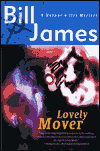
 1) Lovely Mover
, by Bill James, though several of the other novels from the middle of James' Harpur & Iles series are about as good. The series hits its stride around its seventh book and becomes a kind of grand and cracked portrait of Britain's shifting urban and social landscape, of the murky boundaries between police and criminals, of suburban social climbers who happen to be killers and drug dealers, of the strange ways people build families in changing times. The books are violent, dark, and often very funny. And James just happens to be the best prose stylist who has ever written crime fiction in English.
2) Death of a Red Heroine, by Qiu Xiaolong. A clear-eyed view of 1990s Shanghai that meets every traditional requirement for a full-blooded crime novel. The setting is evocative, the protagonist is unusual (though not the strongest feature of the book), the supporting characters are compelling, and the story has a surprise ending that could only have happened in China.
 3) Cosi Fan Tutti
, by Michael Dibdin, is an exception to my general distaste for novels set in "foreign" countries by writers not from those countries. Such books often degenerate into travelogues. This novel is formally daring, and talk about surprise endings! Dibdin, an Englishman, spent several years teaching in Italy, according to various accounts, and his charmingly named protagonist, Aurelio Zen, offers a kind of Baedeker's guide to official Italian corruption and internecine rivalry, each novel set in a different region: Naples here, the Vatican, Venice, the south in other books. And Rome. Always Rome. "Zen" is a name characteristic of the protagonist's native Venice, but it also has overtones of the detachment with which this Zen moves through the sometimes deadly worlds of Italian officialdom and gangsterdom. Of course, the character's other name, Aurelio, is another clue that he is wise and given to occasional musing, if not outright meditation.
4) "Brown Eyes and Green Hair," a short story by Pentti Kirstila available in "The Oxford Book of Detective Stories (An International Selection)." This delightful, deadpan, at times almost surreal story by the Finnish Kirstila is an exception to the rule that writers from Scandinavia, the Baltic countries and Iceland are morose -- and is the only Kirstila to have been translated into English. Let's raise a fuss and get more of his work translated and published. (Some of his writing is available in German and in some less widespread European languages.)
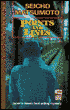
 5) Points and Lines
, by Seicho Matsumoto. This Japanese police procedural is a kind of road movie on the rails, a look at people and places in 1960s Japan through the eyes of a police inspector who travels the length and breadth of the country by train as he tracks down clues to a young couple’s death.
6) No Happy Ending, by Paco Ignacio Taibo II. The protagonist shares a cramped Mexico City office with a plumber, an upholsterer and a sewer engineer. The book begins with a Roman soldier found dead in a bathroom. What more could you ask for? Like Dibdin's Aurelio Zen, Taibo's one-eyed hero, Hector Belascoaran Shayne, bumps up against official corruption and violence. Unlike Zen, Shayne attacks it headfirst. He also has a profound sympathy with victims of police and other official and corporate brutality.
 7) The Prone Gunman
, by Jean-Patrick Manchette. Another author with a distinct political viewpoint. His short, grim novels have a certain formal similarity to Jim Thompson's. But Manchette's protagonists are not fortunate enough to die. Rather, they are brought low, chewed up, and spit out, destroyed or disoriented but still alive, by powerful forces who use them to achieve their own ends before discarding them.
8) Thumbprint and
Fever, by Friedrich Glauser. This 1930s Swiss writer, translated and brought back into print by
Bitter Lemon Press, offers that rarest of detective protagonists: a man who has hit rock bottom professionally without lapsing into alcohol and self-pity. Sgt. Studer works in small corners of a big world: Villages, prison cells, cramped apartments. An insane asylum. An isolated Moroccan Foreign Legion post. He is mordant and humane in a world of which his creator takes a deadpan view. Some say Glauser influenced his countryman Friedrich Dürrenmatt. Maybe, but Glauser was better.
 9)
9) The
Amsterdam Cops series, by Janwillem van de Wetering. This Dutch author has been a businessman, a world traveler, a reserve Amsterdam police officer, and a student at a Zen monastery in Kyoto. All, especially the last three, figure prominently in this series, which includes 14 novels and two overlapping short-story collections. Detective twosomes are a nickel a dozen; Van de Wetering offers the only three-headed protagonist I can think of: the grumpy Adjutant Henk Grijpstra, the younger and sometimes vain Sgt. Rinus de Gier, and their unnamed commissaris, or chief, an elderly mentor with sometimes excruciating knee pains who is a sly collaborator and a kind of guru to Grijpstra and de Gier. Start with
Hard Rain, in part for the larger role it gives the commissaris. Van de Wetering has an interesting approach to translation: He does his own, and he regards the results as versions, rather than translations, of the original. The one book in the series that I read in Dutch has slightly different chapter divisions from the English version and an opening chapter with more physical description. And the first in the series,
An Outsider in Amsterdam, reflects the Dutch language's more frequent use of the present perfect where English would use the simple past. This results in occasional odd sentences such as "I wonder if he has done it."
 10/11) Tales From Two Pockets
 by Karel Capek and
The Mournful Demeanour of Lieutenant Boruvka by Josef Skvorecky. These books of tales are full of sharp observation, wry and wistful humor, and detection of the classic and other kinds. Both just might lay to rest the notion that "literary" crime fiction equals bad crime fiction.
=======
OK, what do these stories have in common, other than that none is set in the United States or in an English village and each offers a vivid sense of place? Damned if I know. Maybe I'll know better once I hear from you.
What about books that didn't make my list? Ruth Rendell's superb
The Veiled One seems far more interested in its killer's psyche than in the story's setting. The great Ken Bruen's Brant and Roberts novels are like Ed McBain 87th Precinct gang whacked out on beer and cocaine. Their violent, good-hearted, hilarious characters clang and crash together in stories that are all action, all character, without much focus on the setting. By all means, read them. (
Bust, on the other hand, Bruen's excellent collaboration with Jason Starr, could qualify for this list with an asterisk, as an Irish writer's view of New York.)
Two books I did not care for helped form my thoughts on international crime fiction. The one Magdalen Nabb "Marshal Guarnaccia" story that I read got the details of its Florence-area setting convincingly right, but the story could have happened anywhere. John Burdett's
Bangkok 8, on the other hand, was all local color, all weird exotica, all too much like a travelogue, albeit an especially weird one, for my tastes.
A last note: I've omitted
Murder Must Advertise, the one Dorothy Sayers novel that I've read, though it is set in a country where I've never lived. Yet I might include Peter Lovesey's fine
The Last Detective, which takes place in the same country. The reason is simple: In crime fiction, the past is not a foreign country. Sayers, and perhaps Christie, Chesterton and all the rest, created worlds so familiar to crime-fiction readers that they are no longer foreign.
Thanks, and keep those posts coming,
Peter
© Peter Rozovsky 2006Labels: Bill James, Capek, Czechoslovakia, Finland, Friedrich Glauser, Japan, Manchette, Mexico, Michael Dibdin, Netherlands, Pentti Kirstila, Qiu Xiaolong, Seicho Matsumoto, Skvorecky, Taibo, van de Wetering
 Jeff VanderMeer has organized a World Cup of Fiction, which groups the thirty-two nations of this year's soccer World Cup and asks readers to handicap the field in fiction instead of football. I'm refining his terms and restricting myself to crime writing.