Friday, January 20, 2012

Lawyers and ***holes: Carofiglio and Higgins

A typical passage in George V. Higgins' Cogan's Trade runs thus:
"I swore when I got out I was gonna make every minute count, the rest of my life. ... And am I doing it? No. Of course I’m not. I’m just as big an asshole now as I was before.
That's one character, Amato. But assholes run through the novel like the motto theme through a Romantic symphony:
"`Some time, I hope,' Russell said, “you got over being an asshole.”


“`I’m not sure,' Frankie said."
And that sort of self-doubt and introspection, though expressed in earthy terms, is what readers must mean when they praise Higgins for making even violent lowlife characters human.
*
I remarked in yesterday's post that Higgins has a surprisingly large bibliography for an author so strongly associated with a single novel (The Friends of Eddie Coyle.) An alert commenter pointed out that a movie version of Cogan's Trade is due out this year, starring Brad Pitt.

Here's a quick rundown of Higgins' novels that may prove useful to readers unfamiliar with his work beyond The Friends of Eddie Coyle.
***
Higgins is not the only lawyer-turned-crime writer whose work I'm reading these days. Gianrico Carofiglio's Temporary Perfections offers a typical Carofiglio observation that may help explain why he no longer practices law.

Carofiglio's protagonist, Guido Guerrieri, is called on to defend a young man who tries to kill himself by turning on a gas oven in a sealed room, is rescued by carabinieri (Italy's military/civil police), and unexpectedly finds himself in legal trouble:
"They found the young man unconscious on the floor but, miraculously, still in and of this world. In other words, they saved his life. But, after checking with the magistrate on duty at the time, they also arrested him. On charges of mass murder."
The gentle dissection of the absurdity of the Italian law in question that follows is, in its mix of bemusement, matter-of-fact analysis, and quiet crusading, typical of the Guerrieri books. I once asked if Guerrieri might be the world's sanest crime fiction protagonist. That was just another way of saying he might be the most likable and endearingly human.
© Peter Rozovsky 2012

Labels: , , ,

Sunday, November 20, 2011

Gianrico Carofiglio's new eye for an old crime-fiction convention

This "new eyes" stuff is old hat for Gianrico Carofiglio.

Carofiglio, asked at the Bouchercon 2011 crime-fiction convention why he, a former prosecutor, had made his protagonist a defense lawyer, replied with Proust's statement about the only real journey being to view the world through others' eyes. He inscribed a version of the quotation on a book I had him sign for a friend after our Bouchercon panel.

And in Temporary Perfections, his most recent novel to appear in English, he applies the dictum to one of crime fiction's old chestnuts, that of the detective who can tell without fail, via some subtle clue, that a suspect is lying:
 "Ask him if he can tell when someone's lying. The ones who say they can tell, who think it's impossible to trick them with a lie, are the biggest fools around.  They're the ones a skilled liar can wrap around his little finger with the greatest ease and enjoyment."
What other crime novels and stories explicitly confront conventions of the genre this way?
***
Gianrico Carofiglio was a member of my panel "A QUESTION OF DEATH: HOW IMPORTANT IS WHODUNIT?" at Bouchercon 2011.

© Peter Rozovsky 2011

Labels: , ,

Tuesday, September 27, 2011

Gianrico Carofiglio, Howard Curtis, and a translator's challenge

(Games People Play)
A reader's complaint, an incautious reply, and a translator's thoughtful explanation have revived one of this blog's oldest questions: What cultural and linguistic challenges does a translator face?

The complainer objected to the name chosen for a poker game in the Gianrico Carofiglio novel translated in English as The Past is a Foreign Country:
"The fat man cut the cards and said, 'Five card stud.' He said it in the same tone of voice he'd used all evening. What he thought of as a professional tone. A good way to recognize an easy mark at a poker table is to see if they use a professional tone.

"He dealt the first card face down and the second one face up. A professional gesture, as if to prove my point."
"Who is Carofiglio kidding?" my reader objected. "There's no other way to start a game of five card stud. Playing the first card face down and second one face up wouldn't tell you jackshit about anybody."

I speculated that five-card stud might be a rough English equivalent for a game in the novel's original version whose Italian name English and American readers would not recognize, and it turned out I was right. Rather than a lapse on Carofiglio's part, I wrote, "We've uncovered some sloppy work by the translator, then."

Today the translator weighed in with a reply that made me ashamed of my flip comment. That translator is Howard Curtis, and here's what he had to say:
"Sorry I've only just seen this thread. As translator of The Past is a Foreign Country, I'd like to comment on the above remarks about my `sloppy work' on the poker aspects of the book. Not being a poker player myself, I had to do some research when translating these sections, and `five card stud' did seem to be the most accurate translation of what was being played at that point. The poker references were checked and approved by someone at the publishing house who knew about poker, and the original UK edition carried a preliminary note explaining that this was an Italian version of the game, employing a 32-card deck. I haven't seen the US edition, so I don't know if this note was reproduced."
Having written about the challenges translators face, I should have speculated about Curtis' choice rather than dismissing it. In any case, it appears this problem was difficult, if minor. The U.S. edition of the book does, indeed, offer an explanatory note, but is that enough? I'd read the novel without noticing the note.  The poker references passed muster at the publishing house, but not with a reader out there in cyberland (Ireland, actually). Could translator or publisher have chosen another way to explain the game?

I suggested that the translator might use the original Italian name a time or two in the text, perhaps with an unobtrusive explanation, and let context take care of the rest. Would that have worked? I don't know, but I am reminded once more of how bloody difficult a translator's job can be, especially if the work in question is popular fiction, where ease of reading is paramount.
***
Howard Curtis is an experienced translator from French, Italian and Spanish. Among novels discussed here at Detectives Beyond Borders, his translations include works by Carofiglio, Jean-Claude Izzo, and Caryl Férey.

© Peter Rozovsky 2011

Labels: , , , ,

Tuesday, September 20, 2011

Bouchercon 2011: The insomniacs' (fictional) bookstore

Gianrico Carofiglio's protagonist, Guido Guerrieri, sometimes visits a bookstore called Osteria Caffe Latte when he can't sleep. That establishment is a Bari bookshop run by an insomniac who opens his doors around 10 at night, closes them around six in the morning, then finally falls asleep in the apartment upstairs as the rest of Bari is well into its daily business.

At times in my life I'd gladly have lived in such a place, and the prospect is still enticing. Alas, unlike the midlife crisis and legal detail so much parts of the Guerrieri novels, this bookstore/coffeeshop/nocturnal refuge is fiction, Carofiglio says.  I'd have been ready to make pilgrimage, if not to sign a long-term lease.

What sort of commercial establishment do you most wish were open twenty-four hours a day?
***
Gianrico Carofiglio was a member of my panel "A QUESTION OF DEATH: HOW IMPORTANT IS WHODUNIT?"  at Bouchercon 2011.

© Peter Rozovsky 2011

Labels: , ,

Monday, August 22, 2011

The world's sanest crime-fiction protagonist?

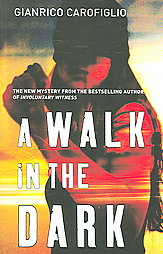
Last week I mentioned protagonist Guido Guerrieri's midlife angst in Gianrico Carofiglio's A Walk in the Dark. Things are not going so well for Guerrieri in Involuntary Witness, the series' first book, either, but the angst is funnier.

Here's Guerrieri on his profession, that of a lawyer, or avvocato:
  • "[I]n my office, the routine went as follows: my secretary called me, in the presence of the person who urgently needed to see a lawyer. If I was busy -- for example, with another client -- I made them wait until I was finished.

    "If I was not busy, as on that afternoon, I made them wait all the same."
  • "People think that lawyers often have important meetings."
  • On a previous client, "a drug pusher for whom I had managed to negotiate a disgracefully light sentence."
I quite like the amused detachment of those passages. Naturally, Guido's wife leaves him, and 
For several months I lived a wild life ... I kept outlandish company, went to fatuous parties, drank too much, smoked too much and all that."
He can't bring himself to say the word psychiatrist, yet he persuades himself to visit one, who tells him:
"I must try to find distractions. I must avoid dwelling on myself. I must attempt to see the positive side of things and avoid thinking there was no way out of my situation. I must hand over 300,000 lire, there was no question of a receipt, and we'd meed in two months time for a check-up."
If that's not enough, when you see what Guerrieri does with the drugs the psychiatrist prescribes, you'll realize that has to be one of crime fiction's saner and more level-headed protagonists.
==================
Gianrico Carofiglio will be part of my panel "A QUESTION OF DEATH: HOW IMPORTANT IS WHODUNIT?"  on Thursday, Sept. 15, 10 a.m.-11 a.m., at Bouchercon 2011.

© Peter Rozovsky 2011

Labels: , , ,

Tuesday, August 16, 2011

Gianrico Carogiflio's angst in Italy

A Walk in the Dark, second of Gianrico Carofiglio's four novels about Italian lawyer Guido Guerrieri, is at least as much  middle-aged angst trip as it is legal thriller.

Guerrieri's meeting with an old friend induces melancholy over his own current lack of companions ["Maybe that's normal, when you get to your forties. Everyone has their own affairs — family, children, separations, careers, lovers."]. The revelation that the friend's wife has died induces an emotion-choked phone call to his own girlfriend in which he can't quite bring himself to say, "I love you."  But we already know that Guerrieri is sensitive because the pop music he listens to is pensive stuff: Tracy Chapman and Bruce Springsteen's  "The Ghost of Tom Joad." 

Carofiglio readily acknowledges that a midlife crisis sparked his writing career. But A Walk in the Dark is more than a New Yorker short story blown up to novel length. The book brings to life the conflicts between Italy's overlapping police jurisdictions better than do some other Italian novels, and it takes righteous shots at corruption and nepotism. And if you've ever wanted your crime-fiction protagonist to work out part of his angst by kissing a nun, this may be your book.

The trial and hearing scenes are exciting, as one might expect from an author who used to be an anti-Mafia judge. And the courtroom color is even better. It's easy to imagine Magistrato Carofiglio being distracted by the carnival around him and wishing he could plunge into it instead of getting ready for a trial:
"The entrance hall was packed: women, young men, carabinieri, prison wardens and lawyers, most of them provincial. It was the first day of the trial of a group of drug dealers from Altamura.  The background nouse was the kind you hear in a theatre before the show starts."
==================
Gianrico Carofiglio will be part of my panel "A QUESTION OF DEATH: HOW IMPORTANT IS WHODUNIT?"  on Thursday, Sept. 15, 10 a.m.-11 a.m., at Bouchercon 2011.

© Peter Rozovsky 2011

Labels: , , ,

Tuesday, August 09, 2011

Has Gianrico Carofiglio ever been a copy editor?

"At first he'd corrected everything: syntax, grammar, spelling, even punctuation. Then he realised he couldn't go on like that. The men were hurt, he'd spend hours on end trying to correct texts that were usually impossible to correct, and none of his superiors, in the Prosecutor's Department or anywhere else, ever noticed the difference. So, after a while, he adapted. He would still change a few things here and there, just to show them that he read everything, but. mostly, he adapted.

"Anyway, he'd always been very good at adapting."
-- Gianrico Carofiglio, The Past is a Foreign Country
==================
Gianrico Carofiglio will be part of my panel "A QUESTION OF DEATH: HOW IMPORTANT IS WHODUNIT?"  on Thursday, Sept. 15, 10 a.m.-11 a.m., at Bouchercon 2011.

Labels: , , ,

Saturday, December 29, 2007

Reasonable doubts

This title of this post is deliberately simple. It’s the title of the book in question, the third of Gianrico Carofiglio’s novels about the Italian defense lawyer Guido Guerrieri. I chose it in part because of passages like this one:

“I broke off, but too late. I was about to say, even supposing your husband is telling the truth – and supposing doesn’t mean conceding – proving it, or at least creating a reasonable doubt, will be extremely difficult. I broke off because I didn’t want to reawaken her more than reasonable doubts.”
That’s Guerrieri talking to the wife of a client jailed and accused of smuggling forty kilograms of cocaine from Montenegro into Italy. Look how much Carofiglio tells us about Guerrieri in three simple sentences. He’s lawyerly, he’s good-hearted, he’s humorous, and he sends the narrative off in two directions: toward Guerrieri’s case, and toward his relationship with the client’s wife. Reasonable doubts (a literal translation of the Italian title) does double duty in its legal sense and its everyday sense.

The passage is ironical for a third reasonable doubt, unstated here: Guerrieri’s own doubts about the case. Or perhaps those doubts are implied in that second sentence, with its stops, starts, hedges and changes of direction that contain a humorous hint of Dickens. In any case, it helps make Guerrieri an enormously appealing protagonist, more so than he would be if he were just another good-guy lawyer fighting for the downtrodden. (I'll guess that the smoothly delivered multiple meanings are a tribute to the translator, Howard Curtis.)

Before I stop typing and resume reading, I'll ask you to think about titles. Reasonable Doubts applies to the novel's action in least three senses. That makes it a hell of an appropriate title. What titles can you think of that work similarly, surprisingly well?

© Peter Rozovsky 2007

Technorati tags:


Labels: , , , , ,