Thursday, June 05, 2014

Of Cops and Robbers: Now, THIS is the way to integrate reality into a crime novel

This new thriller by Mike Nicol is both tangled and straightforward, so chilling and so entertaining, that I don't know where to start.  Perhaps its most impressive accomplishment is that it offers a rich and credible account of what South African government and society are really like behind the headlines, both before and after 1994.

It can't be easy for an author, especially in popular genres such as crime and thriller writing, to work real events into the story without turning the book into a Movie of the Week. Nicol gets around this by choosing events less likely to be familiar, at least to readers outside South Africa. The novel never mentions Nelson Mandela, for instance, though one of his highest-profile colleagues figures in a subplot.

And he endows real events with the magic and imagination of fiction, whether they be the overseas assassination of an anti-apartheid activist, or the Miss Landmine Angola beauty pageant.  He knows, in other words, that his job is to tell an entertaining story.  That's a hell of a lot more effective than didactic, statistic-spouting chapter headings.

What should an author keep in mind when making real events parts of a novel? What crime novelist are best at it, other than James Ellroy?

© Peter Rozovsky 2014

Labels: , , ,

Sunday, June 01, 2014

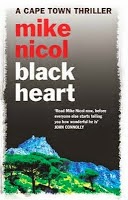
Black Heart, or Why you should spend your pennies on a book by Mike Nicol

Oh, man, did I like Mike Nicol's 2011 Cape Town thriller Black Heart. Here are a few of the reasons:

1) It is quite literally impossible at times to say who--the protagonists or the principal villain--is chasing whom. That's because each is chasing the other, and has good reasons for doing so.

2) And that's leaving aside the secondary villains--or are they secondary good guys?

3) The main good guys, a pair of security-company owners named Mace Bishop and Pylon Buso, are very clearly good, yet they have done dreadful things.

4) The principal villain, one of the more memorable in recent crime fiction, is evil beyond all doubt, yet she is given a chilling back story rooted in South Africa's recent past:
"Mace had watched her taken away to the Membesh camp. Nights of rape ahead of her as the big boys had their way. The big boys now MPs, government men, oligarchs. Was hardly a wonder he and Pylon went off to run guns. The camps weren’t a picnic."
One could discuss that passage at some length. For now, suffice it to say that Nicol avoids the easy temptation of making her horrible past an easy pop-psychological excuse for her evil present. Oh, and has any villain ever had a better name, with a more resonant first syllable, than Sheemina February?

5) The Hammett-like terseness that bursts into occasional rueful Chandlerian acid, as in this observation about Sheemina February's building:
"a cliff of expensive caves owned by film stars, rich business machers, trust babies, highflying models with too much money too soon."
6) The reference to "Government men, all the old strugglistas" who "get fatter by the minute with their deals and schemes." Strugglistas is my word of the week.

7) The humor:
"‘That’s your name? I call you Dancing Rabbit?’" 
 "‘That’s what I answer to. Also Veronica.'"
8) The humor at the tensest moments, as here, when Mace and Pylon confront Dancing Rabbit and her husband who, it turns out, are Native American casino entrepreneurs eager to swing a deal in South Africa:
“‘Maybe you should have told us. Sort of thing puts you in a different category for us … `In our books,’ said Pylon, ‘you were rich and famous coming here for a good time. Just needed the edge taken off the street life. No big deal.’” 
“‘Still not,’ said Dancing Rabbit. ‘In our experience people say they’re going to scalp you, they’re generally blustering.’  
 “‘Not here,’ said Mace. ‘People here say that’s their intention, most often it is exactly.’”
9) A comic set piece that does extra duty as local color and entertaining lesson in how vernaculars mix in a multi-ethnic country:
 "He rapped his knuckles on the lid. ‘Ja, hell man, this old biddy, this’ – he shook his head – ‘I’d say, hell man, I’d say, ja,’ – he folded his arms – ‘I’d say the way it is with your car, ag man, short and sweet like a beet, the fucking fucker’s fucked, ek se. Finish ’n klaar. Know what I mean. End of story.’"
In short, if you like your thrillers drum-head tight, sharply observed, with a keen satirical edge, thoroughly entertaining even as they offer serious commentary on the countries of their setting, you want to read Mike Nicol.

© Peter Rozovsky 2014

Labels: , , ,

Monday, May 26, 2014

Mike Nicol on South African crime writing

I've been back on the South African crime fiction bandwagon in recent days, with James McClure, Mike Nicol, and Diale Tlholwe, all of whom who have reminded me how exciting South African crime fiction can be. What better time to bring back Nicol's guest post about South African crime fiction? Matters have changed since I first put up the post; several of the authors he mentions have published new books, and at least one has died. Most notably, perhaps, that excellent Cape Town thriller writer, Roger Smith, has come into the picture. As a further update, here's a list of twenty top South African crime novels, from the Crime Beat Web site. But Nicol's essay remains a valuable introduction to and outline of one of the world's most interesting and vibrant crime-fiction scenes. Thanks again, Mike.

(Since soccer's World Cup begins in a couple of weeks, here's an illustration to bring back memories of South Africa 2010. Anyone remember what that instrument at the upper right is?)
=======================

Despite the vibrancy of thriller and crime fiction elsewhere, not much has happened in SA crime fiction over the last five decades. Until recently that is. This isn’t exactly surprising as the cops have been more or less an invading army in the eyes of most of the citizenry since forever. Certainly, come the apartheid state in the late 1940s no self-respecting writer was going to set up with a cop as the main protagonist of a series. It was akin to sleeping with the enemy.

So to get round this, in the late 1950s, a young woman named June Drummond found a way to enter the genre with a novel called The Black Unicorn that used an amateur sleuth to solve the mystery. Hers was the first crime novel in English, although some four years earlier, a popular magazine, Drum, that had a vibrant readership in the townships, ran a series of short stories featuring a character called the Chief. The author, Arthur Maimane, was hugely influenced by the US pulps and the stories were derivative but highly entertaining. Unfortunately they’ve never been collected although there is one to be found in the Crime Beat archives.

In Afrikaans crime fiction also took decades to reach maturity. During the 1950s there’d been cheaply printed novels featuring steak-loving, hat-wearing detectives investigating single murders. Often these stories were set in small towns and tended more towards pulp fiction than noir. After that Afrikaans crime fiction all but disappeared during the height of the apartheid era.

In English the thriller side of the genre was taken up by, most notably, Wilbur Smith and Geoffrey Jenkins, during the 1960s but it was not until the end of that decade that a major figure emerged – James McClure with a novel called The Steam Pig. This book introduced two cops, Tromp Kramer and Mickey Zondi. They would feature in a series that spanned the 1970s, disappeared for the 1980s, and finally ended with a prequel in 1993, The Song Dog. McClure’s twosome have gone some way to setting a convention for SA writers: the clever underling Zondi, the unsubtle Tromp with his built-in racism. In fact the books were highly satiric yet only one was banned, The Sunday Hangman. McClure died [in 2006] , after spending most of his life in the UK in Oxford.

McClure’s absence during the 1980s was filled by a different sort of crime thriller, a series written by Wessel Ebersohn, featuring a prison psychologist, Yudel Gordon, as the protagonist. Ebersohn published five Gordon novels up to 1991. The 1990s, however, were to see a number of changes, not least the change in the country to a democracy with the 1994 general election that ended the apartheid state. Overnight, well, almost overnight, the cops became the good guys and our literature started taking on a different perspective. But it takes some time for a country to mature and give itself permission to write and read escapist books, especially as we’d been used to writing and reading as an act of protest.

For the current crime thriller writers, the 1990s were significant because of a man called Deon Meyer. His novels first appeared in Afrikaans and made it to the top of Afrikaans best-seller lists. Meyer not only revolutionised Afrikaans literature but he was well translated into English and these books opened the genre to new voices. All the same it took a number of years – six in fact – before Meyer was joined on his lonely platform. In 2005 Richard Kunzmann published the first of his Harry Mason and Jacob Tshabalala series, Bloody Harvests, and Andrew Brown won the Sunday Times Fiction Prize for his Coldstream Lullaby – proving that a krimi could out-write the literary reputations. Also new Afrikaans figures appeared: Francois Bloemhof, Piet Steyn, Quintus van der Merwe, and Dirk Jordaan among them.

As for the sort of topics that have engaged these writers, well, initially serial killers – or to put it in a broader perspective, crimes of deviancy – were the subjects of choice for both English and Afrikaans writers. Perhaps in this there was a desire to steer away from the political issues dominating a nation in transition, although this attitude is changing. Social and political concerns are back on the agenda, and the bad guys are now as likely to be politicians, business moguls, and figures of authority as perverts, drug dealers, serial killers and gangsters.

Recent titles include Margie Orford’s Like Clockwork and Blood Rose, Richard Kunzmann’s Salamander Cotton and Dead-End Road, Angela Makholwa’s Red Ink, and Jassy Mackenzie’s Random Violence.
======================

Meet Mike Nicol and his mates from Crime Beat here. For more information, reviews and interviews with SA crime novelists, check out the Crime Beat blog, which includes a who's who of South African crime writing.

Reliable online book shops selling South African crime fiction are:
Kalahari.net, Loot.co.za and Exclusive Books.

© Peter Rozovsky 2008, 2012

Labels: , , , ,

Saturday, May 24, 2014

More highlights from Diale Tlholwe's Counting the Coffins

A few more things to know about Diale Tlholwe's novel Counting the Coffins, discussed in this space yesterday:

1) The protagonist, Thabang Maje, and his bosses, Thekiso and Ditoro, work in the Bedlam Building in Johannesburg.

2) An anonymous bar, away from where "the trendy congregate to congratulate themselves with expensive drinks," is on Nugget Street.

3) Maje tells of meeting another character "at one of those debauched parties that were held every day under the pretext of celebrating our new democracy."

4) A variation on the theme:
"`Nothing is certain or permanent in this world, especially in this country.'

“`Even our new democratic system?'

“`Especially that,' Thekiso said firmly and rose to leave."
5) This exchange, which could serve as the novel's thematic statement:
“`What are you then, now?' Tau Ditoro asked just as suddenly as he had appeared at my side.

“`What do you mean?'

“`A true believer or a sceptic?'

“`A true believer.'

“`In what?'

“`In scepticism.'

“`The only true faith!' he bellowed as he bundled me into the car ..."
6) Followed shortly thereafter, however, by:
"`Too much scepticism can be bad for your eyesight.'"
"Yes," you'll be saying to yourself about now, "this book looks worth reading." And you'll be right.

© Peter Rozovsky 2014

Labels: , ,

Friday, May 23, 2014

Diale Tlholwe, an exciting new (to me) South African crime novelist

Diale Tlholwe reminds me of his late, great countryman James McClure.  Like McClure, South Africa's greatest crime writer, Tlholwe writes with an amused, detached narrative voice that makes his social observations all the sharper.

McClure wrote during South Africa's apartheid era. Tlholwe sets his books amid the hangover after the euphoria of apartheid's overthrow, thus observations such as the following, from his second novel, Counting the Coffins:
“`Oh, Jacky. He used to be a journalist too. Now he is a spokesperson for some high official.'

“`Which one? The official, I mean.'

“`There’s been so many of them. Jacky is always moving around, advocating one cause today and another the next. He is a typical new South African. Right now, I think it’s small-business enterprise. After the mall mess he was in public works. Anyway, the same people are usually involved in all these things in different ways – public, private and everything in between.'”
or this, in which the protagonist, an investigator named Thabang Maje, indulges in high spirits on the job:
“`Evening, ladies and gents of the majority, as we used to say a million dark years ago just before looting and burning down your houses. I’m . . . I’m Lebogang.' For some reason my mind was back at the blazing season of my school days when we would terrify ineffectual people like these whom we suspected were fence-sitters in the liberation struggle.” 
That's funny and sad and scary at the same time, I'd say, enough by itself to make the novel worth reading.  The book so far also reminds me of the best of Northern Ireland crime fiction, in its invocations of ghosts that remain, however, very much alive.

I still have about half the book left to read, but Counting the Coffins bids fair to be my most exciting crime fiction discovery this year. I'll also look forward to reading Tlholwe's Ancient Rites.

© Peter Rozovsky 2014

Labels: , , ,

Wednesday, May 21, 2014

Back to South Africa in James McClure's shorts

Detectives Beyond Borders has long been a fan of James McClure's Kramer and Zondi novels, which pair a white Afrikaner police lieutenant and his Zulu assistant in apartheid-era South Africa, and do not spare the reader the harsh words that swirl around, about, and between the two. (Read all Detectives Beyond Borders' McClure posts; click the link, then scroll down.)

So I was especially excited to hear from the good folks at Crime Beat (South Africa), about God It Was Fun, a collection of McClure's short stories and scripts. These include the screenplay for a film adaptation of his novel The Steam Pig, a production "halted in circumstances that remain a mystery to this day," according to a short, informative biographical introduction by McClure's children.

It has been a while since I've read South African crime fiction, a body of work I've called second only to Ireland's in international crime writing, and it's good to be back.
*
Want to join me in exploring South African crime fiction? Here's a Crime Beat list of twenty top South African crime novels. I might have chosen different books by Mike Nicol and Roger Smith, but it's an exciting list, including a few authors new to me, one of whose novels I have just bought.

© Peter Rozovsky 2014

Labels: , ,

Thursday, January 30, 2014

Roger Smith in America

New Pulp Press, whose roster includes Jonathan Woods, Les Edgerton, Anonymous-9, and Crime Factory, is bringing two novels by South African chill- and gritmeister Roger Smith to America in print editions: Dust Devils and Capture.

Detectives Beyond Borders raves:
"Roger Smith knows how to play up the good, old-fashioned virtues of honor, persistence, redemption, and love of adventure. He also keeps the bullets flying, the blades flashing, and the spinning tires kicking up dust on sun-baked South African roads. 
"The result in Dust Devils ... is as much unabashed fun as I can remember having had reading a crime novel."
and
"Roger's Smith's Capture gets out into the streets in and around Cape Town's forbidding Flats more than his previous novels do, and the results make Capture feel more sociable than its predecessors. 
"The grim shacks remain, and grim things happen inside them (and in rich sea- and hillside houses, too), but characters also punch out drunks in crowded strip clubs or risk their health dodging cars. ... 
"But in the main, the story is Smith's customary mix of damaged characters interacting in dangerous ways, then rushing hellbent to redemption, romance, or messy death. And Smith even offers some laughs along the way."
Release date is Feb. 20.

© Peter Rozovsky 2014

Labels: , , ,

Sunday, July 14, 2013

A Bastille Day post: Tocqueville on France and Algeria

I somehow neglected this in my springtime frenzy of reading about the French-Algerian War, but its ringing words may be even more relevant in the waning moments of Bastille Day than than they were in April.
=============

I still don't know why France treated Algeria differently from Tunisia and Morocco, making of it a full-fledged colony while holding the others as protectorates. It couldn't really be because of a fly swatter, could it?

It transpires, though, that some of the impetus for France's decision about how to proceed after its invastion of Algiers came from the guy better known for writing about America:
"Tocqueville himself had sought such an incorporation when, in his 1847 report, he described the goal that would guide France's elusive, destructive, and ultimately failed project in Algeria:

"`We should set out to create not a colony properly speaking in Algeria, but rather the extension of France itself across the Mediterranean.'"
I don't say that makes him a perp, but he is at least a person of interest.

© Peter Rozovsky 2013

Labels: , , , , ,

Monday, May 06, 2013

North Africa: A History From Antiquity to the Present with a couple of mistakes

The latest book in my Maghrebi jones, North Africa: A History from Antiquity to the Present by Phillip C. Naylor, has a few exasperating flaws, but it's a fine introduction. One review suggests it might make a good introductory textbook, and it does.

First the good: The book's wide chronological scope allows Naylor to discern patterns that persist over time in a given culture or country. Muammar Qadhafi was not the first ruler who failed to build civic and other social institutions in Libya, for example.  Among other things, I appreciate Naylor's lack of sentimentality and excuse-making over post-colonial troubles in North Africa.

On the minus side, the proofreader apparently lost interest in the book's final chapters, leaving a reference to the former United Nations Secretary General Javier Pérez de Cuéllar as José Pérez de Cuéllar. And the Egyptian statesman whose name is variously spelled elsewhere Saad Zaghloul or Zaghlûl appears throughout Naylor's book as Zaghul, no first l. I don't know if this is due to some vicissitude of transliteration or pronunciation, but it sure looks odd. If the spelling is not simply a mistake, the author should have explained his decision to render the name as he did. Explanations of spellings are routine in books that render names from non-Roman alphabets into English.

I also don't care for Naylor'a love of the odd locution "equates with." Why not "amounts to" or even "means"? And the author gets wifty when summing up postcolonial theory--but then, who wouldn't? Such matters are probably dealt with in longer discussion than this survey permits, or else by reading the original sources.

I do, however, find useful Naylor's assessment that postcolonial discourse abandons binary considerations, the insistence that cultures, countries, and their populations are either modern or outmoded, Western or Eastern, and so on. And mostly I like his last chapter, which amounts to a checklist of contemporary writers from Morocco, Tunisian, Libya, Algeria, and Egypt. That just may feed my craving.

© Peter Rozovsky 2013

Labels: , ,

Wednesday, May 01, 2013

"That line belongs in a crime novel"

"`It is raining on the city.' The streetlights have been on for two hours, lighting up the closed shutters and doors of silent facades. The city is still and secluded, cunning, hostile, and frightened... 
"This was a calm day, a sad autumn day..."
That would be a good opening for a crime story, maybe a novel by Simenon or something out of Northern Ireland, or for a piece of urban post-apocalyptic fantasy. But it's neither. What it is is the opening of the Algerian writer Mouloud Feraoun's journal of the French-Algerian war.  As if that opening is not ominous enough, Feraoun was murdered by the OAS three days before the cease-fire decreed by the French government under the accord that ended the war.

What kind of a story would you expect from a crime novel that began the way Feraoun began his journal?  What passages have you read outside of crime writing that would make good openings or descriptions in a crime novel?

© Peter Rozovsky 2013

Labels: , , ,

Thursday, April 25, 2013

In France, as Cara Black said, it's complicated

I've reached a convenient temporary stopping point in my Franco-Algerian reading. Before I go, though, here are some thoughts I found today about the Algerian War's lingering effects in Algeria and France from a crime writer who sets her books in the latter.

The crime writer is Cara Black, author of the Aimée Leduc novels, and her post on the Murder is Everywhere blog begins "They killed our cook, threw her body down the well and stuck her head on the fence post."

Lest you think the post is all partisan wailing, its title is "In France it's Complicated."

© Peter Rozovsky 2013

Labels: , , ,

Tuesday, April 23, 2013

The Day of the Jackal and the Continental Op

So, what does my recent Algeria obsession, in the form of having just read Alistair Horne's A Savage War of Peace: Algeria 1954-1962, have to do with crime fiction, anyhow?

For one thing, it reinforces how strongly Frederick Forsyth's Day of the Jackal, for all its thriller trappings, is really a police procedural that has marked affinities with hard-boiled P.I. stories as well (No wonder it won the best-novel Edgar Award from the Mystery Writers of America in 1972).

The villains of Forsyth's classic 1971 novel are the leaders of the OAS, the breakaway paramilitary organization that, enraged by French President Charles de Gaulle's concessions to Algeria, hires a hit man known as the Jackal to kill him. The OAS were (and perhaps still are) dissident military men who constituted themselves as a group in Francoist Spain, then turned self-destructive fanatics and terrorists both in Algeria and in France.

The OAS and their followers were a complex bunch, not least in that they explicitly adopted tactics and organization from their principal opponents, the Algerian FLN, or National Liberation Front. Some had fought in the French Resistance against Nazi Germany. Not all were racist. And there was ample anxiety, suspicion, and contempt on the anti-de Gaulle side between some in the OAS on the one hand, and the ultras among the civilian pieds noirs on the other.

Forsyth wisely sketches this background very lightly or not at all. Instead, after setting the stage with the story of a real-life plot against de Gaulle, he has a council of French ministers and other big shots bring in  Claude Lebel, "the best detective in France," and if that sounds like the leading citizens of a Wild West town desperately seeking a new sheriff — or like the Continental Op being called in to clean up Poisonville in Dashiell Hammett's Red Harvest — there's more to come.

Lebel is an ordinary cop, and his belittling by pompous, condescending, artistocratic ministers with whom he meets nightly is a running motif of The Day of the Jackal. This may remind readers readers of a thousand stories about P.I.s or cops who have trouble with authority. One passage near novel's end even calls Lebel "the little detective," which would also work as a description of Hammett's squat little Op.

On the plot side of things, Forsyth alternates sections describing the Jackal's maneuvers all over Europe, and the authorities' efforts to catch him. The idea, of course, is to build suspense by getting the reader wondering if the cops will get to the Jackal before the Jackal gets to de Gaulle, and the chapters devoted to the authorities are an exciting, convincing story of a criminal investigation, only in this case of a criminal who plans to kill the president of France.

(Hear Frederick Forsyth talk about The Day of the Jackal in an interview with the BBC.)
***
A Savage War of Peace has one passage in particular that, whether or nor Alistair Horne intended so, may remind readers of a famous passage from Raymond Chandler. Take it away, Sir Alistair:
"Then, suddenly, with the least warning, the sky yellows and the Chergui blows from the Sahara, stinging the eyes and choking with its sandy, sticky breath. Men think, and behave, differently. It is a recurrent reminder that this is indeed Africa."
© Peter Rozovsky 2013

Labels: , , , , ,

Monday, April 22, 2013

“Algérie montait à la tête”

Charles de Gaulle in Aïn Témouchent,
Algeria, December 1960
  Sorry, folks, but, as Alistair Horne remarks several times in A Savage War of Peace: Algeria 1954-1962, “Algérie montait à la tête” — Algeria went to one's head (or, one might say, got under one's skin), and it's gone to mine. I'm not sure I'll visit any time soon (though Morocco or a return trip to Tunisia are not out of the question), but I bought a biography of Charles de Gaulle today and also Algerian White, by Assia Djebar.

Here are some of the small and large delights and surprises of Horne's book for me, who had known little about Algeria, particularly about that savage period in its history:
  • Almost seven years into the bloody Algerian war, crowds of Muslims shouting: “Algérie algérienne… Vive de Gaulle!” in Aïn Témouchent — and the event that precipitated the deminstration: de Gaulle's astonishing reference in a 1960 speech to “an Algerian Republic, which will one day exist."
  • That same year, as plots against de Gaulle's life by disaffected members of the military and pieds noirs mount by the minute, “A handsome young pied noir playboy, tired of life, decided to ram de Gaulle’s helicopter with his private plane.” He didn't do it because he couldn't figure out which helicopter was de Gaulle's.
  • Horne's quotations from Frantz Fanon, known previously to me only as the apologist for revolutionary violence, the author of The Wretched of the Earth, and the revolutionary whose éclat was second only to Che Guevara's, on women's roles the Algerian uprisings.The mentions are brief, but the effects of women taking active roles where they had never done before must have been even more cataclysmic in Algeria's traditional Arab and Kabyle cultures than was the influx of women into the workforce in America during World War II.
I should note, too, that Assia Djebar, mentioned above, who is still around today, writes both in French and under an alias (she took the nom de plume because she feared her father's disapproval, her Wikipedia biography says.) Algerian White, according to a blurb, "weaves a tapestry of the epic and bloody ongoing struggle in her country between Islamic fundamentalism and the post-colonial civil society," which makes her seem like a woman worth reading.

It also sounds a bit like Yasmina Khadra, who writes in French under an assumed name and who criticizes both the state of Algeria and what he sees as Western misunderstanding of the Islamic world. Sounds to me like Algeria is one pretty interesting country, though I'm not sure I'd feel comfortable visiting these days.

© Peter Rozovsky 2013

Labels: , , , , , ,

Saturday, April 20, 2013

Algeria in the '50 and the '90s: Yasmina Khadra and Alistair Horne

I'm still burrowing into the complicated history of France and Algeria in the mid-twentieth century via Alistair Horne's A Savage War of Peace,  In the meantime, here's an old post about an Algerian crime novel that paints a grim picture of the country a few decades after the events Horne recounts.
==================
Yasmina Khadra's novels about an Algiers police inspector named Brahim Llob owe much to the tradition of the alienated detective, but Khadra's wit is more bitter than is usual for that wisecracking tradition, and his target is his own country. Thus the opening pages of Dead Man's Share offer this:

"I try to catch the wall doing something wrong so I can investigate it."
but also
"We Algerians react only to what happens to us, never to forestall something that might happen to us.
"While waiting for the storm, we carry on with our rituals. Our patron saints take good care of us, our garbage cans are overflowing with food, and the planet's impending economic crisis is as distant as a comet—to us."
The novel's opening pages are full of bitter reflections on what Algeria does to its thinkers, how it consumes people of talent, how its leaders want to keep the people dumb. There may be a touch of autobiography to such passages; "Yasmina Khadra" is a pen name that the author, whose real name is Mohammed Moulessehoul, adopted to avoid censorship when serving as an Algerian army officer. He now lives and writes in France.
***
Dead Man's Share, published in French in 2004 as La part du mort and translated in 2009, is the fourth Brahim Llob novel. Khadra's comprehensive Web site (in French) includes excerpts, summaries, news, interviews, and the author's explanation of why he writes in French rather than Arabic.

A 2007 article surveys Khadra's work, including the Llob novels and non-series books that constitute a travelogue the Muslim world's miseries and agonies (The Attack, The Swallows of Kabul, The Sirens of Baghdad). And here are previous Detectives Beyond Borders posts about Khadra (click the link, then scroll down.)

© Peter Rozovsky 2012, 2013

Labels: , , , , ,

Wednesday, April 17, 2013

A savage war of reviews

My recent reading of The Day of the Jackal has led me to A Savage War of Peace, Alistair Horne's history of France's Algerian War.

The vast majority of the book’s free customer reviews on Amazon are five-star, but I was most interested in the two two-star reviews. Here's an excerpt from the first:
“Alistair Horne … is first and foremost hopelessly biased in favor of the Algerians.”
Here’s one from the second:
“This epic work … remains a remarkably racist work loved by State Department officials and neocons alike … Alistair Horne describes in gory detail atrocities committed by the FLN, or Algerian nationalist rebels, while skimming over far worse atrocities committed by the nice white-guy French.”
See also: Albert Camus, Yasmina Khadra, Rachid Taha

© Peter Rozovsky 2013

Labels: , , , ,

Tuesday, March 26, 2013

Who needs crime fiction?

I had sat down to prepare the day's post when I realized that my copy of the novel about which I'd intended to offer some remarks for which exact quotation was necessary was some miles away, resting near the top of the literary compost heap known as my living room. In its stead I've dug up a post from this time last year that asks an always pertinent question.
================= 
Let's stay in South Africa awhile longer. A provocative discussion in the Crime Beat section of the South African Books Live Web site asks "Is crime fiction redundant?"

Site keeper/novelist Mike Nicol writes about an e-mail exchange with the crime-fiction reviewer Gunter Blank. “I would say,” Blank  wrote, according to Nicol, “that in a society like Germany, Sweden, the US, crime fiction is becoming more and more redundant.”

“I agree it has become pretty difficult finding a decent crime novel that’s not chewing up the same ol’, same ol’." Blank added. "I mean how many serial killers, people with troubled childhoods, old Nazi criminals, heists gone awry and adultery turned murder, can you invent to keep the genre fresh?"

“In turbulent or haunted societies," according to Blank, "societies that are trying to find out who they are – there are still hundreds and thousands of lives and experiences to tell."

What do you say? Is crime fiction becoming redundant in the rich world? More relevant in the developing world? Both? Neither? If it is becoming redundant, as Blank suggests, how can it become relevant again? And if crime fiction is still relevant in "turbulent or haunted societies that are trying to figure out who they are," WHY THE HELL ARE U.S. PUBLISHERS NOT BUYING UP AND PROMOTING THE BEJABBERS OUT OF CRIME WRITING FROM NORTHERN IRELAND?

Before you chuck your Stieg Larsson box sets at Blank's noggin, head over to Crime Beat, read the Nicol-Blank exchange, then feel free to comment here, there, or both. (In addition to his provocative propositions, Blank offers an impressive list of favorite and underappreciated crime writers. The man's got good taste.)
***
Read a Detectives Beyond Borders guest post from Mike Nicol. Read more from Nicol on South African crime writing, including his own. In a related blog post, It's a crime! (Or a mystery…) discusses "New clichés in crime fiction." Think dentistry.]

© Peter Rozovsky 2012

Labels: , , ,

Wednesday, November 07, 2012

Ross Thomas on politics and other absurd subjects

In honor of the day's events, I'm bringing back two posts I made way back at the beginning of the campaign season about Ross Thomas, a great political satirist, humorist, and Edgar Award-winning crime writer.
=================
Thumbs up to Ross Thomas' The Seersucker Whipsaw for its title, its subject, and its humor.

The political strategists at the Pen & Pencil Club here in Philadelphia are almost as bad as the cigar smokers and the lawyers, but Thomas' operatives, plotting a campaign for the first election in the newly independent fictional African nation of Albertia, make the profession sound like delightful fun without being more cynical than thou:
"I'm going to call him Chief," Shartelle said firmly. "It’s the first time I’ve ever worked for anybody who was a real chief and I’m not going to pass up the opportunity to address him by his rightful title.”
The book is also full of amusing social observations about its time (it appeared in 1967):
“English lit—right?”

“Wrong. Letters.”

“Letters?”

“As close to a classical education as Minnesota got that year. It was an experiment. A little Latin, and less Greek. It was to produce the well-rounded man. I think they abandoned it in favor of something called communications shortly after I was graduated.”
How good a writer was Thomas? He won two Edgar Awards, but I'm two-thirds of the way through the novel, no crime has been committed, and the book still works as highly entertaining political comedy.

With an American presidential election campaign on, the book will make especially entertaining reading. (Of course, there's almost always an American presidential campaign on.)
***
Speaking of American presidential campaigns, did I mention that, in a burst of serendipity Thomas could hardly have envisioned when he wrote the novel forty-five years ago, one of its characters is the Ile of Obahma? © Peter Rozovsky 2011

It's a strange land, where normal rules don't apply, where shifting tribal loyalties make life dangerous for the unwary, where even the most careful and idealistic visitors may soon get sucked into the intrigue and become indistinguishable from those whom they had previously affected to deplore.

It's Washington, D.C., and it's the setting for Ross Thomas's 1967 international thriller Cast a Yellow Shadow. Less overtly a satire of politics than the two Thomas novels I'd read previously (The Seersucker Whipsaw and The Fools in Town Are on Our Side), the book is nonetheless full of snippets of dialogue and nuggets of description evocative of their place and time in politics:
“The call came while I was trying to persuade a lameduck Congressman to settle his tab before he burned his American Express card. The tab was $18.35 and the Congressman was drunk and had already made a pyre of the cards he held from Carte Blanche, Standard Oil, and the Diner’s Club. He had used a lot of matches as he sat there at the bar drinking Scotch and burning the cards in an ashtray. `Two votes a precinct,' he said for the dozenth time. `Just two lousy votes a precinct.' “`When they make you an ambassador, you’ll need all the credit you can get,' I said as Karl handed me the phone.”
and
“He had watched it evolve from a virtually unexplored territory into a private preserve of the British South Africa Company, then into a colony, and finally into a self-governing country. Now he claimed it was independent, but Britain said it wasn’t and that its declaration of independence was tantamount to treason. Because of the chromium, the U.S. had made only gruff warnings about not recognizing the declaration.”
and
“It sounds like a typical American intelligence plot,” he said. “Only 2,032 things could go wrong—and probably will.”
Here are some notes about Ross Thomas and a Thomas bibliography. While you browse them, ponder these questions: What is your favorite Washington crime novel? Your favorite political crime novel?

© Peter Rozovsky 2012

Labels: , , , ,

Monday, October 01, 2012

Amara Lakhous on conflict Islamic style

Thursday's "Wide world of hate" post took up the diversity of ethnic resentment, conflict, and suspicion as revealed in crime fiction.

Amara Lakhous' Divorce Islamic Style, a social comedy in the guise of a spy story, offers this:
"I have to constantly remind myself that I’m Tunisian, and this neighborhood is full of Egyptians. Many people don’t know that there are rivalries among the Arabs. For example, it’s not smooth sailing between Syrians and Lebanese, between Iraqis and Kuwaitis, between Saudis and Yemenis, and so on and so on. It’s why they can’t seem to come up with a plan for unity, in spite of a common history, geography, Arabic, Islam, and oil. The model of the European Union will have to wait!"
That the Tunisian is really an Italian impersonating a Tunisian – albeit an Italian whose grandfather had been born in Tunisia of Italian parents before returning to Italy, where he longed to return to the land of his birth – suggests the fun Lakhous gets up to.

Here's what happens in the dormitory where the undercover Tunisian finds a place to stay:
“The non-Egyptian tenants are divided into two categories. Mohammed, the Moroccan, and I are in second place; we’re Arabs and we can communicate linguistically with the majority, limiting insult and injury where possible. But for the Senegalese and the Bangladeshi there’s no escape: they’re at the bottom. They have to submit or leave. To be Muslim isn’t enough. It’s better to be an Arab Muslim, but it would be fantastic to be an Egyptian Arab Muslim!”
Lakhous, Italian and born in Algiers, is only my latest reading encounter with Algeria. Didier Daeninckx built his novel Murder in Memoriam around the 1961 Paris massacre of Algerian protesters. Yasmina Khadra challenges easy notions that the Islamic world is either fundamentalist suicide bombers or Western sellouts.

Coincidence, or did the bloody end of Algeria's colonial ties to France make the country a moral crucible for relations between the West and the Islamic world?

While you ponder the question, here's a song by the Algerian-based-in-France singer Rachid Taha that you've likely heard before, though perhaps not in this version.

© Peter Rozovsky 2012

Labels: , , , , , , ,

Thursday, September 27, 2012

The wide world of hate

Michael Stanley's novel Death of the Mantis has as one narrative current suspicion of and condescension by a group of relative newcomers to southern Africa toward the aboriginal population. The newcomers are black, the indigenous people the Bushmen, who populated the area many thousands of years before the Bantu peoples arrived.

Some years before, I'd noted with interest the suspicion and occasional derision Swedish police officers directed toward an ethnic Finnish colleague in one of Helene Tursten's books. Finns, in turn, are less than generous and fair toward their own country's Sami indigenous population in another crime novel whose title escapes me at the moment.

Finally, I recently met a Canadian who had had extensive professional dealings in China and with its population. "Don't ask the Chinese what they think of black people," he said, shaking his head ruefully.

We in America, where "people of color" is a blanket term, tend to think of racism as, by definition, directed by white people of European descent toward peoples with complexions different from theirs, generally darker. I find it a bracing reminder of the complexity and diversity of humanity to be reminded that ethnic suspicion and resentment are more widespread than that. Knowledge is good.

What about you, generous and inquiring readers? What surprising examples of ethnic suspicion and prejudice have you found in your fiction reading?
==================
Stanley Trollip, who is along with Michael Sears the writing team of Michael Stanley, will be part of my "Murder is Everywhere" panel at Bouchercon 2012 in Cleveland, Saturday, October 6, 10:15-11:05 a.m.

Here's the complete Bouchercon schedule.

© Peter Rozovsky 2012

Labels: , , , , ,

Wednesday, September 12, 2012

Michael Stanley and the crime-fiction trinity

I roll my eyes when I see a crime novel called "plot-driven" or "character-driven." Plot, character, and setting are co-equal, consubstantial, and probably co-eternal as well. You wouldn't ask which of a three-legged table's legs was most important, would you? Lose one, any one, and there goes the good china.

I thought these elevated thoughts after reading Death of the Mantis, third and most recent of Michael Stanley's Detective Kubu mysteries. David "Kubu" Bengu, a police detective whose name means hippopotamus in the Setswana language of Botswana, is the star of the book. Deprived of interesting physical and human settings that include the Kalahari desert, however, Kubu might be nothing but an annoyingly cute collection of endearing traits. Without a compelling mystery (and Death of the Mantis had the "So that's why!"s bursting in my head for a good while after I finished reading), the book would be a travelogue with worthwhile bits, incapable, however, of sustaining its length.

So, yes, I enjoyed the Death of the Mantis, and I'm looking forward to having one of its authors on the panel I'll moderate at Bouchercon next month.  Among the novel's attractions is a note that explains, among other things, why the authors chose to use the term Bushmen for the indigenous people of southern Africa who figure prominently in the novel. Another is an excellent Alexander McCall Smith joke toward book's end.

==================
Stanley Trollip is, with Michael Sears, the writing team of Michael Stanley. Trollip will be part of my "Murder is Everywhere" panel at Bouchercon 2012 next month in Cleveland, Saturday, October 6, 10:15-11:05 a.m. Stop in and say hi on your way to the West Side Market.

Here's the complete Bouchercon schedule.
© Peter Rozovsky 2012

Labels: , , , , , , ,