Wednesday, June 26, 2013

Unmitigated Cunliffe

Relaxing in the corporate-affiliated café of a chain bookstore, having lined up with people ordering 24-ounce ventis.

I'm here browsing more Barry Cunliffe, whose book Britain Begins continues to offer a stimulating, plausible account of the peopling of Great Britain. Among the results of the population movements are those great Neolithic monuments I love to visit. (Call me old-fashioned, but part of me feels the world has been going straight to hell since the onset of the Bronze Age.) A summary chronology: Barrows came first, then passage graves, then the circular "henges," one of which you might know. Historical context only enhances the monuments' power to inspire awe. I now half-expect to visit examples in the Orkneys for next year's pre- or post-Crimefest trip.

Cunliffe also redeems himself for his earlier misuse of mitigate with this entertaining passage:
"The basis of subsistence was now much broader and much more reassuring than in past times, when survival depended on unmitigated reindeer eked out by horse meat."
I don't know about you, but I find unmitigated reindeer beguiling, not least for the images it conjures of Neolithic children complaining: "Reindeer again? This stuff sucks!" Cunliffe's correct use of eke out is a bonus.

All is forgiven, professor.

© Peter Rozovsky 2013

Labels: , , , , ,

Sunday, June 16, 2013

Keeping one's hair in Dublin, plus books I got at Crimefest

Left: Sculpture,
Archaeological Museum
of

 Morbihan, Vannes, Brittany. 
Above: View from the rear
 of my guesthouse, Gardiner
Street Lower, Dublin. All photos
 by your humble blogkeeper.
I opened two packages of books yesterday that I'd shipped home from Crimefest, and I must be a nice guy because I sent myself some good stuff. Among the highlights:
  1. Betrayal, by Giorgio Scerbanenco. This is a new translation of a novel by the master of Italian noir. Its previous English translation was released in the 1960s as Duca and the Milan Murders.
  2. The Killing Way, by Anthony Hays. A mystery set in Arthurian Britain might not ordinarily be my cup of tea, but this looks low on sorcery and faux-Celtic wiftiness, and high on low-down, dirty political intrigue.
  3. The Saint and Mr Teal, by Leslie Charteris, included in my book bag, talked up by panelist Zoë Sharp, and published in a handsome new trade paperback edition. Includes an entertaining tribute to P.G. Wodehouse in one character's name.
Because everyone else is doing it?
When the crew announced itself for my Aer Lingus flight from JFK to Dublin, I first produced my pistol, and I then produced my rapier. Then I realized that Farrell was not, in fact, the captain of the plane but merely a crew member, so I stowed my musical weapons under the seat in front of me and restored my seat back and tray table to their full upright and locked positions.

Muiredach's High Cross
(detail), Monasterboice,
County Louth, Ireland
Speaking of tunes one just might hear in Temple Bar of a Saturday or any other evening, I love the song, but, unless you're Luke Kelly reincarnated, could we vary the repertoire a bit, lads?

© Peter Rozovsky 2013

Neolithic
passage grave,

Loughcrew, County
Meath, Ireland


Labels: , , , , , , , , , , , , , ,

Saturday, June 15, 2013

Stoned in Carnac

(All photos by your humble
blogkeeper)
To paraphrase Barry Goldwater, extremism in the defense of buckwheat crepes filled with Merguez sausage, egg, onions, and salad is no vice. I spent four nights in Carnac and ate the above-named delicious local specialty for dinner the last three. A butter-and-sugar crepe with lemon and orange zest for dessert is no slouch, either.

Here's a last bit of Brittany, from before I got on the rocky road to Dublin, though the rocks were in France.

The first two photos below depict the celebrated Grand Menhir Brisé at Locmariaquer, one head-on, the other a lateral view. Want an idea of how big this 6,700-year-old megalith is — and of how imposing it must have been before its collapse thousands of years ago? Note the groundskeeper standing between two of the fragments in the second photo.


Bizet Breizh!

© Peter Rozovsky 2013

Labels: , , , , , , ,

Tuesday, June 04, 2013

Warships, megaliths, and why publishers should pay for authors' drinks

HMS Warrior, Portsmouth.
Photos by your humble
blogkeeper
Completed my first English Channel crossing this morning, though not on the vessel at left. The crossing was uneventful, the ferry comfortable, with all mod cons except WiFi, which, the ferry operator apparently having heard how much I enjoyed the occasional absence of phone and WiFi service at my hotel in Bristol, decided I could do without it on the water as well.

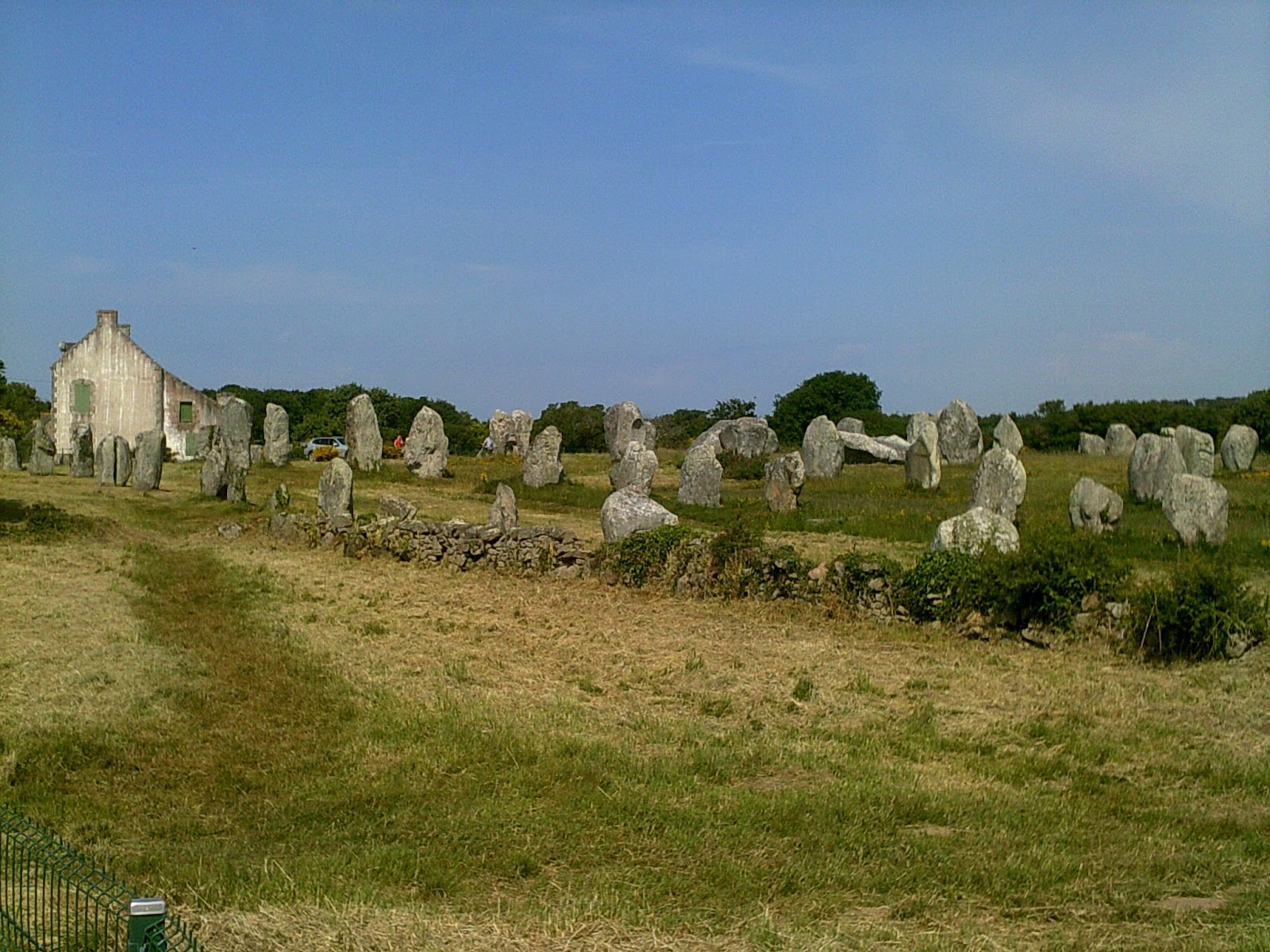
The crossing took me to Carnac in Brittany, which has the world's greatest concentration of Neolithic monuments. I began my explorations this afternoon and will continue them over the next few days, giving Detectives Beyond Borders readers the lowdown on my favorite megaliths.

But first a bit more about Crimefest 2013. Everyone who writes about crime fiction festivals will tell you that the socializing is at least as important as whatever business gets done there. But the two need not be mutually exclusive.

This year, for example, I chatted at the bar with an author named Adam Creed and his charming wife. Both are well-travelled, good conversationalists, with diverse and stimulating interests.  I had not heard of this author before, but I'm discussing him now and I may look into his books.

He probably thought he was passing a pleasant evening at the hotel bar, but he was really getting his name out before whatever forum Detectives Beyond Borders can provide. And that's why publishers should pay for their authors' drinks, and governments should make the expense tax-deductible. It makes good business sense, and it's the right thing to do.

Cheers!

© Peter Rozovsky 2013

Labels: , , , , , , , , , , ,

Wednesday, December 07, 2011

How the new imperils the ancient in Portugal

(Almendres cromlech; photos by your humble blogkeeper)
Stonehenge is the Xerox of Neolithic monuments; guides to and promoters of every other such monument compare theirs to Stonehenge, usually to note that theirs is thousands of years older.

The Almendres cromlech, a group of ninety-five standing stones outside Évora, is about 7,000 years old, predating Stonehenge by 2,000 years, our guide told us this morning, and he's no Portuguese chauvinist. In fact, he said, Portugal does a bad job of protecting the ancient monuments in which the country's southwest is so rich and of educating the public about the monuments.

The three we saw today [the cromlech, its accompanying menhir (left), and the Great Dolmen of Zambujeiro] lack the most basic facilities. There are no visitors' centers, no explanatory plaques, no trash cans or bathrooms. No postcard sellers, no bookstores, nothing to let visitors know they are in the company of anything but what locals, ignorant of the monuments' origins, traditionally called "castles of the Moors."

The dolmen (right), in fact, a high-end burial chamber from late in the Neolithic age, about 2,000 years younger than the cromlech, has been stripped of the earth that covered it, subjected to a series of half-arsed recovery efforts, and left in such danger of collapse that it looks like a row of dominoes about to tumble, or like a mouth full of horribly misfit teeth.

Back to Stonehenge. The British, our guide said, are the models for archaeological preservation and education. In Portugal, he said, appeals to history fall on deaf ears that hang off the head of mercenary politicians, and some of the most important monuments are in private hands, which bars UNESCO from stepping in and declaring the area a World Heritage Site.

Portugal's rich landowners are greedy and uneducated, he said, and the local people, loath to give up their traditional ways of life, resist the idea of rebuilding their local economies around tourism. So, in the end, I'd say I learned at least as much about contemporary Portugal as I did about its Neolithic predecessors.

The guide was an eloquent spokesman for public archaeology, and that's the cause to which he and the group of which he is part devote themselves. The group is called Ebora Megalithica, and I hope you'll join me in reading up on the group and, above all, on the wonderful landscape and history it seeks to protect.

(Read Detectives Beyond Borders' thoughts on some Bronze Age monuments.)

© Peter Rozovsky 2011

Labels: , , , , ,