Sunday, March 06, 2016

Carpool to Hell: A day with David Goodis and his friends

Roosevelt Memeorial Park, Trevose, Pa. (Photos by Peter Rozovsky)
Edward G. Pettit
Tony Knighton, Ed Pettit, Cullen Gallagher
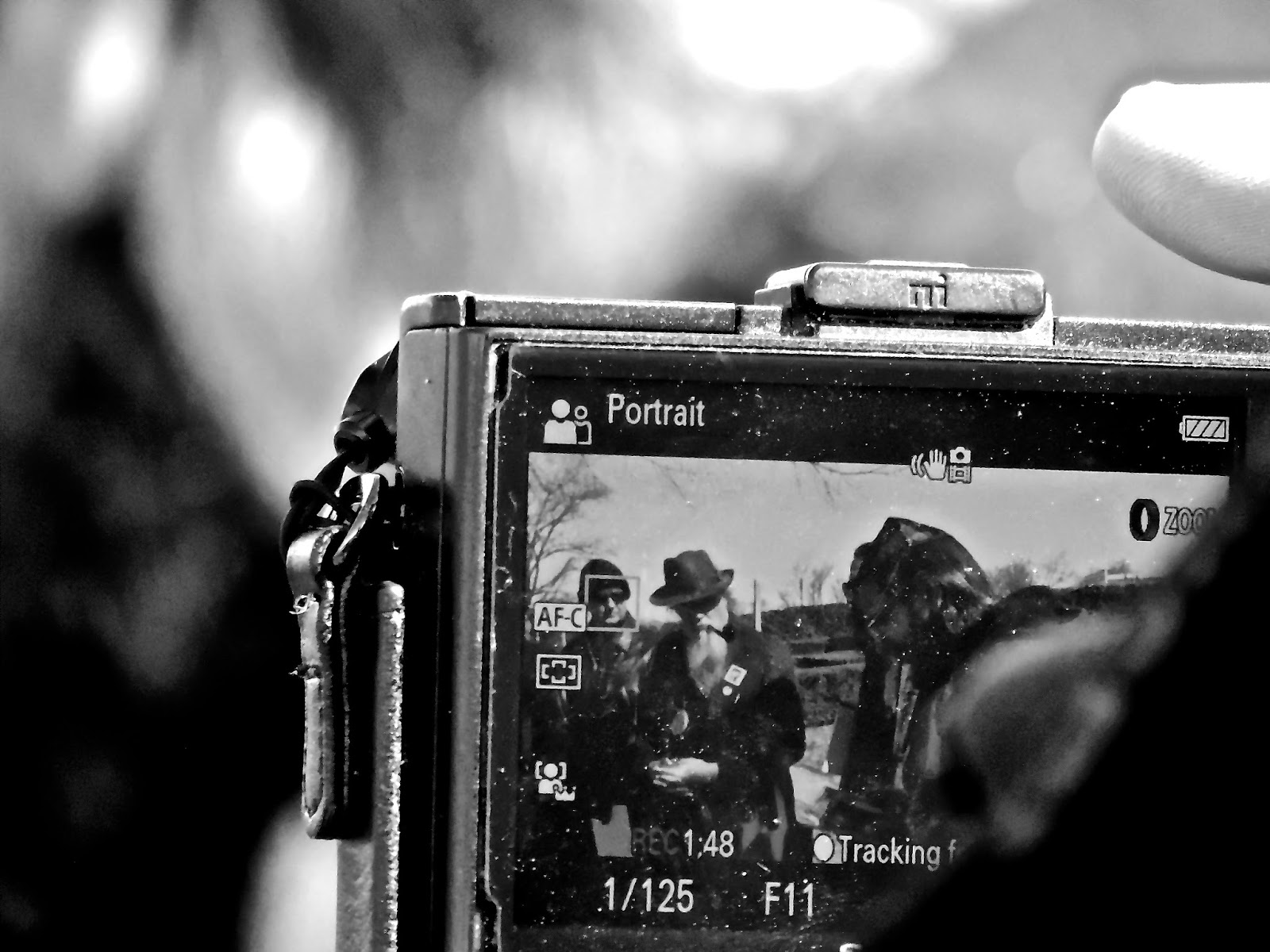
Excellent fun Sunday on the annual Carpool to Hell in honor of David Goodis' 99th birthday. Stimulating conversation with Lou Boxer (Dr. NOIRCON), Jay A Gertzman, Edward G Pettit, Cullen Gallagher, Tony Knighton, Daniel Wolkow, and more fellow carpoolers, shopping at the great Port Richmond Books, and the most gin I have ever drunk before 4:30 in the afternoon. That's a pretty good day, and we can talk more about it on March 19 at Noir at the Bar: The Final Curtain: Society Hill Playhouse.

Dr. Lou "Shadow" Boxer, Goodis fan and
founder of Noircon 
The site of Goodis' childhood home in the Logan
section, since vanished along with the rest of
several blocks in a sinkhole of ash, shoddy
construction, and millions of dollars worth of
payouts.
Until then, read my previous posts about Goodis (click the link, then scroll down).

© Peter Rozovsky 2016
The Goodis house on North 11th Street in Philadelphia's East Oak Lane section (Goodis' bedroom was behind the window at left.). Goodis lived here after his return from Hollywood, and he wrote some of his best-known noir novels in this house.
The docks of Philadelphia, cleaned up since Goodis' day.
Goodis fans at Roosevelt Memorial Park

Labels:

Saturday, April 21, 2012

Goodis the great

Some of the borders I've crossed recently have been ones of time, into American crime writing of the 1940s and '50s.

Based on my first readings of all three authors, I like Bruno Fischer and Fletcher Flora a little better than I like Day Keene. But none was as good as David Goodis.

I'd read some Goodis before, the short story "Black Pudding" and the 1951 best-seller Cassidy's Girl, and I'd been impressed, notably by the heart-breaking compassion he mustered for his characters. But Dark Passage (1946) is, in its opening chapters, even better, a knockout of a book.

I'll likely have more to say later, but for now it's interesting to view the novel as an argument for the old proposition that the way to become a good writer is to write, and write, and write. Dark Passage was Goodis' second novel, and it appeared seven years after his first. In between, Goodis wrote prodigiously for pulp magazines, more than five million words in five years in the early 1940s, according to his own estimate. (See Robert Polito's notes to David Goodis: Five Noir Novels of the 1940s and 1950s.)

The result may not tug at the heartstrings quite as hard as some of Goodis' later works do, but it is self-consciously stylish without going over the top, a difficult feat for any writer, much less one not yet thirty years old. The book's first chapters are full of words repeated to amusing effect. And if you like how Ken Bruen and Allan Guthrie use humor at dark moments and somehow make it seem right, you'll find the roots of the practice in protagonist Vincent Parry's conversation with the taxi driver in Chapter Seven.

But first, my favorite line of the book so far, tough, naive, funny and touching at the same time:
"Being good to people sounds nice but it's hard work."
***
Mingle with Goodis-heads and noir fans this Nov. 8-11 at Noircon 2012 in Philadelphia.

© Peter Rozovsky 2012

Labels: , , , , , , ,

Sunday, March 08, 2015

Street of No Return: The David Goodis pilgrimage, 2015

Lou Boxer
Much of David Goodis' Philadelphia has disappeared, from the waterfront dives and cheap apartments of Cassidy's Girl to the house where he lived as child that was demolished because the neighborhood was sinking into a subterranean creek.

The house on North Eleventh Street
where Goodis lived and wrote after
he returned from Hollywood.
Cullen Gallagher
reading by Goodis'
graveside at Roosevelt
 Memorial Park in
Trevose, Pa.

Joe Samuel Starnes
Every year a gang of Goodis fans gathers to visit these forgotten places and others significant in the life of Philadelphia's greatest crime writer, and one of the most moving and compassionate writers anywhere, in any time.

Erik Arneson interviewing Andrew Kevorkian.
Kevorkian knew Goodis and attended his
funeral in 1967.
Eric Rice
Here's a record of this year's pilgrimage, which took place Saturday, photos by your humble blogkeeper.

© Peter Rozovsky 2015  

Lou Boxer, Jeff Wong


Foreground: Cullen Gallagher and your humble
blogkeeper/photographer. Background: David
Goodis' house on North 11th Street.
Joe Samuel Starnes, Erik Arneson, Cullen
Gallagher, Lou Boxer
The Street of No Return: Site of Goodis' childhood home
in Philadelphia's Logan section.


Monday, January 26, 2009

The David Goodis memorial

January cold came in from two rivers around a dozen David Goodis fans Sunday. The twelve of us had gathered by the great Philadelphia noir writer's grave site to read from his work and talk about him. We then repaired to a local diner, echoing a gathering of Goodis' friends after his funeral.

I probably had read less of Goodis than anyone else in the group, several of whom had met Goodis, and one of whom had taught him to shoot pool ("He was as bad as you can get."). But I read a selection from his 1953 story "Black Pudding" for its note of hope and even redemption, touching and unexpected from this darkest of noir writers.

Lou Boxer, of Noircon fame, read from Goodis' first book, Retreat From Oblivion. Some might call the passage maudlin, the sentimental work of a writer barely out of his twenties. I say it showed a man thinking more seriously about death than most crime writers ever do, and I'll be seeking out more of Goodis.

Duane Swierczynski posts some photos and video.

© Peter Rozovsky 2009

Labels:

Friday, November 29, 2013

Thankful for Black Friday

Since I once read that the term Black Friday to designate the masochistic shopping crush in which all those other people are engaged at this moment originated in Philadelphia, I see no harm in bringing back this post from 2010 about Black Friday, by Philadelphia's own David Goodis.

TODAY ONLY: Stay home and read this book instead of going to the mall, and derive 70% more pleasure from your reading!!!
====================== 
I read David Goodis's 1954 novel Black Friday on Thanksgiving Day, and I can see why the French love this guy. The book's bleak, uncertain ending reminds me strongly of Jean-Patrick Manchette.

I also got a kick out of its mention of my newspaper and out of its references to Dizzy Gillespie and the painters Corot and Courbet.

Here's a routine bit of description whose tone is, however, indicative of Goodis' bleakness:
"The front of the cellar* was divided into two sections, one for coal, the other for old things that didn't matter too much."
And here's a tiny excerpt from Black Friday read at Goodis' graveside.
============
* I know of no Goodis story in which cellars do not play a part: Black Friday, Down There, "Black Pudding." That has to say something about Goodis. Here’s your humble blogkeeper reading from “Black Pudding.”

© Peter Rozovsky 2010

Labels: , ,

Friday, April 20, 2012

Crime in the canon

Remember a few years ago when everyone was getting all worked up about literary canons and whether or not they were good things?

Geoffrey O'Brien sidesteps such matters neatly when talking about David Goodis. The American literary canon, he said -- and he used the word without hesitation or explanation -- exists, but it's expanding constantly into the future, as time passes, and also into the past.

O'Brien's remarks carry considerable weight because he's editor-in-chief of the Library of America, probably the closest thing to an American literary canon, and because LoA has just published David Goodis: Five Noir Novels of the 1940s and 1950s. O'Brien joined the Library of America in 1992 and has been editor-in-chief since 1998, and he says he's been reading Goodis since he was 14 years old. I don't know about you, but I like the idea of genre fiction having a mole on the inside of high American culture. During his tenure, Philip K. Dick had joined the canon, as have Jim Thompson, Cornell Woolrich, James M. Cain, Patricia Highsmith, and now, with his own volume, Goodis.

So, any more Goodis on its way to the canon? "We will continue to talk about Goodis," O'Brien told a questioner at the Free Library of Philadelphia. "That's for sure."

© Peter Rozovsky 2012

Labels: , ,

Saturday, May 07, 2011

David Goodis on screen and beyond borders

The 1972 movie ... and Hope to Die crosses a number of borders, notably from print to film (it's based on David Goodis' novel Black Friday) and from the U.S. to France (the movie's original title is La course du lièvre à travers les champs, and its director is René Clément, one of several French directors who adapted Goodis.)

I knew about both before I rented the movie. But I was stunned to see the opening chase scene take place not on a cold Philadelphia street, as in the book, but in front of one of Montreal's iconic most familiar buildings: Buckminster Fuller's United States pavilion from the Expo '67 world's fair.  

This was no case of Montreal filling in for New York or Chicago, either. Characters make several references to Montreal, and the camera lingers at least once on a sign for the real University Street. The cash strewn around throughout the movie looks American, though. Maybe the gang's hideout is just over the border in Vermont,  or perhaps they popped down to the States for a bit of shopping in Plattsburgh.

The movie, like the book, lays bare Goodis' yearning for family, and it features a number of fine performances, notably by Robert Ryan as Charley, the gang's leader and father figure. (The Wikipedia article on Ryan omits the movie. This only adds to the small errors and omissions I have found in Wikipedia's articles on movies. Use Wikipedia at your peril!)

(The screenplay is by the French crime novelist Sébastien Japrisot, whose novels include A Very Long Engagement. You may know that book from its adaptation into a movie starring the adorable Audrey Tautou, whose last name is probably one of the more often misspelled in moviedom. )

Read an appreciation of Black Friday. Read Vincent Canby's highly unappreciative review of the movie from the New York Times.

© Peter Rozovsky 2011

Labels: , , , , , , , , , ,

Friday, June 22, 2012

In a Goodis mood

I have all kinds of exciting new crime fiction lined up to read and talk about, from people like Adrian McKinty, Mark Pryor, Paul Charles,  Paul O'Brien, Andrea Camilleri, Wolf Haas, and others.

But somehow the mood seems right for David Goodis. Maybe it's the chaotic state of my newsroom, stripped of office furniture, a meager staff banging away at keyboards while others scavenge for bargains in books, mugs, and leftover promotional T-shirts. Only now our move to  a new building has been postponed a week or two, so we're all feeling a bit like stunned post-apocalyptic bottom feeders.

Anyhow, Goodis' tales of loneliness and isolation seem especially appropriate, though the novel I'm reading now, Nightfall, is set in Manhattan, rather than in Goodis' native Philadelphia, where I am typing these words.

What crime writers seem especially suited to a given mood? Do you ever choose the books you read based on such considerations? Which authors do you reach for? And what mood are you in when you reach for them?

© Peter Rozovsky 2012

Labels: ,

Tuesday, March 03, 2015

Hear Detectives Beyond Borders read, and celebrate David Goodis

(Photo by your
humble blogkeeper)
Erik Arneson (right) has posted a podcast of "Three Minutes of Terror" from Noircon 2014 in Philadelphia. I was one of about twenty authors who read from their work, three minutes maximum, or risk being attacked with a chainsaw.  Have a listen; I'm up at the 18:45 mark in this second part of the two-part podcast.

Then on Saturday, I'll join a few dozen Goodisheads to celebrate the life and work of David Goodis, Philadelphia's greatest crime writer and one of the best noir writers anywhere. This annual event has in part years included visits to sites associated with Goodis' work as well as to the cemetery where he was buried.

We'll discuss Goodis, we'll read from his writing, and a convivial meal is generally on the itinerary. Here's a favorite moment from the one year I attended the celebration previously.  Weather forecasts call for temperatures more comfortable than they were that year.

© Peter Rozovsky 2015

Labels: , ,

Wednesday, October 19, 2016

David Goodis: Best bar scene bar none? plus Noircon 2016!

If you're like me, your crime fiction reading has likely included a scene or two set in a bar. But has anyone ever written bar action as surprising and as funny (and that in the midst of a decidedly downbeat story) as this, from David Goodis' 1961 novel Night Squad:
"As Nellie collided with the falling chair, Carp started a circular route that took him swiftly in the direction of the bar., Knowing what was coming, the regulars at the bar reached quickly for their shot glasses and grimly held on. Others weren't quick enough. As Carp flashed past the bar, his arms functioned with the speed of a piston. Before he reached the far end of the bar, he'd snatched and downed a double rye and a single of California brandy. Then he headed for the front door and scampered out."
Speaking of Goodis, next week is time once again for Noircon, the best little biennial crime fiction convention in Philadelphia or anywhere else. See you there. 

© Peter Rozovsky 2016

Labels: ,

Saturday, June 23, 2012

"Such a good pal that you give me the blues"

What did I mean when I wrote that David Goodis knew how to create a mood? How about this:
"`Don't get me wrong. I'm not sore. You're a nice guy. But I don't want to listen to you any more. I don't want to see you any more.'

"`Don't leave. I hardly ever get to talk to anybody. Let me buy you a drink. I promise to keep my big mouth shut.'

"`Sorry,' Vanning said. `Thanks a lot, but you're such a good pal that you give me the blues.'"
That passage stood out from any number of more overtly heartstring-tugging depictions of loneliness in Goodis' 1947 novel Nightfall for its humor. Readers of this blog will know that I like humor in crime writing especially when it appears at unexpected moments. This passage will get a man laughing into the bottom of his gin glass.
***
The Boston Phoenix's assertion to the contrary, all five novels included in the Library of America's new Goodis collection, where I read Nightfall, did not appear as paperback originals. Dark Passage and Nightfall appeared first in hardcover editions issued by Julian Messner. This information is available in the notes to the LofA volume.

© Peter Rozovsky 2012

Labels: ,

Thursday, November 24, 2011

The Grifters, or Mother Knows Best and other crime-fiction family matters

I wrote a few years ago about some of the ways crime writers portray families. The writers I cited were Swedish, Welsh, Dutch, and French, and their characters struggle to build or hold together families or family substitutes not always nuclear.

How do American crime writers take up the theme?  In the Father Knows Best/My Three Sons/Leave It to Beaver era of American popular culture, noir writers said nope!, there are scarier things in life than crotchety but lovable old Uncle Charlie.

I'm reading Jim Thompson's The Grifters (1963) now, and the last American noir novel I read from about the same era was David Goodis' 1954 Black Friday (which means I should be putting up this post tomorrow instead of today, American Thanksgiving).  Mid-century American noir is not my main area of reading, so I don't know how typical each book is of its author's work or of its period. But each thrusts its lone-wolf protagonist into an odd, criminal echo of a traditional family (more like a clan in the Goodis and Mother Knows Best in the Thompson), and that has to mean something.

It would be easy to read such books as protests against or twisted echoes of the cheerful picture of suburban family life presented elsewhere in popular culture of the time, but they're more than that. The Goodis especially betrays a longing for family.

So, what did family mean in post-war American noir writing, and why?
***
Happy Thanksgiving, whether or not you're spending it with your family.

© Peter Rozovsky 2011

Labels: , , ,

Tuesday, March 06, 2007

Juan de Recacoechea's Bolivian noir

An interesting afterword follows Juan de Recacoechea's American Visa, about which I posted a comment last week. The writer and teacher Ilan Stavans, one of whose students translated American Visa from Spanish into English, calls Recacoechea's style "picaresque noir." I won't be giving away too much if I say both terms of the description fit. The novel is a kind of travelogue, its protagonist's observations on La Paz in the 1990s perhaps reflecting the author's own impressions after he returned to Bolivia from two decades working in Europe.

Stavans calls American crime fiction Recacoechea's "prime stimulation," and he notes the author's references to Dashiell Hammett, Raymond Chandler, Chester Himes, and movies based on their work. The novel is also akin in temperament to David Goodis' work in a way that might surprise some readers familiar only by reputation with that prototypical noir writer.

I'm less certain of Stavans' assertion that the Mexican crime novelist Paco Ignacio Taibo II is probably Recacoechea's main regional model. Yes, both authors take harsh looks at large Latin American cities (Taibo's Hector Belascoaran Shayne is a private investigator in Mexico City.) Both offer stark depictions of societies that crush their poor, their dispossessed, and even their ordinary workers. Yet, unlike Taibo, Recacoechea and his first-person protagonist, Mario Alvarez, never speechify. And that made Recacoechea a bit easier to read for this son of the bourgeoisie.

© Peter Rozovsky 2007

Technorati tags:


Labels: , , ,

Saturday, March 22, 2014

Noir is a state of mind: Giorgio Scerbanenco's A Private Venus

Here are some reflections inspired by my second reading of Giorgio Scerbanenco's 1966 novel A Private Venus, available in the UK from Hersilia Press and in the U.S. from Melville House:
1) The novel is thoroughly noir long before it portrays any violence or criminal acts. This may remind some readers of David Goodis.
2) Its protagonist, Duca Lamberti, is a doctor who has been struck from the register for an act of euthanasia. That sounds like Goodis' ex-singer or piano player protagonists, but unlike them, Lamberti has not hit the skids. He has a sister, a niece, a powerful friend on Milan's police force, and a place to live. Noir is not synonymous with squalor. It's a state of mind, not an economic category.
© Peter Rozovsky 2014

Labels: , , , , ,

Sunday, January 08, 2012

David Goodis on drinking

Its plot wanders, and some of its dialogue is wooden, but these two bits of high melodrama from David Goodis' 1951 novel Cassidy's Girl are worth the price of admission:
"She sat there with an empty glass in front of her. She was looking at the glass as though it were the page of a book and she were reading a story."
and
"`You're young and you're little and it's a shame.'
“`What's a shame?'

“`Drinking. You shouldn't drink like that.” He raised his hand slowly and tried to form it into a fist so he could hit it on the table. His hand fell limply against the table and he said, `You want a drink?'”
Heartbeaking, and good evidence for the proposition that compassion is an essential ingredient of noir.
© Peter Rozovsky 2012

Labels: ,

Wednesday, April 18, 2012

Descent into Death: A glimpse at 1950s American crime fiction

Are the 1950s the most luridly masochistic, twisted, self-obsessed, self-voyeuristic decade in American history? Based on the period's crime fiction, yep.

I've been reading a fair number of crime novels and stories from the 1950s, reissued by Wonder Publishing Group with suitably lurid covers after original publication in magazines of the time, notably Manhunt. Two highlights have been "As I Lie Dead" by Fletcher Flora and We Are All Dead by Bruno Fischer. In each, a first-person narrator relates a tale that takes him exactly where you'd expect from the title, and it's hard to imagine anything more self-involved than imagining one's own death.

Why did these authors have their characters do it? Is lurid embrace of death really more prevalent in American crime writing of the 1950s (and late 1940s) than in that of previous and succeeding periods? If so, why?  As a gross generalization, I'd say that characters in 1950s crime melodrama embraced the forbidden when doing so could still exact a tremendous toll in guilt, psychological dissolution, even death, and that this lends stories of the time their giddy, nasty kick. Shed one's inhibitions, as we've all been doing since the 1960s, and you shed the possibility of writing such stories.
***
This is a fine time to ponder such questions. On Thursday I'll attend two events celebrating the Library of America's publication of David Goodis: Five Noir Novels of the 1940s and 1950s.  The durable, handsome volume includes Dark Passage, Nightfall, The Burglar, The Moon in the Gutter, and Street of No Return, and you can meet the book's editor, Robert Polito, for a program at the Free Library of Philadelphia. The fun starts at 5:45 with a screening of The Burglar, for which Goodis wrote the script, and Polito takes the stage at 7:30. Visit the library's website for information.

© Peter Rozovsky 2012

Labels: , , , , , , , , , , ,

Friday, December 07, 2012

"Take this, Job, and shove it"

So, how is the Book of Job like a crime novel, anyhow? Like many crime novels, not all of them Scandinavian, it has an ominous prologue before it gets to the good part.

And here's some of that good part, from Stephen Mitchell's translation:
"Why is there light for the wretched,
life for the bitter-hearted,
who long for death, who seek it
as if it were buried treasure,
who smile when they reach the graveyard
and laugh as their pit is dug."
That's noir, but it sounds more like a noir author or reader than a noir protagonist, most of whom go more meekly or at least resignedly to their fates.  It's as if one of David Goodis' wretched protagonists sat down to write his own story instead of letting Goodis do it.
***
And now, turning from the substantive to the atmospheric side of noir, here's a view right around my corner, photo by your humble blogkeeper.

© Peter Rozovsky 2012

Labels: , , , , , , , , , ,

Sunday, March 30, 2008

NoirCon 2008 in Philadelphia this week

It began last year as GoodisCon, honoring Philadelphia's own David Goodis, whose work included the novels made into the movies Dark Passage and Shoot the Piano Player. This year's version is called NoirCon, and it honors the kind of writing Goodis exemplified.

The event runs from April 3-6, and it includes discussions, movies, meals, a silent auction and more. Tributes to Georges Simenon, Dorothy B. Hughes, Jim Thompson, Donald Goines, Charles Willeford and Carroll John Daly are on the agenda, though these are scheduled as early as 8:45 a.m., a highly un-noirlike hour to expect attendees to be out of bed. Guest of honor among a star-studded list of attendees, and a man I'll hope to meet, is Ken Bruen.

More information here.

© Peter Rozovsky 2008

Labels: , ,

Monday, October 31, 2016

Why NoirCon is good for the soul

Woody Haut talks about David Goodis and Central Avenue, Los
Angeles. Photos by Peter Rozovsky unless otherwise noted.
Charles Ardai, Stona Fitch
You know what noir is about? Good fellowship, empathy, sharp wit and keen intelligence, subversion without destruction, doing good for others, working hard at work one loves, and communicating that passion, among other things. And it's about gin. Always gin.

Leigh Redhead
That's how it was at Philadelphia's NoirCon 2016, which ended Sunday. Ninety-nine percent of what we hear, read, see, or are told is trivial at best, arrant lies and bullshit at worst.  I thank Woody Haut, Charles Ardai, Stona Fitch, Barry Gifford, Aurélien Masson, Leigh Redhead, Buffy Hastings and others for reminding me that things don't always have to be that way. And I thank Vicki Hendricks for the gin — a Hendrick's and tonic, naturally.


Jonathan Woods, Annie Finnegan

Ed Pettit flanked by Eric Rice (left) and Cullen
Gallagher
Haut's presentation on David Goodis and Los Angeles' Central Avenue was the first time I had the feeling I was seeing something real about L.A. Ardai, who has enjoyed success in several fields, talked about how his Hard Case Crime imprint publishes the books he loves — even if these include no books by Harry Whittington — illustrated with cover art he loves just as much. Receiving a canvas by Robert McGinnis, Ardai said, is like getting a fresco by Giotto in the mail.


Aurélien Masson
Masson was passionate and voluble about the venerable French crime imprint he heads, Série noire, about what it's doing, about how French crime fiction has changed, and about authors all across that political spectrum can find a home there and still go out for a drink together.And Fitch shared the story of his Concord Free Press and its unusual "business" model.

Charlie Stella
Gifford, interviewed on stage by Wesley Stace, offered inspiring reminder that classic books don't just reappear; someone has to do the work to get them before the public. Gifford's Black Lizard press did that for many of the hard-boiled and noir classics that we take for granted today as part of our cultural landscape.

Mike Dennis assumes his Don
Donovan persona for Wednesday's
Noir at the Bar at the Pen & Pencil
Club
Vicki Hendricks, Leigh Redhead
Redhead, who also read at Wednesday's pre-Noircon Noir at the Bar at Philadelphia's Pen & Pencil Club, gave the only conventional presentation on a "Masters of Suspense" panel, but her thoughts on Scott Smith were so sharply focused and her examples so well chosen that I want to read Smith. (The unconventional choices were by Lano Waiwaiole, who talked about Richard Stark as a suspense writer, and Radha Vatsal, who discussed adventure films of the 1910s directed by women and featuring women in prominent roles.)

Suzanne Solomon, Cullen Gallager,
Ed Pettit, Andrew Nette
Vicki Hendricks, Hendrick's and tonic, and me.
Photo by Lou Boxer
And how nice it is to be among people to whom books matter. Huzzahs and thanks to Lou Boxer and Deen Kogan for the best edition yet of this excellent festival. I'll be beck at NoirCon in 2018. You should be, too.

Richard Vine
Jay Gertzman, Jedidiah Ayres, Charles Ardai
Veteran Boxers Association, Ring 1, site
 of NoirCon's wind-down gathering
Radha Vatsal, Lano Waiwaiole, Leigh Redhead
Bob and Barbara's
Richard Edwards, Warren Moore
On the way to Port Richmond Books
The main NoirCon site
© Peter Rozovsky 2016

Labels: