Thursday, June 27, 2013

Win books by a couple of Irish guys — We have a winner!

During and after Crimefest 2013 in Bristol, I collected, among other books, the latest novels by Kevin McCarthy and William Ryan. Within days of returning home, I received by mail, among other books, the latest novels by Kevin McCarthy and William Ryan.

That promotional largesse can now win you the books, as I'll send the extra copies to the first readers who correctly answer these skill-testing questions:

  1. McCarthy's novels are set amid the agonizing birth of the modern Irish state. The first is titled Peeler. What is a peeler? Win a copy of McCarthy's new book, Irregulars.
  2. Ryan's books, set in mid-twentieth-century Soviet Russia, include a notable real-life Russian writer as a character. Who is that writer? Win Ryan's The Twelfth Department. 
*
That didn't take long, did it? One reader in California knew both that peelers are police in Northern Ireland (named for Sir Robert Peel, whose first name became the colloquial name for police in England: bobbies.), and that Isaac Babel is a character in William Ryan's novels. Congratulations. Thanks to you, two Irish guys are smiling, and I save postage by sending two books to one place.

© Peter Rozovsky 2013

Labels: , , , , , ,

Wednesday, August 27, 2008

Weighty expectations

I've recently started one book and borrowed another, both of which raise great expectations in the fiction-to-be-taken seriously department.

Abdelilah Hamdouchi's The Final Bet is the first Arabic-language detective novel to be translated into English, according to the jacket copy, and its author one of the first to write detective fiction in Arabic.

Chingiz Aitmatov's The Place of the Skull not only bears a jacket blurb from Arthur Miller, but the Times Literary Supplement called it "arguably the most representative text of the Gorbachev thaw." Not novel or book, but most representative text, mind you.

Now, while I see if these novels live up to their weighty promise, I'll ask you to ponder this difficult question of weightiness.

Leonardo Sciascia comes to mind for his acceptance and impeccable credentials both as an important crime author and as an important author, period, no qualification.

What crime writers enjoy similar acceptance both as masters of their genre and as important writers even to those who may not read crime fiction? How do you feel about claims for importance on behalf of crime stories?

© Peter Rozovsky 2008

Labels: , , , , , ,

Tuesday, November 21, 2006

Boris Akunin avoids the big questions

An amusing and richly informative 2004 article/interview in The Telegraph examines the novelty of Boris Akunin's situation in Russia's cultural life:

"Until the fall of communism in 1991, educated Russian readers had retained a taste for classic literature ... There was no such thing as reading merely for pleasure. But that all changed with the lifting of the ban on decadent Western fiction. As suddenly as crime rose in Russia, so did crime fiction."

Unlike two of his fellow Russian practitioners of the new art of Russian crime fiction, the article continues, Akunin could write. Still, Akunin says, Russian readers can't avoid asking the big questions. "I never meet readers in Russia," he says, "because there would always be some guy who would stand up and say, 'What is the meaning of life? Does God exist?' "

Of course, Akunin did not reject the Russian classics completely. Here's how he created Erast Fandorin:

"When I was a kid there was never a Russian literary character who I could imitate. I was either Sherlock Holmes or d'Artagnan or some other bloody foreigner. You cannot pretend when you are 11 or 12 that you are a hero of Turgenev. ... I approached this problem in a scientific way. I grafted a bit from every protagonist in Russian literature whom I admire. I took 10 per cent of Andrei Bolkonsky [from War and Peace], 10 per cent of Prince Mishkin [The Idiot], 10 per cent of Lermontov's Pechorin. Then I added a recipe of my own design, mixed and stirred. At the beginning he looked like a Frankenstein, a homunculus. Then miraculously he came to life, for me at least, and started not doing what I wanted him to do. Now for me he is more alive than most of the people I know."

© Peter Rozovsky 2006

Technorati tags:

Labels: ,

Monday, November 20, 2006

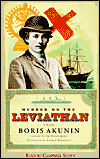
Paradise tossed ("Murder on the Leviathan")

There's plenty of good, old-fashioned fun in Boris Akunin's tale of murder off and on the high seas: suspects gathered in one place, funny lines, rivalry between English and French (with a Russian coming out on top), nods to Wilkie Collins, Agatha Christie, Sir Arthur Conan Doyle, The Maltese Falcon, and just maybe Maurice Leblanc, and the tale of a French police inspector who just knows that he'll get off the damned boat one of these days.

The Leviathan is a super steamship bound for Calcutta in 1878. Its passengers include a doctor or two, a doctor's wife, and a highly nervous nobleman. A middle-aged English lady suddenly grown rich under suspicious circumstances is part of the group, scandalized by the behavior of a Russian diplomat with a slight stutter. A flighty young woman in a delicate condition has her own reason to be nonplussed by the Russian, and a specialist in Indian archaeology arouses suspicion when he chucks a napkin under a table. One of the group has slaughtered ten people in a Paris townhouse -- maybe.

The characters take turn narrating chapters, and each misinterprets the state of affairs in his or her own way. Each, without knowing it, stumbles upon certain truths well before the detective in charge, Erast Fandorin. And, in a strange way, each is part of his or own Tempest, only these characters lose their illusions and delusions at sea, instead of on a wild island, before heading home, free of "the feverish stupor that had shrouded our minds and souls."

© Peter Rozovsky 2006

Technorati tags:

Labels: , ,