Tuesday, August 25, 2015

My Bouchercon panels — I Got Carter: What movie adaptations can and cannot do

OK, so Get Carter was too good to read slowly; I finished it in one evening, and that spurred one more observation about books and movies, namely the rather obvious one that the page is a better place for getting inside a character's head than is the screen.

Mike Hodges, who directed the celebrated 1971 movie adaptation of Get Carter, explains in a foreword to the new Syndicate Books edition some of the changes he made from Ted Lewis' novel. (The book was published originally as Jack's Return Home, should you find an old copy.)  Hodges explained that he wanted to include locations in the north of England that had opened his eyes to poverty and social inequality during his naval service. He also wanted a more visually interesting location for a key confrontation in the novel.

Not from Get Carter, the book
or the movie. This is one of
my own.
But he does not explain his most obvious and, arguably, most sensible choice: not to attempt a straightforward transcription of Carter's thoughts, mostly about the brother whose death he has come to avenge and that make up a large part of the novel. The movie gives us less than the book does about the dead Frank Carter, less of Jack's mix of fondness and embarrassment about his brother, almost none of the latter. That makes the movie feel less personal than the book. This is no argument for book over movie or vice versa. In this case, both are excellent. It's just a recognition that each form can do some things better than the other can.

Now it's your turn. What do books do better than movies? Movies better than books? (Read Detective Beyond Borders posts on Why books are better than television.)
========
Jordan Foster will discuss Get Carter author Ted Lewis as part of a panel I'll moderate at Bouchercon 2015 in Raleigh, N.C.,  called "Beyond Hammett, Chandler, Spillane, and Macdonald." The panel happens Thursday, Oct. 8, at 2:30 p.m., and there is still time to register for the convention. Trust me: It's fun.

© Peter Rozovsky 2014

Labels: , , , , , , , , ,

Thursday, April 09, 2015

Crimefest memories: Mike Hodges on how to make a classic movie for £7,000

Ted Lewis' great crime novel Get Carter (along with the rest of Lewis' work) is or soon will be back in print and easily available, thanks to those good people at Syndicate Books/Soho Press.  Five years ago, at Crimefest 2010 in Bristol, England, I had the chance to meet Mike Hodges, who directed the excellent and influential movie version of Get Carter. (This is one in an occasional series of blog posts about Crimefests past and present leading up to Crimefest 2015, which takes place May 14-17.)
==================
Seven thousand pounds. That's how much money Mike Hodges made for writing and directing Get Carter, the classic 1971 hit-man movie starring Michael Caine, and not a penny more.

Hodges made that surprising statement during Friday's pre-screening conversation with Maxim Jakubowski at Bristol's Arnolfini cultural center. He also said the many humorous touches in the otherwise bleak tale encouraged him in the making of his 1972 follow-up, Pulp: "I really thought I would like to hear laughter."

Hodges said after a panel discussion today that yes, there had been pressure from producers and other heavies to have Michael Caine's title character walk away at the end of Get Carter. But Hodges resisted, and Carter gets— but you'll have to watch the movie to see what happens.

© Peter Rozovsky 2010

Labels: , , , , , , , ,

Thursday, July 17, 2014

Get Carter, or what crime movies are just about as good as the novels from which they are adapted?

I've started reading Syndicate Books' reprint of Ted Lewis' 1970 crime novel Get Carter (first published as Jack's Return Home), and I'll want to read it slowly because it's so good.

Few crime writers could inject menace and desperation into small talk the way Lewis did, and he had a fine eye for period detail — the Hammond organ in the bar at the Cecil, for instance. Does anything say 1960s like the cheesy warbling of a Hammond?

This new edition of the novel, to be published in September, includes an introduction by Mike Hodges, who directed the celebrated 1971 film adaptation, starring Michael Caine and chosen by the Guardian/Observer in 2010 as the seventh-best crime movie of all time. (Its top crime film is Chinatown, so the list is by no means perfect, but still ... )

Hodges is both forthright about the changes he made and highly respectful and deeply admiring of Lewis' novel. And that raises this interesting question: What other crime movie adaptations rank as high in critical and popular esteem as do the novels on which they are based as do Lewis' Get Carter and Hodges'? The closest example I can think of is The Maltese Falcon. How about you?

© Peter Rozovsky 2014

Labels: , , , , , ,

Tuesday, July 08, 2014

Get Carter is coming to America

I have on my desk as I type this post the upcoming U.S. rerelease of Ted Lewis' 1970 novel Get Carter (originally published as Jack's Return Home), the first U.S. publication of the influential, gritty, downbeat British crime classic in many, many years.  The new edition arrives in September from Syndicate Books, an imprint distributed by Soho Crime and "focusing on out-of-print or neglected mystery and crime fiction of cultural relevance." 
 

Syndicate also plans to publish two more Lewis novels this year, one of them for the first time in North America, according to the company.  While you wait to read them, here's a post I first put up a few years ago about Jack's Return Home/Get Carter and Mike Hodges' celebrated movie version. The new edition of the novel includes a foreword by Hodges that offers illuminating discussion of his feelings about the book and of changes he made when filming it.  And here's a link to another post I put up after hearing Hodges speak at Crimefest 2010 in Bristol.

 ============================
Mike Hodges' 1971 movie Get Carter is rich with a sense of place. So is the 1970 Ted Lewis novel on which it is based though, so far, in a somewhat different way.

Jack's Return Home, later rereleased under the same title as the movie, is full of angry observations on the North England city to which tough-guy Jack Carter return to investigate his brother's death. (The setting is Newcastle in the movie, the Doncaster area in the book.)

Hodges' movie is full of gritty interiors, rows of housing apparently foreshortened by a long camera lens to emphasize the degree to which they are squashed together beneath giant belching smokestacks. Hodges and cinematographer Wolfgang Suschitzky also offer up a gorgeous gallery of deeply etched local faces drinking in a local pub. That first pub scene and the shots of houses and smokestacks look straight out of a gritty documentary. (Go here for a rundown and photos of real locations used in the movie.)

Lewis' social portraits are more cutting, here in a dissection of the crowd at Cyril Kinnear's club:
"The clientele thought they were select. There were farmers, garage proprietors, owners of chains of cafés, electrical contractors, builders, quarry owners, the new Gentry. And occasionally, though never with them, their terrible offspring. The Sprite drivers with the accents not quite right, but ten times more like it than their parents ... Not one of (the wives) was not overdressed. ... They'd had nothing when they were younger, since the war they'd gradually got the lot, and the change had been so surprising they could never stop wanting ... "
or
"The dark, close trees came to and end and I was back bathing in the rateable value of the yellow street lights. ... The California-style homes were still and silent, tucked away beyond the yards and yards of civic-style lawn. Where a house showed signs of life naturally the curtains were drawn well back to inform the neighbours of the riches smugly placed within."
The second bit is more sneering and less specific than the first and therefore has dated less well. But by God, they both give the novel an attitude.

© Peter Rozovsky 2010, 2014

Labels: , , , , ,

Saturday, March 27, 2010

Get Hodges

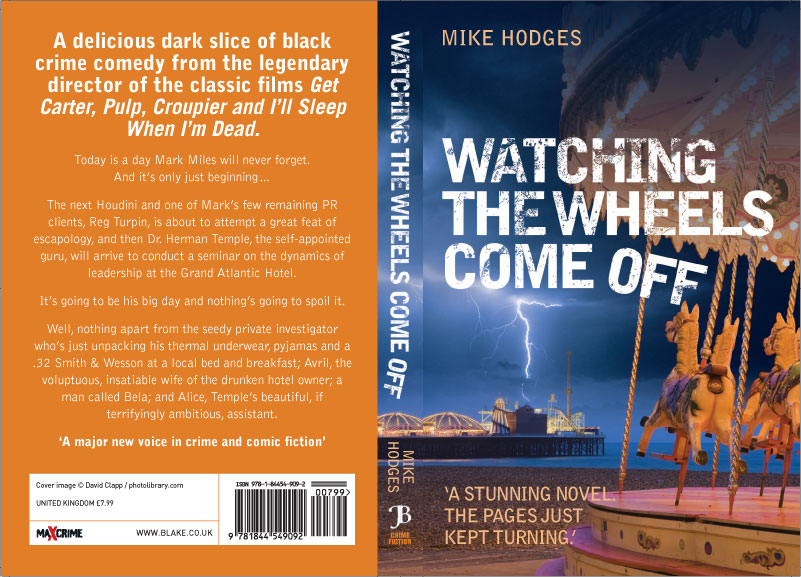
The deadpan narration of Watching the Wheels Come Off reminds me of Clive Owen's deadpan voiceovers in Mike Hodges' 1998 movie Croupier.

No surprise there, perhaps. Hodges, who began his movie career directing Get Carter in 1971, published Watching the Wheels ... , his first novel at age 77 and one of the first two titles from Maxim Jakubowski's Max Crime imprint.

I don't quite know why, but I find passages like this beguiling:

Alone, in a long black dress on a tall black bar stool, sits Ursula Letts. Everything about her, from the cut of her hair to the shape of her shoes, radiates style and originality. Even the stigma of a lazy right eye suits her quirky style. Ursula is a primary-school teacher. She also has the dubious honor of being Mark's childhood sweetheart and very first lover. Unfortunately for her, the affair won't quite lie down and die.
It's an odd story involving a faded seaside resort, a plucky public relations man who lives in his office, a fascistic cult leader, a down-at-the-heels detective, and a latter-day Houdini who, at the point I have reached, has vanished into the ocean chained in a trunk.

Here are two more bits I've liked:

He picks up the evil-looking burger. "Jesus, it couldn't be more dangerous than this."

He thinks about taking another bite but decides against it. Instead, he watches Ursula walk out of his life. The waitress moves in to clear the table.

"Anything else?"

"Yes, penicillin."
and

When conferences began to replace communities, every seaside resort in the country built a centre for them. These centres, with the greedy fingerprints of local burghers all over them, were inevitably portentous, ugly and erected on a prime location where nobody could ignore them. ... Conferences make the world go round or, more exactly, give the appearance of making it go around. Like careousels, things tend to end up pretty much where they started.
© Peter Rozovsky 2010

Labels: , , ,

Sunday, February 21, 2010

Get Carter gets American — and English

The second Newcastle scene of Mike Hodges' 1971 movie Get Carter has Michael Caine climbing a dingy stairwell of peeling wallpaper and, I think, crumbling plaster.

The scene is quintessentially American, and I doubt that any previous English crime movie had included anything comparable. Moreover, Hodges and Caine knew they were bringing an American sensibility to British moviemaking; check out the book Caine's character reads on the train from London to Newcastle.

But as obvious and as bracing as the American influence is, the movie conveys a strong sense of place. Streets crammed with rows of attached houses are dwarfed by a mammoth, steaming, exhaling industrial complex. And the camera lingers on silent, time-worn faces in the local pub, in the manner of a good documentary. I don't know if this picture of Tyneside in the early '70s is accurate, but it is convincing, and that's what matters.

I also don't know how big Newcastle's Irish population was at the time, but if my uneducated ears don't deceive me, the movie is full of Irish accents, and not bad ones, either. This, too, makes the setting all the more convincing and convincingly English.

This naturally puts me in mind of the debt that current Irish crime writers acknowledge to Americans who went before. Perhaps the strongest such acknowledgement comes from Ken Bruen, who has said that "All my influences are American. That's how I learned to read. That's how I learned to write." And that doesn't make Bruen or Declan Hughes or Declan Burke or any of them any less Irish in my eyes.

© Peter Rozovsky 2010

Labels: , , , ,