Saturday, January 14, 2017

What makes this great beginning great?

Here's how Lester Dent opens Chapter Three of his 1956 novel Honey in His Mouth:
"The hospital was as noisy a place as Harsh had ever been in."
To my mind that's one of the best opening sentences ever. Do you agree? If so, why? Disagree? If so, why?

© Peter Rozovsky 2017

Labels: , ,

Sunday, July 05, 2015

Mickey Spillane could write for the critics, whether he admitted it or not

"`A man of such determination I must kiss,' she said."
*
"From nowhere. From everywhere. ... She is a rumor. A wisp of smoke. A legend."
They just don't write like that anymore, and that's good. Not too many people write like the following anymore, either, which is too bad:
"The coin flips again, comes up tails, and an intern looking for a gold star goes to the trouble of fingerprinting an accident victim whose I.D. somehow got lost in the shuffle, and those prints get sent to a local precinct house and on to Washington, and you? You're not even awake yet." 
All three examples are from The Consummata, started by Mickey Spillane as a sequel to his 1967 novel The Delta Factor, abandoned, completed by Max Allan Collins, and published by Hard Case Crime in 2011.    I don't know if the first two examples are bad writing as much as they are badly dated; perhaps they would have seemed fresher a half-century ago.  The third example, though, is wryly comic and works just as well today as it could have when it was written. (All three examples are from the first half of the book, so I'm guessing they're Spillane's rather than Collins'.)

Spillane may have sneered at critics, but the hell with him; the man had chops even if not every sentence has aged well. (Here's a post about Spillane's late-career novel Dead Street, also published by Hard Case. The book is a worthwhile mix of bluster, nostalgia, and, I suspect, Spillane having a bit of fun with his own tough-guy reputation. The book's cracks about 21st-century events rendered in typical tough-guy Spillane style are great fun and a reminder that, though people may think of him as a 1950s writer, he wrote almost until his death in 2006 and he still had something left in the literary tank at the end.)

© Peter Rozovsky 2015

Labels: , ,

Friday, May 01, 2015

Edgar Awards 2015 — The speeches, or Charles Ardai on editors, plus DBB and YA

Charles Ardai
I've long admired Charles Ardai for founding and running Hard Case Crime. I've long respected him for what Hard Case authors say about his devotion to their work. And I am grateful for his  generosity when I had some questions about publishing and editing a few years ago.

But I like him even better after this week's Edgar Awards dinner. Ardai was on hand to receive the Ellery Queen Award, and his acceptance speech constituted the best vindication of editing and editors I have ever heard.

Would anyone scold a great conductor for not letting the first bassoon play more? he asked. Would anyone denigrate a great movie director for exercising casting control over his or her own movies? No. Yet people these days disguise their ignorant contempt for editors and editing behind references to "gatekeepers," perpetrating the delusion that editors only interfere with a writer's "voice."  Ardai became the second person I know to describe gatekeeper as a "sneering" term. Since I was the first, while I maintained my composure and kept snapping pictures during Ardai's speech, inwardly I was cheering myself hoarse.

Ardai said he gained his respect for editors early, when an editor performed surgery on one of his stories, changing almost every sentence. That taught him that editors make stories better, and that's what made him decide to be an editor when he grew up. On the way, though, he founded an Internet company and became an award-winning author. Yet an editor is what he wanted to be and what he talked about.

If I were an author, I'd want a man like Ardai behind my work. Join me in saluting a righteous dude, Charles Ardai.
  ***
Hilary Davidson
Lois Duncan
I was a youth and then an unmodified adult; young adult fiction had not been invented when I was a YA myself.  That's why I had never heard of Lois Duncan before Edgar night.

Duncan was named a Mystery Writers of America grand master, and I learned from Hilary Davidson's introduction that Duncan is rated alongside S.E. Hinton and Judy Blume on the young-adult Mount Rushmore. I learned that her books had been censored, and that she wrote an account of the quest for her daughter's killer.  I learned from Davidson and later from Sarah Weinman how much Duncan's work had meant to them.  And that's one of the things I like best about conventions, dinners, and other mass crime fiction gatherings: The chance to learn about fascinating people and genres I might not otherwise have considered.

© Peter Rozovsky 2015

Labels: , , , , ,

Tuesday, April 21, 2015

It's almost time for the Edgars

It's almost time for the Edgar Awards, presented by the Mystery Writers of America and recognizing the best in crime fiction published in the U.S., and the 2015 awards dinner ought to be especially entertaining: James Ellroy is one of this year's two MWA Grand Masters.

I'll also be pleased to see Charles Ardai receive his Ellery Queen Award. Ardai is an entrepreneur, a publisher, an editor, and an award-winning author who changed the look of American crime fiction when he founded Hard Case Crime with Max Phillips. He's thoughtful, he's intelligent, and he's a nice guy to boot.

I'll get to see Jon and Ruth Jordan accept the Raven Award for outstanding contributions to crime fiction in an area other than creative writing, and, as I wrote when they won an Anthony Award at Bouchercon in 2009, "I feel quite sure that no one has deserved an award more."

Jon and Ruth publish Crimespree Magazine, and they organize Bouchercons. They are friends to authors everywhere, inspirations to all who know them, and they live in the world's coolest house: over the family machine shop, housing more books than the Library of Congress, with fresh sausage on the stove 24 hours a day, a bathtub filled with beer, and nooks and crannies even they probably have never seen.

The awards dinner happens Wednesday, April 29, at the Grand Hyatt in New York, and it's just part of a slew of events this week and next; here's a page with links to everything that's happening. Here's a bit about the Jordans, Ellroy, and their fellow special-award winners.  And here's a complete list of nominees, including Stuart Neville, whose Final Silence is up for the best-novel Edgar.

© Peter Rozovsky 2015

Labels: , , , , , , , ,

Thursday, January 15, 2015

Max Allan Collins, Tim O'Mara, and other professionals, plus a question for readers

You have to figure that someone with something over a hundred books to his credit knows how to get the job done, and Max Allan Collins does.  I first made the acquaintance of Collins' Quarry novels as I prepared to moderate a panel at Bouchercon 2014 of which Collins was a member, and I reacted, in part, thus:
"His three most recent Quarry novels, the latest in a series that began in the 1970s, suggest that Collins shared the savvy professionalism of the pulp and paperback-original writers who will be the panel's main subject."
The three most recent Quarrys at the time were numbers eight, nine, and ten, and book eleven, Quarry's Choice, is newly out from Hard Case Crime.  How does an author keep faithful readers coming back to a series without, however, boring them? By retaining familiar set pieces, but putting a slightly new spin on each.  By occasionally introducing major changes in the protagonist's life without ever deviating from his or her essential character markers.

Collins does it again in Quarry's Choice. Quarry readers, for example, will know the character's backstory, how he returned from Vietnam, found his wife in bed with another man, and killed the man the next day. They will be familiar with Quarry's telling of the story near the beginning of each book, complete with the lover's coarse dismissal of Quarry just before his own death, how Quarry wound up being recruited to work as a contract killer.  That coarse dismissal is always the same, and it's a pretty funny line, a familiar old friend to readers. And yet the story varies in the manner of telling just enough from book to book to avoid putting readers off.

And I like, too, the balance that Quarry manages to maintain between nice guy and the sort of amorality characteristic of a man who kills people for a living.  Even when Quarry does the sort of thing to melt one's heart, Collins is savvy enough to infuse the situation with just enough menace to create suspense and tension.
***
I knew I was likely to like Tim O'Mara's Dead and Red when it opened with the narrator/protagonist not hearing the shot that killed the man sitting next to him in a taxi, and with everything fading not to black, but rather to white as the narrator lapses into unconsciousness. And I like the combination of menace and comedy that characterizes the relationship between the protagonist, Raymond Donne, and a fellow ex-cop.  Small touches, perhaps, but the sort of thing likely to keep me reading..

(O'Mara is a teacher by day, and a crime writer when not teaching. Could his protagonist's name be a tribute to Raymond Chandler and John Donne?)
***
And now your turn, readers: What does professionalism mean to you in crime writing? Forget inspiration and genius for the moment, and just tell me which writers are simply good at their jobs.

© Peter Rozovsky 2015

Labels: , , ,

Monday, December 01, 2014

Donald Hamilton, Line of Fire

I'm in that happy after-vacation state where I have recovered both from post-travel disorientation and from the giddy panic over which book to read from among the many I bought or otherwise acquired at Bouchercon and after.

This year's first post-Bouchercon reading, Donald Hamilton's 1955 novel Line of Fire, is an adventure story, a love story, a mob story, a political story, a revenge tale, and a buddy story at the same time, with a fair amount of dry, dry wit.

I'm still a novice when it comes to mid-twentieth-century paperback originals, but I'm guessing there may have been a school of writers back then who wrote crime/adventure stories narrated in a deadpan style without, however, going over the edge into comic crime. Hamilton did so in Line of Fire, and Richard Powell did it in Say It With Bullets, republished a few years ago by Hard Case Crime.

Line of Fire is a beautiful piece of storytelling, its central conflicts laid out early, but their origins revealed only gradually. Another writer may have foamed and salivated over those origins and turned the protagonist, a gunsmith named Paul Nyquist, into a bloodthirsty killer. Hamilton makes of Nyquist a amiable, if serious sort who shoots only when he has to, and not always for reasons the reader might expect.

The novel is driven to an unusual extent by the revelations alluded to above, so I'll shut up on the subject of plot, for fear of introducing spoilers. The novel's low-key wit that manages always to remain hard-boiled as jell.  is easier to discuss, and there's plenty of it. Here are some examples:
"There were a couple of jerks in the outer office. There were always a couple of jerks in the outer office."

"It was a good face except for the mouth ... under other circumstances I suppose I'd have had no complaints about the mouth, either.  The weakness it betrayed--the slight, moist fullness to the lower lip that any man would recognize--was not, I was aware, considered a handicap in the circles in which she moved. It was all in the point of view."

This, as Nyquist enumerated the types one is likely to find at a hunting lodge: "There'll be the get-away-form-it-all boys who simply want to commune with nature for a couple of weeks each year--I don't know why this always involved leaving the razor at home."

"Being surprised at Marge is always a waste of time"
Read Bill Crider's review of Line of Fire. Read John Fraser's "Writer at Work: Donald Hamilton" at http://www.jottings.ca/john/thriller_writ1.html and a shorter piece at http://www.jottings.ca/john/thriller_quik1.html#DonaldHamilton

© Peter Rozovsky 2014

Labels: , , , ,

Thursday, October 02, 2014

My Bouchercon 2014 panels: Max Allan Collins just wants to have fun

Max Allan Collins will discuss other writers during a panel I'll moderate at Bouchercon 2014 next month, but his own work is worth reading as well. His three most recent Quarry novels, the latest in a series that began in the 1970s, suggest that Collins shared the savvy professionalism of the pulp and paperback-original writers who will be the panel's main subject.

The three books—Quarry in the Middle, Quarry's Ex, and The Wrong Quarry, each published by Hard Case Crime—begin with the hitman/entrepreneur protagonist, Quarry, embarking on a job. (Collins sets the books in the Reagan era and has just enough fun with the period's social, political, and, most of all, musical trappings to remind readers of the setting without getting in the story's way.)

Quarry became a hitman after military service in Vietnam, where he learned to kill; killed his boss after the boss cheated him; then created and exploited a niche in the murder market: He uses his boss' old files to track the contract killers long enough to figure out who their targets are, then goes to the targets and offers to kill the killers for a handsome fee—which he does in due course, about a third of the way through each book. And that's where the real fun starts, and Quarry is forced to turn detective and figure out who the bad guys really are.

This format lets Collins exploit any number of crime and adventure conventions. Quarry is a disillusioned Vietnam vet, though without the psychological baggage. He's a tough-guy ass-kicker with a bit of the wise-cracking self-awareness of the Saint. He's a mildly self-effacing babe magnet, with an amiable susceptibility to women, a Shell Scott with more sex and fewer extravagant anatomical similes. And, when compelled to figure out who's really who, and who wants what and why, he makes a more than credible detective.

Along the way, the books' (possible) crime-fiction references include Richard Stark's Parker: Quarry in the Middle has one character apprehensive that Quarry plans to rob a casino, a la The Handle. But Quarry laughs and reassures his nervous interlocutor that he, Quarry, is part of no plunder squad. (One of Collins' other series pays amusing tribute to crime and espionage classics in such titles as A Shroud for Aquarius and The Baby Blue Rip-Off.)

I don't know how the Quarry series has changed over the years, whether the earlier novels are more straightforward hitman tales than these later ones. Nor do I know whether those early books partake as freely of the crime-fiction smorgasbord. But Quarry in the Middle, Quarry's Ex, and The Wrong Quarry take a '50s-style tough guy, give him a '60-style back story, and set the results in the 1970s. Pastiche? Maybe, but by God, Collins pulls it off, and has lots of fun doing it.
==============
Max Allan Collins will be part of my Beyond Hammett, Chandler, and Spillane: Lesser Known Writers of the Pulp and Paperback Eras panel Friday, Nov. 14, 3 p.m. at Bouchercon 2014 in Long Beach. See you there.

© Peter Rozovsky 2014

Labels: , , , , , ,

Tuesday, September 23, 2014

My Bouchercon panels: The Wrong Quarry, Max Allan Collins' '60s-style original

Max Allan Collins will be on a panel I'll moderate at Bouchercon in November.  He'll discuss writers from the past, so I thought I take a look at his own writing to see what it owes to those authors and how it differs from their work.

For one thing, Collins has written about as much as some of the old-timers did, a list prolifically long, especially by today's more polished standards. And The Wrong Quarry (2014), most recent in Collins' long-running series about a U.S. Marine sniper turned hit man, stays faithful to terse, tough-guy narrative, a la Richard Stark or Ennis Willie, while seasoning things with more contemporary touches and topical references (Ronald Reagan, Deep Purple) that keep the story from sliding into nostalgia or pastiche.

The sex is just a little more explicit than that of early 1960s sleaze paperbacks without, however, getting as graphic as the more graphic of today's crime fiction.  I especially like the novel's handling of a gay character, flamboyant and safely exotic, in the approved 1940s-1960s manner, yet thoroughly aware that such flamboyance is a front and a shield. Collins' Web site says his rock and roll band plays an "engaging mix of classic rock and their own '60s-style originals." That's The Wrong Quarry: A fast-paced, entertaining '60s-style original.

While I read the novel's second half, I'll ask readers to ponder these questions: How do books or a movies preserve the feeling of a previous time or style without turning into nostalgia?  What are your favorite examples?
==============
Max Allan Collins will be part of my Beyond Hammett, Chandler, and Spillane: Lesser Known Writers of the Pulp and Paperback Eras panel Friday, Nov. 14, 3 p.m. at Bouchercon 2014 in Long Beach.

© Peter Rozovsky 2014

Labels: , , , ,

Friday, May 09, 2014

Grave Descend: Suspense at its most efficient

Grave Descend reads as if it were written in urgent, economical haste, the sort of thing a post-doctoral fellow in medicine might squeeze in among lab sessions and clinical rounds. And that’s a good thing.

Michael Crichton was, indeed, studying medicine when he wrote the novel around 1970 under the name John Lange, and he was so loath to waste words and time that he cut straight to the cliffhangers and surprising set-ups. Descriptions are brief. Placed in pain and peril, the protagonist, a salvage diver named McGregor, simply and efficiently works his way out of them without narrative hyperventilation about what will happen if he fails. Nothing about extra-terrestrial micro-organisms or dinosaur DNA here.

 The plot is simple and its narrative engine simpler: McGregor, who lives and works in Jamaica, is hired to retrieve something from a sunken boat, and nothing is what it seems. Crichton followed the plan strictly, and every deviation from the expected is one more cliff-hanger, one more suspense-builder, one more reason to make the reader keep turning the pages. And then, when Crichton decided it was time to end the story, he threw in a coda that, if arbitrary, is plausible and even a bit shiver-inducing.  Grave Descend is an entertaining way to pass a couple of hours, and its stripped-down mechanics probably make it a worthwhile textbook for writing suspense.

 *
 Grave Descend is one of two early Crichton novels Hard Case published some years ago under the John Lange name. It has now reissued all eight Lange books under the author’s real name, credited to “Michael Crichton writing as John Lange.” Read a sample of Grave Descend on the Hard Case Web site, where you will also find samples of all the publisher's books.

© Peter Rozovsky 2014

Labels: , , ,

Tuesday, July 30, 2013

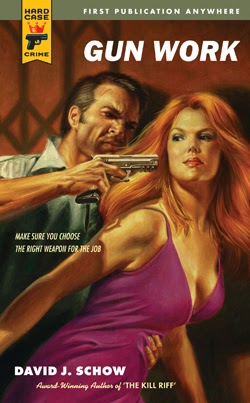
What is the sound of one gun shooting?: David J. Schow's Gun Work

David J. Schow's 2008 novel Gun Work is a perfect "new" hard-boiled novel in significant ways.  It captures the hard edge of post-war pulp without seeming campy or nostalgic on the one hand or veering into smirky self-consciousness or jokey, over-the-top violence on the other. (Happily, or sadly, events obliged Schow. Gun Work is set in Mexico, the country's explosion in kidnapping last decade permitting a plausible recycling of that old hard-boiled stand-by, the dangerous trip south of the border.)

Schow's handling of violence is especially nice.  On the one hand, one bit of violence perpetrated on the protagonist is horrific, much more so than what Schow's predecessors in previous decades would have depicted. On the other, the act happens off stage and is revealed to the reader (and the protagonist) in such a way as to banish any possibility that Schow is peddling torture porn.

As a longtime copy editor of metropolitan newspaper stories, whose reporters somehow always know that gun fire "rang out" even though they did not hear the shots, I was especially tickled by Schow's dissertation on the sounds a gun really makes:

“Contrary to entrenched cliché and what nitwits repeatedly say on the evening news, shots do not `ring out,’ and anybody who tells you they do has never heard gunfire. Report is more akin to the startlement of a heavy door slammed by a gust of wind; you know how that makes you jump, and no matter how prepared you think you are, the sound always comes as a surprise. It stops time for a millisecond and obliterates all other sound. Ignition and launch of a bullet evacuates the air from around your head in a phenomenon called blowback. If you’re not ready for it, the noise jump-starts the human fight-or-flight reflex in some small primitive corner of the brain. You freeze momentarily until the gunshot allows the rest of the world to come back. Once you’ve gotten past that first shot, subsequent shots are easy — you can even make them without blinking because your mind has processed that initial speed-stop, which no way, nohow, never in history, `rings out.’”
Finally, a quirk of Gun Work that should have driven me nuts but did not: Schow's more than occasional odd, if not downright incorrect word usages, cognate as a verb, for instance, or iterations, which Schow iterates more than once, or ultimata, which is a correct plural of ultimatum, but ultimata? Give me a respite!

But Gun Work is so good that I half-think the half-baked erudition (ingresses for entrances is another example) is a nod to the occasional flashes of learning Jim Thompson gives his characters, especially Lou Ford in The Killer Inside Me. So let me iterate that Gun Work is smart, fun, and probably one of the best books on Hard Case Crime's list.

© Peter Rozovsky 2013

Labels: ,

Tuesday, January 22, 2013

False Negative: Where the hell is my newspaper?

I like get a malicious kick out of am scandalized that Joseph Koenig's False Negative has a protagonist who works for the Atlantic City Press and that it  mentions the Philadelphia Bulletin plus at least two newspapers from the Jersey Shore without, however, mentioning  the newspaper I work for. The omission may accurately reflect the time in which the novel is set (the 1950s, possibly though not definitely 1953, if it matters), but I and several colleagues enjoyed it nonetheless.

I'm not sure Koenig ever worked for newspapers, but he writes convincingly about writing, whether for newspapers, novels, or true-crime pulp magazines, and I may be back with more on the novel.

In the meantime, here's an excerpt from False Negative of the Hard Case Crime Web site. False Negative is a newly published book, the first new novel in two decades from the author, who made a splash in crime fiction in the 1980s before dropping from sight. This 2005 article by Sara Weinman makes Koenig out to be a bit of a shit but therefore an interesting character.

© Peter Rozovsky 2013

Labels: , ,

Monday, January 09, 2012

Nipples and Spinoza

Donald E. Westlake's The Comedy Is Finished put me in a Hard Case frame of mind. I'm reading Lester Dent's Honey in His Mouth now, with Westlake's Memory on deck.

Dent wrote Honey in His Mouth in 1956, toward the end of a career spent largely writing Doc Savage, and the book is full of South American dictators, tight dresses that stay on, and frank one-word delineations of what lies beneath. It also shows an intellectual streak reminiscent of Woody Allen's essays and hard to imagine in popular culture today:
"Harsh listened with a black expression. Jesus, he thought, who had ever heard of such stuff being sprung on a man. However, Miss Muirz had a reading voice that was low and cultured and musical, and her dress had an interesting way of snuggling up when she took a deep breath so that her nipples stuck out at him. But he did not care greatly for Spinoza."
The book is obviously a product of its time, in other words, but without seeming dated. How does Dent manage this? With a light touch, a wild plot, and a grifter protagonist, Walter Harsh, refreshingly upfront about his life's goal: money.

More, perhaps, later.

© Peter Rozovsky 2012

Labels: ,

Thursday, October 27, 2011

Meet the new Spillane, same as ...

When you want to unwind with some relaxing reading while crossing Delaware Bay, the only choice is Mickey Spillane.

Dead Street, published by Hard Case Crime, brought near completion by Spillane, and finished by Max Allan Collins based on Spillane's notes, is Spillane's final crime novel.

It's a non-Mike Hammer book set in our time (People think of Spillane as a 1950s author, but he wrote almost to the end of his life, in 2006). Despite the contemporary setting, Spillane and his retired cop protagonist yearn for their Hammeresque past as hard as the book's central figure yearns to recapture the memory she had lost in a car crash twenty years before.

Thus the protagonist, Jack Stang, as he hears the unlikely tale of the woman's survival:
"My hand was on the .45 now. My thumb flipped off the leather snap fastener and eased the hammer back. If this was a pathetic jokester he was about to die at this last punch line."
Stang finds a pipe, "the sort rich little slobs liked to tote around to puff on weed or hash."   There's even a reference to "what used to be called un-American activities." Coming from Spillane, that sounds positively nostalgic.

Cape May Welcome Center
So,  if the book is full of Spillane's well-ripened political and cultural views, how do we know that the story takes place in our time rather than Mike Hammer's? How's this for a zinger:
"`I hear fancy apartments are going in.'
"`Yeah. And guess who's behind it?'
"Another stupid little surprise, I supposed. `Tell me.' 
"`A Saudi investment group.' 
"`Only seems fair.'
"`Yeah?'
 "`They took down two buildings, didn't they? Ought to put up a few.'"
© Peter Rozovsky 2011

Labels: , , , ,

Friday, September 30, 2011

Christa Faust, new books, and the remembrance of things past

I've always thought authors must feel weird, at least early in their careers, promoting books that they may have written two or three years earlier.

The book is new and exciting to readers, but the author has long since moved on to new projects. Do you remember what you were working on two years ago? Do authors find it difficult or odd to talk with enthusiasm about something that may be old to them? (Authors' comments welcome.)

I got a taste of this temporal dislocation when I read Christa Faust's Choke Hold this week. A couple of years ago, Faust made a blog post or Tweet that she was off to do research on the effects of traumatic brain injuries. Hank, a major supporting character in Choke Hold, very likely suffers from such injuries, and Faust does a hell of a job showing their effect rather than telling us about them. I'd bet a week's worth of bagels and whitefish salad that Hank is the product of that long-ago research trip.

This has also made me think about social media. The biggest effect of social media on our lives is the blizzard of speculation about the effect of social media on our lives, but in a small way, Faust long-ago blog post/Tweet makes me feel that I've had a glimpse into the gestation and genesis of a book.

P.S.  The book packs an emotional punch, and that's no cheap joke about its characters' involvement in Mixed Martial Arts.

© Peter Rozovsky 2011

Labels: , ,

Wednesday, June 15, 2011

Early novels and late novels

Donald Westlake's first novel, published in 1960 as The Mercenaries and reissued by Hard Case Crime as The Cutie, offers a protagonist for whom crime is just a job he does well.

Conflicts result from this, some professional, some personal; some comic, some not, but the core of the book, and the source of its action, is a man doing his job.

The comedy is not quite as well-integrated into the main action as it is in Westlake's later books, and the ending is melodramatically reminiscent of the early work of Westlake's friend Lawrence Block. But this longtime Westlake fan was astonished at how consistently Westlake stuck to his main thematic concerns over a hundred or so novels written under various names over almost fifty years.

So here's your question: If Westlake's main thematic interest, like Dashiell Hammett's, was the man whose mission is to do his job well, what are the main interests of other writers with long, productive careers?  In what ways do such authors' early books foreshadow their later ones?  

(Read an excerpt from The Cutie.)

© Peter Rozovsky 2011

Labels: , ,

Thursday, October 21, 2010

Hard Case Crime is coming back

Hard Case Crime will be back next year after it suspended publication when its publisher, Dorchester, decided to move to e-books only.

The new publisher, Titan Publishing, plans to retain the paperback format and to publish e-books across multiple platforms. Hardback titles are also possible, Hard Case headman Charles Ardai says.

Christa Faust's Choke Hold and Max Allan Collins' Quarry's Ex will be the resurrected imprint's first new titles next fall along with "two never-before-published novels by MWA Grand Masters (names to be announced shortly)." Titan also plans to acquire existing stock of Hard Case's backlist and resume shipping the books to bookstores immediately, Ardai says.

Hard Case has strayed into international crime occasionally, with its three Ken Bruen-Jason Starr collaborations and David Dodge's tales of high foreign adventure. Even when it stays home in America, Hard Case does fine work.

Here are some of my previous posts about Hard Case Crime titles (scroll down). And here's to the rebirth of this exciting imprint.

© Peter Rozovsky 2010

Labels: , , ,

Saturday, August 14, 2010

Rhyme and punishment

What was the deal with poets in mid-twentieth-century American hard-boiled writing?

First this, from Dashiell Hammett's story "Too Many Have Lived" (1932):
"`I'd want to talk to her,' Spade said. `Who is this Eli Haven?'

"`He's a bad egg. He doesn't do anything. Writes poetry or something.'"
Thirteen years later, Brett Halliday the author, Murder Is My Business the book, Mike Shayne the detective:
"She won't be married — unless Towne has changed a lot. That's the job I did for him. There was a chap named Lance Bayliss. A poet, Lucy, and a poet is lower than dirt to a two-fisted, self-made financier like Jefferson Towne."
So, just to be on the safe side, if you're a character in a hard-boiled book, try not to be a poet. Or at least get a real job, and write on the side.

© Peter Rozovsky 2010

Labels: , , , , ,

Wednesday, August 04, 2010

Westlake the wonderful

I've just taken a busman's holiday with two classics of American crime writing. One has some tantalizing parallels with a politically edged European author I've discussed here, and I may expound further in a future post. The other offers no such connection, but it's so good that I have to share its opening:
"I bet none of it would have happened if I wasn’t so eloquent. That’s always been my problem, eloquence, though some might claim my problem was something else again. But life’s a gamble, is what I say, and not all the eloquent people in this world are in Congress."
The narrator is a New York cabbie and man, can't you just hear him talking?

That's the beginning of Donald Westlake's Somebody Owes Me Money, and you can read the rest of its first chapter on Hard Case Crime's Web site.

The passage exemplifies a definition I once read of the difference between a comic and a comedian. A comic, a schlepper who stands up and mugs for laughs, says funny things, but a comedian, that acute observer of humanity, says things funny. Westlake was a comedian.

What other crime wrters say things funny rather than just saying funny things?

(Here are some of my posts upon Westlake's death in 2008.)

© Peter Rozovsky 2010

Labels: , , ,

Tuesday, February 17, 2009

The Max

Here's one of those fun posts where I get to highlight a book's exuberantly funny lines. Along the way, I may discuss what makes some of them funny. The book is The Max, third of Ken Bruen and Jason Starr's collaborations for Hard Case Crime, and here are some of those lines:
"The coke kicking in, she took a sip of her stone-cold vanilla latte. (Decaf. She wasn't reckless. That caffeine was, like, addictive.)"

"`I might have to make it into a trilogy,' she said, and Max suddenly had a vision of the great Hollywood trilogies. Star Wars. The Godfather. Shrek. Revenge of the Nerds."
And, among many others, this, from the novel's title character, which pushes the book into Detectives Beyond Borders territory:
"Yeah, okay, there was a downside, he had to be fucking Irish, maybe for the rest of his life, but hey, he could pull it off. After all, how hard could it be to be Irish? He already liked to drink and kill people, he'd be a goddamn natural."
The series has an Irish author and an American author, just as it has a protagonist from each country. Bruen has always looked to American crime writing for inspiration, and that passage, whether it comes from Bruen's pen or Starr's, is a wonderfully blunt statement of some American stereotypes about the Irish. Max Fisher, that utterly amoral, irrepressibly optimistic and impossibly lucky businessman turned drug dealer turned prison lord who embraces the stereotype, is a great American comic character.

Someone asked me if Bruen and Starr planned a fourth book in the series, to follow Bust, Slide and The Max. I didn't and don't know, but The Max leaves possibility open, albeit with a twist.

© Peter Rozovsky 2009

Labels: , , , ,

Tuesday, August 19, 2008

Hey, publishers, what's behind the covers?

Euro Crime notes the near-identical cover designs of The Devil's Star by Jo Nesbø and Paul Johnston's upcoming novel The Soul Collector. In this case, the copycatting seems more blatant than usual, right down to a word in the subtitle of the Johnston novel.

Euro Crime has highlighted a number of such copycat covers, as have other blogs, and the issue has sparked discussion throughout the blogosphere. Some seem to think that publishers, looking for ways to save money, find it easier to use stock photos than to pay artists or photographers. But I haven't heard publishers weigh in.

If you're a publisher, how do you explain and justify this practice? How do you answer the accusation that copycat covers make publishers look cheap, cheesy and foolish ? And when did the phenomenon begin? When did publishers start relying on stock photos for their covers?

Once again, a bouquet for Hard Case Crime, which commissions paintings for all its covers.

© Peter Rozovsky 2008

Labels: , , ,