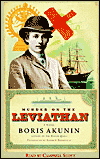
Boris Akunin avoids the big questions
An amusing and richly informative 2004 article/interview in The Telegraph examines the novelty of Boris Akunin's situation in Russia's cultural life:
"Until the fall of communism in 1991, educated Russian readers had retained a taste for classic literature ... There was no such thing as reading merely for pleasure. But that all changed with the lifting of the ban on decadent Western fiction. As suddenly as crime rose in Russia, so did crime fiction."
Unlike two of his fellow Russian practitioners of the new art of Russian crime fiction, the article continues, Akunin could write. Still, Akunin says, Russian readers can't avoid asking the big questions. "I never meet readers in Russia," he says, "because there would always be some guy who would stand up and say, 'What is the meaning of life? Does God exist?' "
Of course, Akunin did not reject the Russian classics completely. Here's how he created Erast Fandorin:
"When I was a kid there was never a Russian literary character who I could imitate. I was either Sherlock Holmes or d'Artagnan or some other bloody foreigner. You cannot pretend when you are 11 or 12 that you are a hero of Turgenev. ... I approached this problem in a scientific way. I grafted a bit from every protagonist in Russian literature whom I admire. I took 10 per cent of Andrei Bolkonsky [from War and Peace], 10 per cent of Prince Mishkin [The Idiot], 10 per cent of Lermontov's Pechorin. Then I added a recipe of my own design, mixed and stirred. At the beginning he looked like a Frankenstein, a homunculus. Then miraculously he came to life, for me at least, and started not doing what I wanted him to do. Now for me he is more alive than most of the people I know."
© Peter Rozovsky 2006
Technorati tags:
Boris Akunin
"Until the fall of communism in 1991, educated Russian readers had retained a taste for classic literature ... There was no such thing as reading merely for pleasure. But that all changed with the lifting of the ban on decadent Western fiction. As suddenly as crime rose in Russia, so did crime fiction."
Unlike two of his fellow Russian practitioners of the new art of Russian crime fiction, the article continues, Akunin could write. Still, Akunin says, Russian readers can't avoid asking the big questions. "I never meet readers in Russia," he says, "because there would always be some guy who would stand up and say, 'What is the meaning of life? Does God exist?' "
Of course, Akunin did not reject the Russian classics completely. Here's how he created Erast Fandorin:
"When I was a kid there was never a Russian literary character who I could imitate. I was either Sherlock Holmes or d'Artagnan or some other bloody foreigner. You cannot pretend when you are 11 or 12 that you are a hero of Turgenev. ... I approached this problem in a scientific way. I grafted a bit from every protagonist in Russian literature whom I admire. I took 10 per cent of Andrei Bolkonsky [from War and Peace], 10 per cent of Prince Mishkin [The Idiot], 10 per cent of Lermontov's Pechorin. Then I added a recipe of my own design, mixed and stirred. At the beginning he looked like a Frankenstein, a homunculus. Then miraculously he came to life, for me at least, and started not doing what I wanted him to do. Now for me he is more alive than most of the people I know."
© Peter Rozovsky 2006
Technorati tags:
Boris Akunin
Labels: Boris Akunin, Russia
posted by Peter Rozovsky at 4:52 PM
0 comments