Saturday, October 08, 2016

Why you should read John Rector

John Rector, Voodoo Lounge,
New Orleans, September 2016.

 Photo by Peter Rozovsky
John's Rector 's 2015 novel Ruthless is a terrific noirish, wrong-man-in-the-wrong-place story, perhaps a bit more emotionally pitched and certainly elegantly written than most. Things get especially interesting when the third circle of hell into which the protagonist plunges threatens to veer off into another genre entirely. But Rector, in supreme control of his storytelling at all times, makes it work.

That paragraph is deliberately vague in order to avoid giving anything away. Suffice it to say that if the main storyline is reminiscent of Charles Williams, the surprising turn may put readers in mind of Alan Glynn. That's a high compliment to Rector on both counts.
*
John Rector first jumped onto my radar screen in a big way a couple of weeks ago when he read his story "In the Kitchen With Rachel Ray" at Jay Stringer's Noir at the Bar in New Orleans. The story is not only jam-packed with hilarious surprises, but rendered with fine control, and the author read it well. You should hear him read if you have the chance.

© Peter Rozovsky 2016

Labels: , , , , ,

Thursday, October 06, 2016

Farewells to New Orleans

Bayou country, Louisiana. Photos by Peter
Rozovsky for Detectives Beyond Borders
The last chapter (not counting an epilogue) of James Lee Burke's Neon Rain has Dave Robicheaux begin the novel's climactic, redemptive final confrontation with a ride along the St. Charles Streetcar Line through New Orleans' Garden District. And then he leaves the city.

St. Charles Streetcar Line, New Orleans
Which gave me a start because after the carousing of Bouchercon, after we'd left the alligators behind and some of my friends were safely home and others headed for the airport, I carried my memories of New Orleans with me on a ride along the St. Charles Streetcar Line through the Garden District. And then I left the city.

Burke ended his book the way I ended my visit, that is, which was a bit of an emotional punch. If you think this is just an excuse to talk about my time in Louisiana, you're right. And now, here's today's favorite Cajun music discovery: the Lost Bayou Ramblers doing a song you might recognize called "Ma Génération."

© Peter Rozovsky 2016

Labels: , , , , ,

Monday, October 03, 2016

James Lee Burke's two halves of the French Quarter

I'm enjoying James Lee Burke's first Dave Robicheaux novel, The Neon Rain, set back when Robicheaux was still a New Orleans police lieutenant.

Here are two of the things I've liked:
  1. The scene in which Robicheaux finds himself drinking with a troupe of circus performers whose transportation has broken down. They have no idea that they're hilarious, but you will.
  2. That Robicheaux seems like he'll be a more believable iteration of the recovering alcoholic cop who falls back off the wagon than are most examples of the type.
St. Louis Cathedral. Photo by Peter
Rozovsky/Detectives Beyond Borders
I especially like Burke's portrayal of New Orleans. He presents a gritty French Quarter populated by hustlers, transvestites, and other rough characters, which he contrasts with inhabitants of a gentrifying Jackson Square. He also takes a shot at fancified fake country bands playing in the street, and he makes sure the reader knows that the Garden District is where the better-off people live.

But Burke also makes certain to have Robicheaux talk about Café du Monde and look out at St. Louis Cathedral. He wanted to rip the veil of the gauzy, gaudy surface of the city, but also to give the punters (like me) what they want; I bought the book as part of my post-Bouchercon hangover, and I'm glad I did.

© Peter Rozovsky 2016

Labels: , , ,

Thursday, September 29, 2016

Bouchercon 2016: A break from Beef Wellington

Bouchercon is about socializing, too, a rare chance for writers and other bookish sorts to get together and talk about something other than recipes for Beef Wellington, as Ali Karim likes to put it.

And we don't talk just about books. One day over lunch at Mena's Palace, just around the corner from the convention hotel on Canal Street in New Orleans, for example, I talked Quebec politics and history with a tableful of people that included my Montreal homeboys John McFetridge and Jacques Filippi.

Jacques Filippi and palm trees on Canal Street.
Photos by Peter Rozovsky
John McFetridge
Jacques doesn't post on Facebook much (What does that man do with his life?), but John, like Benjamin Whitmer and Benoit Lelievre (yet another Montrealer), is one of the sanest, smartest, most articulate people on social media. Quite apart from the perspective afforded by time and by our somewhat different backgrounds, the discussion of René Lévesque's legacy was an invigorating break from the social, political, and professional Beef Wellington of everyday life.

Christa Faust
Over on the book side, a lot of neo-noir writers seem to think meth, violence, and trailer parks are enough for a good story. This decidedly does not apply to Christa Faust, John Rector, Martyn Waites, Johnny Shaw, and some of the other folks who read at Wednesday's pre-Bouchercon Noir at the Bar. That lot has big heart, big laughs, or both. And they all have big chops. The atmospheric Voodoo Lounge on Rampart Street was a fine venue for the best Noir at the Bar I've attended since I created Noir at the Bar eight years ago.

A girl playing guitar in Chris Acker
and the Growing Boys.
And the music in New Orleans! I attended no shows, but I heard more good live music in more varieties in one night just walking down the street in some delightful company and looking in at bars for a gin and tonic than I'll hear in a year where I am now. Suffice it to say that having heard a sidewalk full of people, including an 89-year-old woman, sing "Your Cheatin' Heart" along with Chris Acker and the Growing Boys, I now understand the appeal of Hank Williams much better than I used to.

But nothing beats Cajun music, which can incorporate country and blues. Nothing I've heard so abounds with joy even if one does not understand the French lyrics. This music can express joy and yearning at the same time, and that's even before the singing starts. It's one of the most beautiful things I've experienced in my life

© Peter Rozovsky 2016

Labels: , , ,

Sunday, September 25, 2016

Bouchercon 2016, Part IV: Music on the streets and in the bars of New Orleans


© Peter Rozovsky 2016

Labels: ,

Friday, September 23, 2016

Bouchercon 2016, Part II: One book, lots of pictures

French Quarter, New Orleans. Photos by Peter Rozovsky
for Detectives Beyond Borders.
I rarely find time to read at Bouchercon because I'm too busy doing other things, and that was about five times truer for New Orleans than it was for the previous eight cities where I'd attended the annual world mystery and crime fiction convention.

Photo not by
Peter Rozovsky
The first acquisition that I've dipped into is Harold Q. Masur's novel Bury Me Deep, published in 1947 (despite Google's assertion that it first appeared in 1924). I bought this one on the advice of J. Kingston Pierce, part of a coterie of wise men who know a lot more about vintage paperbacks than I do and who were frequently hovering around the old paperbacks at Mystery Mike's table in the Bouchercon book room. (The other members of the triumvirate were Bill Crider and Rick Ollerman. Only the best can tell me how to spend my money.)

A baby alligator and its admirers in the bayou country.
Masur builds his story to a tight, efficient climax in the early chapters, something like how David Swinson does in his fine novel The Second Girl. Done well, that sort of thing knocks me off-balance in the best possible way and leaves me eager to find out what happens next--not that the stories degenerate into a string of cliffhangers, either. I think of it as a narrative apéritif that whets the appetite for the story to come. Or maybe it's more like an operatic overture, offering clues to the themes that will follow. Whatever your preferred metaphor, Masur pulls it off.

Nanci Kalanta, known on
Facebook as Mountain Jane
Laurel. I'm a gentleman, and

when a lady says, "Do me in
black and white," I smile
and oblige.
The pre-, post-, and para-Bouchercon activities were the most unusual and entertaining I'd enjoyed, and for whatever reason, it seemed that a larger group of folks from various circles of my friends and acquaintances than ever before mingled and intersected in a giant Venn diagram of gin, powdered sugar, and po'boys. What a city!

Garden District, New Orleans.
© Peter Rozovsky 2016
Mike Stotter, Sara Paretsky, Ali Karim.
In the bayou country.
Terrence McCauley
Alison Gaylin, Ali Karim
Jay Stringer, Eric Beetner
Christa Faust
Suzanne Solomon
Joe Lansdale

Labels: , , , , , ,

Wednesday, September 21, 2016

Bouchercon 2016, Part I: Crime with alligators

The Garden District, New Orleans.
Photos by Peter Rozovsky for
Detectives Beyond Borders
Bouchercon 2016 was like no other in my experience, with more music, more color, more humidity, more good food, more courtesy, more good fellowship, more nobility of character, more drama, more hospitality, and more alligators than any I'd attended before.   That's New Orleans and the bayou country, I guess.

My Thursday morning panel went as well as any I'd moderated. The panelists — Eric Beetner, Martin Edwards, Rick Ollerman, and Gary Phillips — were articulate, knowledgeable, and entertaining talking about their favorite crime writers of the past. Those crime writers included some I had previously read and enjoyed, including Charles Williams, Peter Rabe, and Michael Gilbert, and others new to me.

The latter included William Peter McGovern and the remarkable Clarence Cooper Jr. Ten minutes into the panel, Walter Mosley walked in and took a seat in the crowd. He even offered a trenchant and entertaining interjection during the session's question period. I have no photographic evidence of Mosley's presence, but you might be able to hear him on CDs and MP3 files of the session,  available from VW Tapes Conference Recordings.

Christa Faust
The fun had begun the previous night, with the best Noir at the Bar I have attended since I invented Noir at the Bar eight years ago. The Voodoo Lounge on North Rampart Street was a perfect venue: crowded, amiably seedy, with a low, steady buzz of talk punctuating breaks between the superb readings.

The highlights for me? Martyn Waites and Christa Faust, who write violence and grotesquery, which anyone can do, but who do so with sympathy and heart, which few even try.  John Rector's deadpan story, whose television food-show host character appears to cook something you'll never eat, was not just gross-out funny, but also superbly controlled. Johnny Shaw gave a hilarious reading-performance of a story featuring Chingón: The World’s Deadliest Mexican.

Chris Acker and the Growing Boys. French
Quarter, New Orleans
Sunday evening, two of us wandered the French Quarter, stopping in at bars or lingering in the street wherever the music sounded interesting. We heard funk and blues that brought home how important New Orleans was to the formation of rock and roll. We heard pure and clear country music from a sidewalk quartet whose audience included an 89-year-old woman who sang along to everything.

Jay Stringer, Noir at the Bar's
apparently headless host
But she couldn't top the blind man who walked into the first place we had stopped and danced up a storm using his impassive seeing-eye dog as a maypole. At one point in the evening a young man backing out of a doorway carrying an amplifier accidentally bumped my friend and said to her in a voice filled with concern: "Excuse me, sweetheart." That would not have happened in Philadelphia or Boston or Montreal or anywhere else I've ever been.

Music in the French Quarter,
New Orleans
Along the way we became separated from Ali Karim and Mike Stotter, much to Ali's consternation. But his anger had a benevolent cause: He had gone out of his way to help a fellow convention attendee who had got into trouble, and he was worried that the same had happened to us.  Ali is a good human being as well as a hilarious boon companion.

New Orleans food you know about already. Suffice it to say that the spices will wake you up and that the best meal I had was the andouille-crusted fish at the Palace Café. Cajun music? Sone of the rhythms are tricky, but a lot of the songs are based on a simple I-IV-V chord progression that even I can play.

© Peter Rozovsky 2016

Labels: , , , , , , , , , , , ,

Monday, July 30, 2012

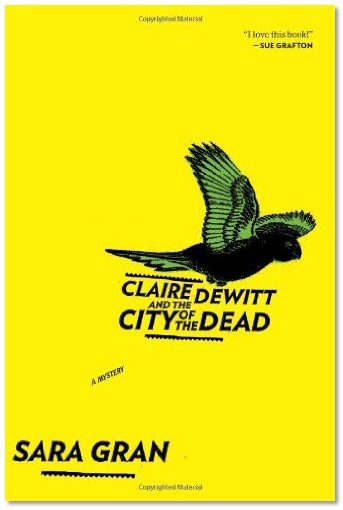
Sara Gran in the City of the Dead

Sara Gran's Claire DeWitt and the City of the Dead is, among other things, a vivid and haunting evocation of New Orleans after Hurricane Katrina. It never mentions the words Katrina or hurricane, however, which only adds to the feeling of authenticity.

I imagine that if I'd been trapped in that swampy, rootless, mud-coated hell, I would not talk like a breathless CNN report, either. Instead, I suppose, I would do what the returned, the uprooted, and the left-behind do in Gran's novel and speak, with understandable fear and reticence, about "the storm."

Claire DeWitt ... is a most unconventional PI novel, and I don't mean merely that Gran gives the title character/protagonist a package of quirks, though she does do that. Claire de Witt has lived in a number of cities, imbibing deeply of the eccentricities of all. She's got a bit of Jack Kerouac to her, a bit of Nancy Drew, and a bit of Ghost Dog.

As much fun as the book is, it is immensely moving in places and it constitutes a serious examination of the nature of guilt, good, and revenge and a touching testimony to the importance of friendship. Along the way, it overflows with compassion. But mostly, Gran knows how to tell a story. I'll leave you with one of my favorite examples of the book's verbal zest:
"In the afternoon I went back to Congo Square. This time I went as Elmyra Catalone, African-Italian American recovering crack addict from Memphis, Tennessee, raised Baptist, now occasionally Pentecostal, occasional sex worker, victim of sexual abuse at the hands of a cousin, mother of four children, one dead, one in foster care, one in Angola, one living in the town of Celebration, Florida, with a wife and two children. Elmyra is off the crack cocaine but she likes her liquor and has a schnapps now and then to be sociable."
© Peter Rozovsky 2012

Labels: , , ,